Psychology
Psychological Assessment and Tests
Types of psychological tests, development, characteristics, principles, uses, interpretation and role of nurses.
Open quizzes and study tools Download PDF
CHAPTER 08: PSYCHOLOGICAL ASSESSMENT AND TESTS
Subject: Applied Psychology
Course: B.Sc. Nursing
1. Introduction
Psychological assessment is the systematic collection and interpretation of information about an individual's behaviour, cognitive abilities, personality, emotions and psychological functioning.
It helps identify psychological strengths, difficulties and support needs.
2. Definition of Psychological Test
A psychological test is a standardized instrument designed to measure a selected psychological characteristic, ability or behavioural pattern.
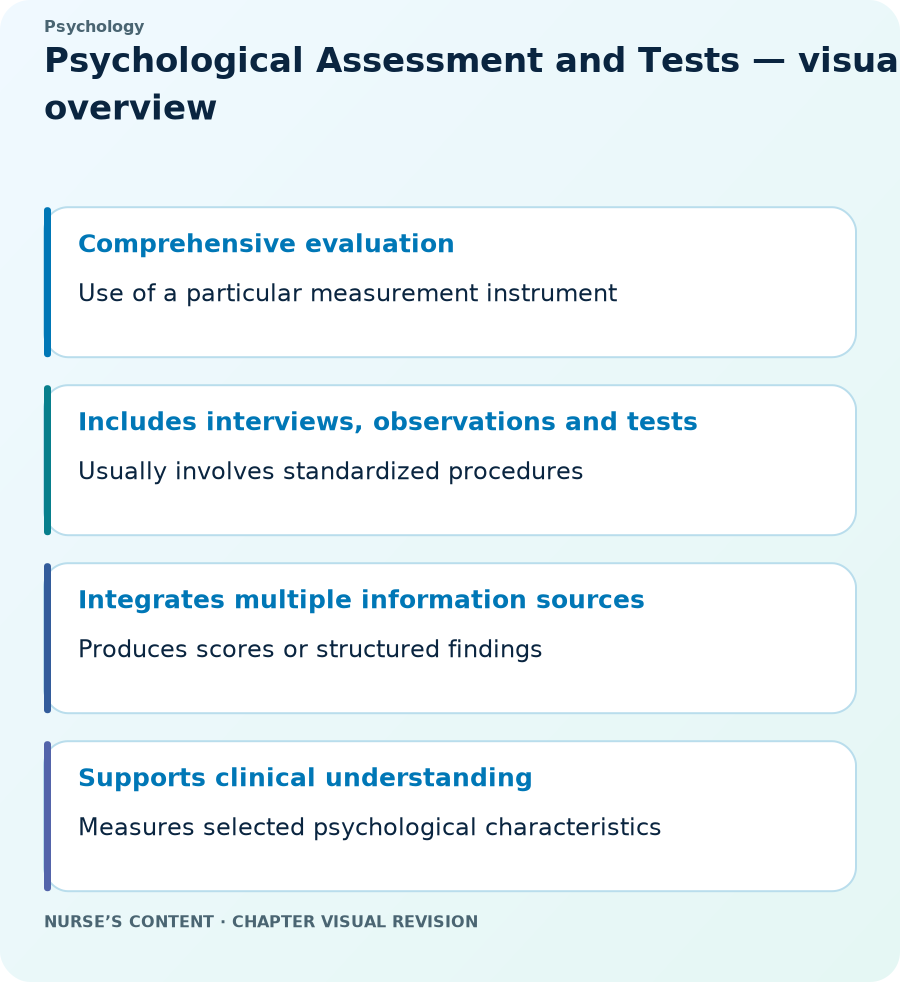
3. Psychological Assessment vs Psychological Testing
| Psychological assessment | Psychological testing |
|---|---|
| Comprehensive evaluation | Use of a particular measurement instrument |
| Includes interviews, observations and tests | Usually involves standardized procedures |
| Integrates multiple information sources | Produces scores or structured findings |
| Supports clinical understanding | Measures selected psychological characteristics |
4. Objectives of Psychological Assessment
- Assess cognitive abilities.
- Identify emotional and behavioural difficulties.
- Understand personality characteristics.
- Identify developmental and learning difficulties.
- Support appropriate clinical evaluation.
- Assist treatment planning.
- Evaluate changes over time.
- Support educational and occupational guidance.
5. History of Psychological Testing
| Psychologist | Contribution |
|---|---|
| Francis Galton | Early measurement of individual differences |
| James McKeen Cattell | Early use of the term mental tests |
| Alfred Binet and Théodore Simon | Development of an early practical intelligence scale |
| Lewis Terman | Development of the Stanford–Binet adaptation |
| David Wechsler | Development of widely used intelligence scales |
| Hermann Rorschach | Development of the inkblot technique |
6. Types of Psychological Tests
A. Intelligence Tests
Measure selected intellectual and cognitive abilities.
Examples:
- Stanford–Binet Intelligence Scales
- Wechsler Adult Intelligence Scale
- Wechsler Intelligence Scale for Children
- Raven's Progressive Matrices
B. Aptitude Tests
Estimate potential for developing particular skills.
Examples:
- Differential Aptitude Tests
- General Aptitude Test Battery
C. Achievement Tests
Measure knowledge or skills already acquired.
Examples include academic examinations and standardized educational achievement tests.
D. Personality Tests
Assess personality traits, behavioural patterns or psychological characteristics.
Structured inventories:
- MMPI
- 16PF
- NEO Personality Inventory
Projective techniques:
- Rorschach Inkblot Test
- Thematic Apperception Test
- Sentence Completion Test
E. Interest Inventories
Assess individual interests and preferences, often for vocational or educational guidance.
F. Attitude Scales
Measure attitudes towards selected individuals, objects, events or concepts.
Examples:
- Likert scale
- Thurstone scale
- Semantic differential scale
G. Neuropsychological Tests
Assess selected cognitive functions associated with brain functioning.
Examples include memory, attention, language and executive function tests.
H. Emotional and Behavioural Screening Instruments
| Instrument | Purpose |
|---|---|
| PHQ-9 | Depressive symptoms |
| GAD-7 | Anxiety symptoms |
| DASS-21 | Depression, anxiety and stress symptoms |
| MMSE | Selected cognitive functions |
| MoCA | Cognitive screening |
| AUDIT | Alcohol-related risk screening |
These are not interchangeable and must be selected according to the purpose and population.
7. Other Classifications of Psychological Tests
| Basis | Classification |
|---|---|
| Administration | Individual and group tests |
| Response format | Verbal, nonverbal and performance-based tests |
| Time requirements | Speed and power tests |
| Scoring | Structured or objective, and judgment-based tests |
| Purpose | Screening, assessment, selection and guidance |
| Delivery mode | Paper-based and computerized tests |
8. Characteristics of a Good Psychological Test
A. Reliability
Reliability refers to the consistency or precision of test scores.
Types include:
- Test–retest reliability
- Parallel-forms reliability
- Internal consistency
- Inter-rater reliability
- Split-half reliability
B. Validity
Validity concerns whether evidence supports the intended interpretation and use of test scores.
Traditional validity categories include:
- Content validity
- Criterion-related validity
- Construct validity
Face validity refers to whether a test appears appropriate, but appearance alone does not establish scientific validity.
C. Standardization
Use of consistent administration, scoring and interpretation procedures.
D. Objectivity
Minimization of examiner bias in administration and scoring.
E. Norms
Reference values obtained from an appropriate population for interpreting individual scores.
F. Practicality
Suitability concerning time, cost, resources and administration requirements.
G. Fairness
Minimization of avoidable disadvantage associated with language, culture, disability or other irrelevant characteristics.
9. Reliability vs Validity
| Reliability | Validity |
|---|---|
| Concerns score consistency | Concerns appropriate score interpretation |
| Examines precision | Examines evidence supporting intended use |
| Necessary for many valid interpretations | Requires more than reliable scores |
| Example: Consistent measurement | Example: Measuring the intended characteristic appropriately |
A test can yield consistent scores while failing to measure the intended characteristic adequately.
10. Development of Psychological Tests
Steps in Test Construction
- Define the purpose of the test.
- Identify the psychological construct.
- Review relevant literature.
- Develop the test blueprint.
- Generate test items.
- Obtain expert review.
- Assess content relevance and clarity.
- Conduct pilot testing.
- Perform item analysis where appropriate.
- Evaluate reliability.
- Collect validity evidence.
- Establish suitable norms or cut-off criteria.
- Standardize administration and scoring.
- Prepare the test manual.
- Revise and periodically evaluate the instrument.
11. Item Analysis
Item analysis evaluates the performance of individual test questions.
Common Indicators
- Item difficulty: For scored ability items, proportion of participants answering correctly.
- Item discrimination: Ability of an item to distinguish among participants with different levels of the measured characteristic.
- Distractor analysis: Examination of the effectiveness of incorrect answer options.
- Item–total correlation: Relationship between an individual item and the overall test score, calculated appropriately.
12. Psychological Test Scoring
Raw Score
The initial score obtained from the responses according to the scoring manual.
Standard Score
A transformed score interpreted relative to a reference distribution.
Percentile Rank
Indicates the proportion of the reference population scoring below, or at or below, a particular score, depending on the convention used.
Z-Score
Z = (Individual score − Mean) ÷ Standard deviation.
T-Score
T = 50 + 10Z.
Standard T-scores have a mean of 50 and a standard deviation of 10 under this transformation.
Likert Scale Scoring Example
For a positively worded attitude statement:
| Response | Score |
|---|---|
| Strongly agree | 5 |
| Agree | 4 |
| Neutral | 3 |
| Disagree | 2 |
| Strongly disagree | 1 |
Negatively worded items may require reverse scoring according to the instrument's scoring instructions.
For a five-point item:
Reverse score = 6 − Original score.
Do not create arbitrary cut-offs or severity categories without a justified scoring framework.
13. Interpretation of Psychological Tests
Interpretation should consider:
- Purpose of assessment
- Test reliability and validity
- Appropriate norms
- Measurement uncertainty
- Age and developmental level
- Language and cultural background
- Educational history
- Physical and psychological condition
- Medication effects
- Testing environment
- Other assessment findings
A score should not be interpreted as a complete representation of a person's abilities or psychological health.
14. Principles of Psychological Testing
- Obtain appropriate informed consent.
- Explain the assessment purpose.
- Select a suitable validated instrument.
- Follow standardized procedures.
- Provide appropriate accommodations.
- Maintain privacy and confidentiality.
- Avoid discrimination.
- Protect restricted test materials.
- Interpret findings within professional competence.
- Communicate results accurately.
15. Uses of Psychological Tests
Clinical Uses
- Mental health screening
- Cognitive assessment
- Treatment planning
- Monitoring outcomes
Educational Uses
- Assessment of learning difficulties
- Academic guidance
- Educational planning
Occupational Uses
- Vocational guidance
- Evaluation of selected job-related abilities
- Training and professional development
Research Uses
- Measurement of psychological variables
- Evaluation of interventions
- Assessment of attitudes and behaviour
16. Limitations of Psychological Tests
- Cultural and linguistic differences may affect scores.
- Anxiety and fatigue can influence performance.
- Self-report responses may contain bias.
- Inappropriate norms may lead to incorrect interpretations.
- Tests measure selected characteristics rather than the whole person.
- Measurement error is unavoidable.
- Screening results may include false positives and false negatives.
17. Role of Nurses in Psychological Assessment
Before Assessment
- Identify the patient's assessment needs.
- Explain the procedure within professional competence.
- Ensure appropriate consent.
- Provide privacy.
- Reduce distractions.
- Identify factors that may affect performance.
During Assessment
- Establish rapport.
- Observe behaviour.
- Follow standardized instructions.
- Avoid influencing responses.
- Ensure patient comfort.
- Document relevant observations.
After Assessment
- Record results accurately.
- Report concerning findings.
- Maintain confidentiality.
- Support appropriate referrals.
- Incorporate relevant information into nursing care.
- Monitor changes in functioning.
Professional Limitations
Nurses may administer approved screening tools when appropriately trained and authorized.
Specialized psychological testing, diagnostic interpretation and complex psychometric evaluation should be undertaken by suitably qualified professionals.
18. Important Examination Questions
Long Answer Questions
- Define psychological assessment and explain the types of psychological tests.
- Describe the characteristics of a good psychological test.
- Explain the process of psychological test development.
- Discuss the role of nurses in psychological assessment.
Short Answer Questions
- Reliability
- Validity
- Standardization
- Norms
- Intelligence tests
- Personality tests
- Likert scale
- Item analysis
- Ethical principles of testing
- Limitations of psychological tests
19. Quick Revision
- Reliability: Consistency of scores.
- Validity: Evidence supporting intended interpretation.
- Standardization: Uniform procedures.
- Norms: Reference population values.
- Raw score: Initial measured score.
- Percentile: Relative position in a reference distribution.
- Screening: Identifies possible concerns requiring further assessment.
- Psychological assessment integrates multiple information sources.
Conclusion
Psychological tests provide structured information about cognitive abilities, emotional functioning, personality and behaviour. Appropriate selection, administration and interpretation support safe nursing care and effective multidisciplinary assessment.
Chapter reference images