Psychology
Personality
Meaning, definition, classification, measurement, evaluation, personality alterations and role of nurses.
Open quizzes and study tools Download PDF
CHAPTER 05: PERSONALITY
1. Introduction
Personality refers to the characteristic patterns of thoughts, emotions, attitudes and behaviours that distinguish one individual from another.
Personality influences how individuals respond to stress, communicate, establish relationships, make decisions and adjust to their surroundings.
2. Definition of Personality
Personality is the relatively enduring pattern of psychological characteristics that influences an individual’s behaviour and adaptation to the environment.
Gordon Allport described personality as a dynamic organization of psychological and physical systems that determines an individual’s characteristic behaviour and thinking.
The word personality is derived from the Latin word persona, meaning a theatrical mask or character.
3. Characteristics of Personality
- Personality is unique to each individual.
- It develops through heredity and environmental influences.
- It is relatively consistent but can change over time.
- It includes conscious and unconscious processes.
- It influences emotional and social adjustment.
- It develops through learning and life experiences.
- It affects interpersonal relationships and behaviour.
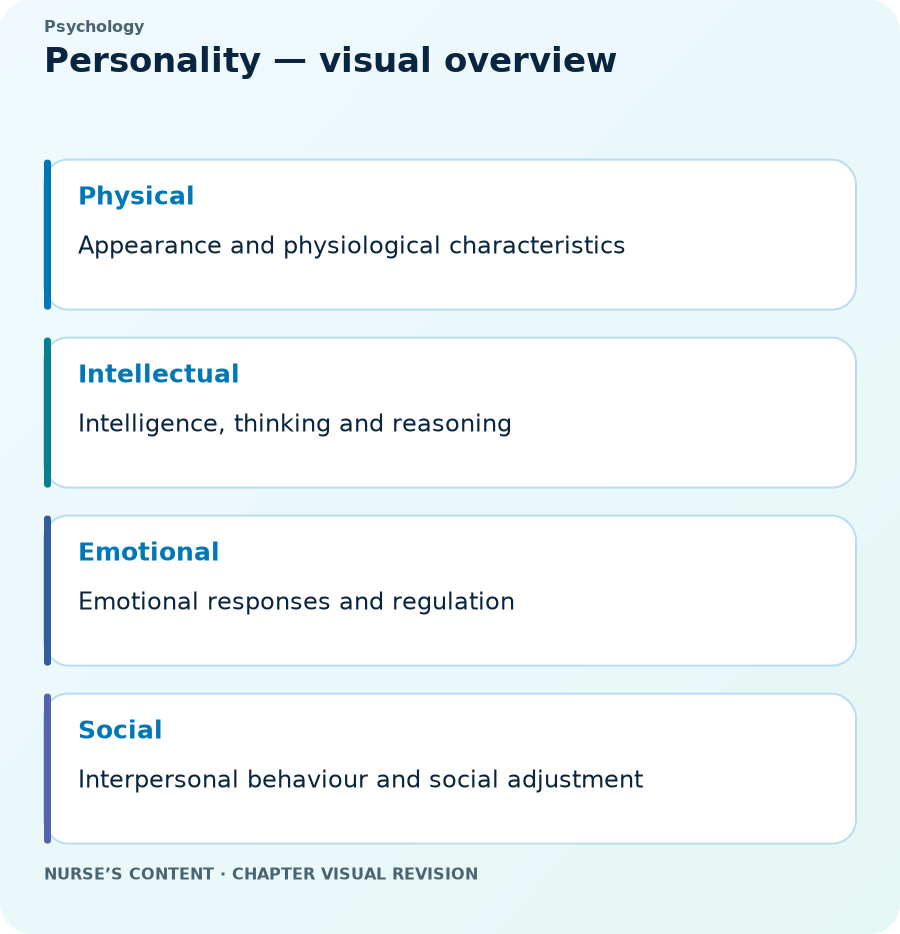
4. Components of Personality
| Component | Description |
|---|---|
| Physical | Appearance and physiological characteristics |
| Intellectual | Intelligence, thinking and reasoning |
| Emotional | Emotional responses and regulation |
| Social | Interpersonal behaviour and social adjustment |
| Moral | Values, beliefs and ethical behaviour |
| Motivational | Needs, interests and goals |
5. Determinants of Personality
Biological Factors
- Genetic inheritance
- Temperament
- Brain functioning
- Hormonal activity
- Physical health
Psychological Factors
- Motivation
- Intelligence
- Emotional experiences
- Self-concept
- Learning
- Coping mechanisms
Social and Environmental Factors
- Family relationships
- Parenting practices
- Education
- Culture
- Peer groups
- Socioeconomic conditions
- Life experiences
6. Classification of Personality
A. Carl Jung’s Classification
Introvert
- Prefers relatively quiet environments.
- Often enjoys independent activities.
- May be reflective and reserved.
- May prefer smaller social groups.
Extrovert
- Generally enjoys social interaction.
- Often demonstrates outward expressiveness.
- May prefer group activities.
- Gains satisfaction from social engagement.
Ambivert
- Demonstrates a combination of introverted and extroverted characteristics.
- May adapt behaviour according to circumstances.
Introversion and extraversion exist along a continuum rather than as rigid categories.
B. Historical Temperament Classification
| Type | Traditional characteristics |
|---|---|
| Sanguine | Sociable, cheerful and expressive |
| Choleric | Assertive, energetic and dominant |
| Melancholic | Reflective, sensitive and reserved |
| Phlegmatic | Calm, patient and relatively passive |
This historical classification originated in ancient medical theories. It is not a validated diagnostic system.
C. Type A and Type B Behaviour Patterns
| Type A | Type B |
|---|---|
| Competitive | Relatively relaxed |
| Time-conscious | Less time-pressured |
| Achievement-oriented | More flexible |
| May display impatience or hostility | Generally patient |
These are historical behaviour patterns rather than fixed personality diagnoses.
7. Major Theories of Personality
A. Freud’s Psychoanalytic Theory
Sigmund Freud proposed three interacting components of personality.
| Component | Function | Principle |
|---|---|---|
| Id | Instinctual desires and impulses | Pleasure principle |
| Ego | Balances impulses with reality | Reality principle |
| Superego | Internalized moral values and standards | Moral standards |
Example: A nurse experiencing anger may want to express it immediately (id), recognize professional consequences (ego) and consider ethical responsibilities (superego).
Levels of Consciousness
- Conscious: Thoughts and experiences currently in awareness.
- Preconscious: Information that can be brought into awareness.
- Unconscious: Mental processes outside conscious awareness.
Freud’s structural theory is historically influential but is not an established biological model.
B. Allport’s Trait Theory
Gordon Allport classified traits into three categories:
- 1. Cardinal traits: Dominant characteristics that may strongly influence a person’s life.
- 2. Central traits: Major characteristics used to describe personality.
- 3. Secondary traits: Preferences or characteristics expressed in particular situations.
C. Cattell’s Trait Theory
Raymond Cattell identified 16 primary personality factors and developed the 16 Personality Factor Questionnaire (16PF).
D. Eysenck’s Personality Theory
Hans Eysenck proposed three major dimensions:
- Extraversion
- Neuroticism
- Psychoticism
The term psychoticism in this theory refers to a personality dimension and does not establish a diagnosis of psychosis.
E. Big Five Personality Theory
The Five-Factor Model describes personality through five broad dimensions.
Mnemonic: OCEAN
| Trait | Characteristics |
|---|---|
| Openness | Curiosity, creativity and willingness to explore |
| Conscientiousness | Organization, responsibility and self-discipline |
| Extraversion | Sociability and assertiveness |
| Agreeableness | Cooperation, consideration and interpersonal warmth |
| Neuroticism | Tendency towards negative emotional experiences |
Individuals vary along each dimension.
F. Humanistic Theory
Carl Rogers
- Emphasized self-concept.
- Proposed that acceptance and supportive relationships facilitate personal growth.
- Described congruence between self-concept and experience.
Abraham Maslow
- Emphasized human needs and motivation.
- Described self-actualization as realization of personal potential.
G. Social-Cognitive Theory
Albert Bandura emphasized interactions between:
- Personal factors
- Behaviour
- Environment
Important concepts include observational learning, reciprocal determinism and self-efficacy.
8. Measurement and Evaluation of Personality
Personality assessment involves collecting information about characteristic behaviour, emotional functioning, attitudes and psychological traits.
Methods of Personality Assessment
| Method | Description |
|---|---|
| Observation | Systematic assessment of behaviour |
| Interview | Collection of personal and psychological information |
| Case history | Review of developmental, medical and social history |
| Rating scale | Structured rating of selected characteristics |
| Personality inventory | Standardized questionnaire assessing personality traits |
| Projective technique | Responses to relatively ambiguous stimuli |
| Behavioural assessment | Examination of behaviour in specific situations |
9. Important Personality Tests
Objective Personality Tests
- Minnesota Multiphasic Personality Inventory (MMPI)
- 16 Personality Factor Questionnaire (16PF)
- Eysenck Personality Questionnaire (EPQ)
- NEO Personality Inventory
These instruments use structured responses and standardized scoring procedures.
Projective Tests
- Rorschach Inkblot Test
- Thematic Apperception Test (TAT)
- Sentence Completion Tests
Interpretation of projective techniques requires specialized training. Scientific evidence varies across instruments
and scoring methods.
No personality test should be interpreted independently of the individual’s history, circumstances and other assessment findings.
10. Alterations in Personality
Personality alterations refer to significant changes in characteristic behaviour, emotional responses, interpersonal functioning or personality patterns.
Causes
- Brain injury
- Neurological illness
- Dementia
- Substance use
- Severe psychological stress
- Trauma
- Mood disorders
- Medication effects
- Other psychiatric or medical conditions
Possible Manifestations
- Sudden irritability
- Social withdrawal
- Emotional instability
- Impulsive behaviour
- Increased suspiciousness
- Inappropriate behaviour
- Reduced judgment
- Changes in motivation
Sudden personality changes require assessment for possible medical, neurological or substance-related causes.
11. Personality Disorders
Personality disorders involve enduring, inflexible patterns of inner experience and behaviour associated with significant distress or impairment.
Traditional DSM Cluster Classification
| Cluster | Personality disorders |
|---|---|
| Cluster A – Odd or eccentric patterns | Paranoid, schizoid, schizotypal |
| Cluster B – Dramatic or emotionally unpredictable patterns | Antisocial, borderline, histrionic, narcissistic |
| Cluster C – Anxious or fearful patterns | Avoidant, dependent, obsessive-compulsive personality disorder |
Brief Characteristics
- Paranoid: Persistent distrust and suspiciousness.
- Schizoid: Social detachment and limited emotional expression.
- Schizotypal: Unusual beliefs, behaviour and interpersonal difficulties.
- Antisocial: Persistent disregard for the rights of others.
- Borderline: Difficulties with emotional regulation, self-image and relationships.
- Histrionic: Excessive emotionality and attention-seeking patterns.
- Narcissistic: Grandiosity, need for admiration and impaired empathy.
- Avoidant: Social inhibition and sensitivity to rejection.
- Dependent: Excessive reliance on others.
- Obsessive-compulsive personality disorder: Preoccupation with order, perfectionism and control.
ICD-11 primarily classifies personality disorders according to severity and trait patterns rather than these traditional clusters.
Personality traits alone do not establish a personality disorder.
12. Factors Promoting Healthy Personality Development
- Positive self-esteem
- Supportive relationships
- Emotional regulation
- Constructive feedback
- Realistic goal setting
- Effective coping
- Healthy communication
- Self-awareness
- Opportunities for learning
- Professional psychological support when required
13. Role of Nurses
Assessment
- Observe behaviour and emotional responses.
- Obtain relevant medical and psychosocial history.
- Identify recent changes in personality.
- Assess coping and interpersonal difficulties.
- Report significant behavioural changes.
Nursing Interventions
- Establish a therapeutic relationship.
- Maintain clear professional boundaries.
- Communicate without judgment.
- Encourage emotional expression.
- Promote effective coping strategies.
- Support realistic goal setting.
- Maintain a safe therapeutic environment.
- Encourage appropriate psychological and psychiatric follow-up.
14. Important Examination Questions
Long Answer Questions
- 1. Define personality and explain its determinants and classification.
- 2. Explain the major theories of personality.
- 3. Describe personality assessment methods.
- 4. Discuss personality alterations and the role of nurses.
Short Answer Questions
- 1. Freud’s structure of personality.
- 2. Introvert, extrovert and ambivert.
- 3. Big Five personality traits.
- 4. Allport’s trait theory.
- 5. Personality inventories and projective tests.
- 6. Classification of personality disorders.
- 7. Factors influencing personality development.
15. Quick Revision
- Personality describes characteristic patterns of thoughts, emotions and behaviour.
- Jung: Introversion and extraversion.
- Freud: Id, ego and superego.
- Allport: Cardinal, central and secondary traits.
- Cattell: 16 personality factors.
- Eysenck: Extraversion, neuroticism and psychoticism.
- Big Five: OCEAN.
- MMPI and 16PF: Structured personality inventories.
- Rorschach and TAT: Projective techniques.
- Personality assessment requires appropriate professional competence.
Conclusion
Knowledge of personality helps nurses understand individual differences and behavioural responses to illness. It supports therapeutic relationships, individualized care, early recognition of behavioural alterations and appropriate psychological support.
Chapter reference images