Psychology
Motivation and Emotional Processes
Motivation, theories, types, emotions, stress, adaptation, coping and attitudes.
Open quizzes and study tools Download PDF
CHAPTER 07: MOTIVATION AND EMOTIONAL PROCESSES
Subject: Applied Psychology
Course: B.Sc. Nursing
1. Motivation
Definition
Motivation is the psychological process that initiates, directs and sustains goal-oriented behaviour.
It explains why individuals perform particular activities, pursue goals and continue their efforts despite difficulties.
Characteristics of Motivation
- Goal-oriented
- Dynamic
- Influenced by internal and external factors
- Varies among individuals
- Influences behaviour and performance
- May be conscious or unconscious
2. Types of Motivation
Intrinsic Motivation
Motivation arising from personal interest, enjoyment or satisfaction.
Example: Studying nursing because of genuine interest in patient care.
Extrinsic Motivation
Motivation arising from external rewards or consequences.
Example: Studying to obtain high examination marks.
Positive Motivation
Encourages behaviour through desirable goals, recognition or rewards.
Negative Motivation
Behaviour influenced by the desire to avoid unpleasant consequences.
Biological Motivation
Arises from physiological requirements.
Examples include hunger, thirst, sleep and sexual motivation.
Social Motivation
Develops through interpersonal relationships and social experiences.
Examples include affiliation, achievement, recognition and status.
3. Motivation Cycle
The motivation cycle describes how needs may initiate goal-directed behaviour.
Need → Drive or tension → Goal-directed behaviour → Goal attainment → Satisfaction or reduction of tension.
Example: Hunger creates a drive to obtain food. Eating reduces hunger and temporarily satisfies the need.
Not every form of motivation follows a simple tension-reduction cycle.
4. Biological and Special Motives
| Biological motives | Social or special motives |
|---|---|
| Hunger | Achievement |
| Thirst | Affiliation |
| Sleep | Recognition |
| Sexual motivation | Power |
| Avoidance of injury | Curiosity |
| Temperature regulation | Independence |
Achievement Motivation
Desire to accomplish challenging goals and achieve competence.
Affiliation Motivation
Desire to establish and maintain meaningful interpersonal relationships.
Power Motivation
Desire to influence individuals, situations or available resources.
Curiosity
Motivation to explore, investigate and acquire knowledge.
5. Theories of Motivation
A. Maslow's Hierarchy of Needs
Abraham Maslow proposed that human needs may be organized into a hierarchy.
| Level | Need | Nursing example |
|---|---|---|
| 1 | Physiological | Oxygen, food, water and sleep |
| 2 | Safety | Protection from injury and infection |
| 3 | Love and belonging | Family support and relationships |
| 4 | Esteem | Respect, dignity and confidence |
| 5 | Self-actualization | Personal growth and fulfillment |
The hierarchy is a useful educational framework, but individuals do not always satisfy needs in a fixed order.
B. Drive Reduction Theory
Associated with Clark Hull.
Behaviour may be motivated by physiological needs that produce drives, leading to actions that reduce internal imbalance.
Example: Drinking water to relieve thirst.
C. Incentive Theory
Behaviour is influenced by anticipated external rewards or desirable outcomes.
Example: Working towards a professional qualification to obtain employment opportunities.
D. Instinct Theory
Suggests that some behaviour is influenced by inherited biological tendencies.
It does not fully explain complex learned human behaviour.
E. Arousal Theory
Individuals may seek levels of stimulation that support interest and effective functioning.
Very low or very high arousal may impair performance, depending on task difficulty.
F. McClelland's Theory of Needs
David McClelland emphasized three learned motives:
- Need for achievement
- Need for affiliation
- Need for power
G. Herzberg's Two-Factor Theory
Primarily applied to workplace motivation.
| Hygiene factors | Motivators |
|---|---|
| Salary | Achievement |
| Working conditions | Recognition |
| Job security | Responsibility |
| Organizational policies | Professional growth |
| Supervision | Meaningful work |
H. Self-Determination Theory
Edward Deci and Richard Ryan emphasized three basic psychological needs:
- Autonomy: Sense of choice and personal control.
- Competence: Feeling capable and effective.
- Relatedness: Meaningful connection with others.
6. Nursing Applications of Motivation
- Encourage patient participation in treatment.
- Support realistic health goals.
- Identify barriers to treatment adherence.
- Provide constructive feedback.
- Encourage independence.
- Improve patient education.
- Support rehabilitation.
- Promote professional development among nursing personnel.
Nurses should avoid coercion and respect the patient's right to make informed decisions.
7. Emotions
Definition
Emotion is a complex psychological state involving subjective feelings, physiological changes, cognitive appraisal and behavioural expression.
Components of Emotion
- Subjective component: Personal emotional experience.
- Physiological component: Changes in bodily functions.
- Cognitive component: Interpretation of the emotional situation.
- Behavioural component: Facial expressions, gestures and actions.
Examples of Emotions
- Happiness
- Sadness
- Fear
- Anger
- Surprise
- Disgust
- Shame
- Guilt
- Jealousy
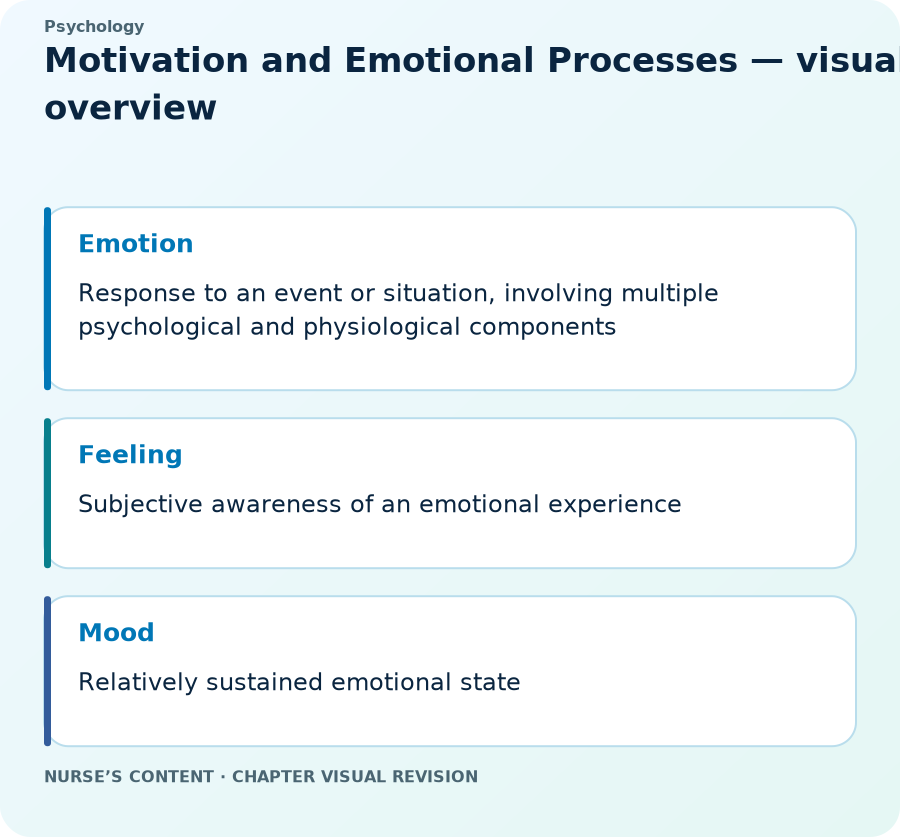
Emotion vs Feeling vs Mood
| Concept | Description |
|---|---|
| Emotion | Response to an event or situation, involving multiple psychological and physiological components |
| Feeling | Subjective awareness of an emotional experience |
| Mood | Relatively sustained emotional state |
8. Development of Emotions
Infancy
- Early expressions of distress and pleasure.
- Development of social smiling.
- Formation of emotional attachment.
Childhood
- Increasing emotional awareness.
- Development of empathy.
- Learning social rules concerning emotional expression.
Adolescence
- Increasing emotional complexity.
- Development of identity and self-awareness.
- Greater influence of peer relationships.
Adulthood
- Continuing development of emotional regulation.
- Responses shaped by relationships and life experiences.
9. Physiological Changes During Emotions
Emotional experiences may involve changes in:
- Heart rate
- Blood pressure
- Respiratory rate
- Sweating
- Muscle tension
- Pupil size
- Gastrointestinal activity
- Hormonal secretion
The particular physiological response varies according to the emotion and individual circumstances.
10. Theories of Emotion
James–Lange Theory
Emotional experience follows perception of physiological changes.
Stimulus → Physiological response → Emotional experience.
Cannon–Bard Theory
Physiological arousal and emotional experience may occur simultaneously.
Stimulus → Physiological arousal and emotional experience.
Schachter–Singer Two-Factor Theory
Emotion results from physiological arousal combined with cognitive interpretation of the situation.
Arousal + Cognitive interpretation → Emotional experience.
Lazarus Cognitive Appraisal Theory
Emotional responses are influenced by how an individual evaluates the meaning and significance of a situation.
These theories provide different explanations and are not mutually exclusive accounts of every emotional experience.
11. Emotional Intelligence
Emotional intelligence involves abilities related to recognizing, understanding and managing emotions.
Common components include:
- Self-awareness
- Emotional regulation
- Motivation
- Empathy
- Social skills
Importance in Nursing
Emotional intelligence supports therapeutic communication, teamwork, conflict management, leadership and professional self-regulation.
12. Alterations in Emotional Processes
| Alteration | Description |
|---|---|
| Anxiety | Apprehension or anticipation of perceived threat |
| Apathy | Reduced emotional engagement or motivation |
| Anhedonia | Reduced ability to experience pleasure |
| Emotional lability | Rapid or marked changes in emotional expression |
| Irritability | Increased tendency towards frustration or anger |
| Flat affect | Markedly reduced observable emotional expression |
| Euphoria | Unusually heightened sense of well-being |
| Dysphoria | Unpleasant emotional state involving distress or dissatisfaction |
Clinical assessment is necessary to determine the cause and significance of these findings.
13. Emotional Responses to Illness
Patients may experience:
- Fear of diagnosis or treatment
- Anxiety about prognosis
- Anger
- Grief
- Feelings of dependence
- Loss of confidence
- Uncertainty
- Body-image concerns
- Social isolation
Nursing Management
- Encourage appropriate emotional expression.
- Listen actively.
- Provide accurate information.
- Acknowledge patient concerns.
- Maintain confidentiality.
- Support coping strategies.
- Assess risks to patient safety.
- Facilitate professional mental health assessment when needed.
14. Stress
Definition
Stress is a psychological and physiological response to demands or circumstances perceived as challenging, threatening or exceeding available resources.
Stressor
A stressor is an internal or external factor that contributes to a stress response.
Types of Stress
| Type | Meaning |
|---|---|
| Eustress | Manageable stress associated with motivation or positive challenge |
| Distress | Stress associated with suffering or impaired functioning |
| Acute stress | Short-term response to an immediate situation |
| Chronic stress | Prolonged response to persistent demands |
Sources of Stress
- Academic pressure
- Occupational responsibilities
- Financial difficulties
- Illness
- Interpersonal conflicts
- Family responsibilities
- Environmental changes
- Traumatic events
15. Stress Response Cycle
Stressor → Cognitive appraisal → Physiological and emotional response → Coping → Recovery or continued stress.
16. General Adaptation Syndrome
Hans Selye described three stages of prolonged physiological stress response.
- Alarm reaction: Initial activation of stress-response systems.
- Resistance: Continued adaptation to the stressor.
- Exhaustion: Prolonged demands may impair the ability to adapt.
Physiological Mechanisms
- Sympathetic nervous system activation.
- Release of adrenaline and noradrenaline.
- Activation of the hypothalamic–pituitary–adrenal axis.
- Cortisol secretion.
17. Effects of Stress
| Physical | Psychological | Behavioural |
|---|---|---|
| Headache | Anxiety | Social withdrawal |
| Muscle tension | Irritability | Changes in eating |
| Fatigue | Poor concentration | Substance misuse |
| Sleep disturbance | Emotional distress | Reduced productivity |
Persistent symptoms require appropriate evaluation because physical and psychological conditions may have overlapping manifestations.
18. Adaptation
Adaptation is the process of adjusting to environmental, physiological or psychological changes.
Types
- Physiological adaptation
- Psychological adaptation
- Social adaptation
- Behavioural adaptation
Adaptation helps maintain functioning and manage environmental demands.
19. Coping Strategies
Problem-Focused Coping
Addresses the source of stress through planning and problem-solving.
Emotion-Focused Coping
Manages emotional responses through relaxation, acceptance or support.
Adaptive Coping
Includes exercise, adequate rest, seeking assistance and realistic goal setting.
Maladaptive Coping
Includes harmful substance use, persistent avoidance and destructive behaviour.
20. Stress Management
- Time management
- Comfortable breathing exercises
- Progressive muscle relaxation
- Physical activity
- Adequate sleep
- Balanced nutrition
- Mindfulness
- Social support
- Professional counselling
- Organizational support and reasonable workloads
21. Attitude
Definition
An attitude is a relatively enduring evaluation or predisposition towards a person, object, idea or situation.
ABC Model of Attitude
| Component | Meaning | Example |
|---|---|---|
| Affective | Feelings | Feeling anxious about vaccination |
| Behavioural | Behavioural tendency | Avoiding a vaccination appointment |
| Cognitive | Beliefs and thoughts | Believing incorrect information about vaccines |
22. Characteristics of Attitude
- Influenced by learning and experience.
- May be positive, negative or neutral.
- Influences behaviour but does not always predict it.
- Can change over time.
- Influenced by social and cultural factors.
23. Factors Influencing Attitude
- Family
- Education
- Culture
- Peer groups
- Personal experiences
- Media exposure
- Religious and social beliefs
- Knowledge
- Emotional experiences
24. Attitude Change
Attitudes may change through:
- Accurate information
- Persuasive communication
- Direct experience
- Social influence
- Role modelling
- Reflection
- Constructive discussion
25. Role of Attitude in Health and Illness
Attitudes influence:
- Healthcare-seeking behaviour
- Treatment acceptance
- Medication adherence
- Health-related decision-making
- Preventive healthcare
- Responses to illness
- Stigma towards mental illness
Nurses should explore patient beliefs respectfully rather than assume that non-adherence reflects a negative attitude.
26. Psychometric Assessment of Emotion and Attitude
| Assessment | Purpose |
|---|---|
| PHQ-9 | Screening and severity assessment of depressive symptoms |
| GAD-7 | Screening and severity assessment of anxiety symptoms |
| DASS-21 | Assessment of depression, anxiety and stress symptoms |
| Likert scale | Measurement of attitudes or agreement |
| Semantic differential scale | Assessment of evaluations using contrasting adjectives |
| Emotional intelligence measures | Assessment of selected emotional abilities or characteristics |
Use validated versions and appropriate administration procedures. Screening instruments do not establish a diagnosis independently.
27. Role of Nurses
- Assess emotional and motivational needs.
- Identify sources of stress.
- Encourage constructive coping.
- Promote patient autonomy.
- Provide therapeutic communication.
- Support informed health decisions.
- Identify significant emotional alterations.
- Refer patients when indicated.
- Maintain professional emotional regulation.
28. Important Examination Questions
Long Answer Questions
- Define motivation and explain its types and theories.
- Describe Maslow's hierarchy of needs.
- Define emotion and explain its major theories.
- Describe stress, adaptation and coping.
- Explain attitude, its components and its role in health.
Short Answer Questions
- Motivation cycle
- Intrinsic and extrinsic motivation
- McClelland's theory
- Emotional intelligence
- James–Lange theory
- Emotional responses to illness
- General adaptation syndrome
- Stress-management techniques
- ABC model of attitude
- Role of nurses in emotionally distressed patients
Conclusion
Motivation, emotions and attitudes influence behaviour, psychological adjustment and healthcare decisions. Nurses apply these concepts to support patient education, treatment participation, coping, recovery and emotional well-being.
Chapter reference images