Psychology
Mental Health and Mental Hygiene
Mental health, characteristics of a mentally healthy person, warning signs, mental hygiene, defence mechanisms, frustration, conflict and coping.
Open quizzes and study tools Download PDF
1. MENTAL HEALTH
Introduction
Mental health is an essential component of overall health. It influences how individuals think, feel, behave, make decisions, establish relationships and respond to stressful situations.
Mental health is not merely the absence of mental illness. It includes emotional, psychological and social well-being.
Definition of Mental Health
According to the World Health Organization (WHO), mental health is a state of mental well-being that enables individuals to cope with life’s stresses, develop their abilities, learn, work and contribute to their communities.
Components of Mental Health
| Component | Description |
|---|---|
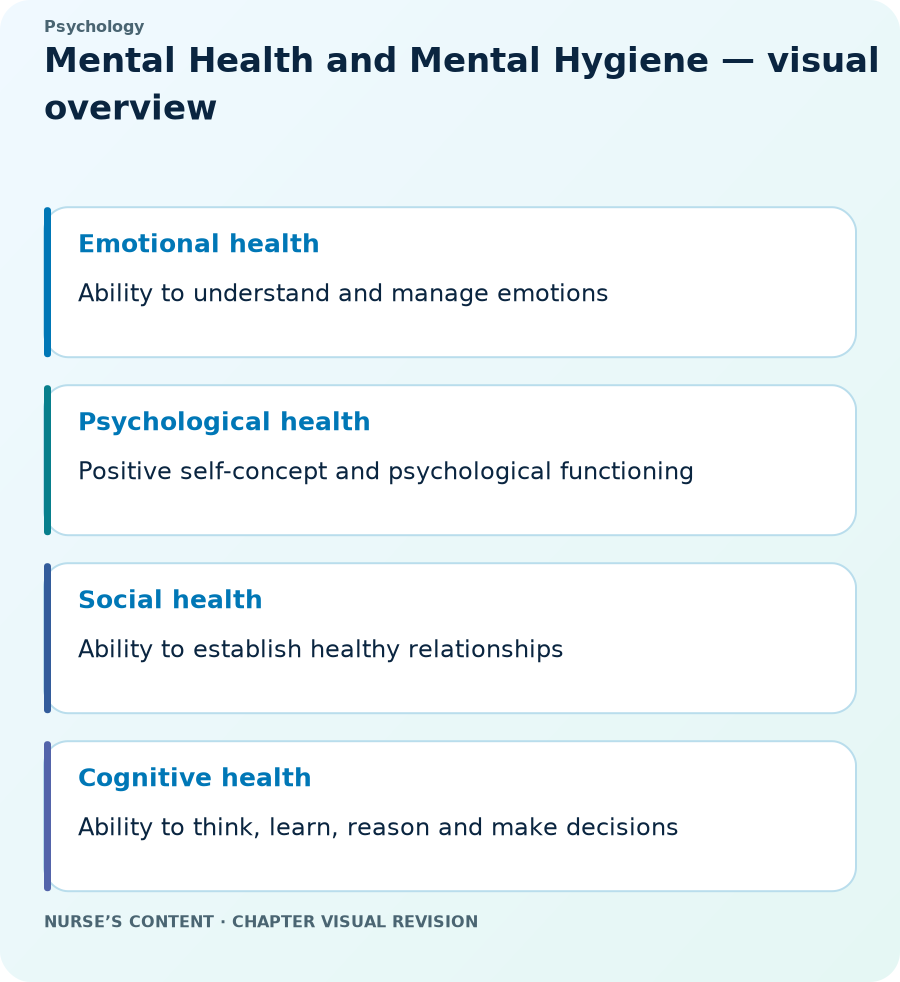
| Emotional health | Ability to understand and manage emotions |
| Psychological health | Positive self-concept and psychological functioning |
| Social health | Ability to establish healthy relationships |
| Cognitive health | Ability to think, learn, reason and make decisions |
| Behavioural health | Ability to respond constructively to situations |
| Spiritual well-being | Sense of meaning, purpose and personal values |
Objectives of Mental Health
- Maintain emotional stability.
- Promote healthy personality development.
- Develop positive self-esteem.
- Improve decision-making abilities.
- Promote healthy interpersonal relationships.
- Develop effective coping mechanisms.
- Improve psychological adjustment.
- Prevent mental health problems where possible.
- Promote independence and quality of life.
Factors Affecting Mental Health
A. Biological Factors
- Genetic predisposition
- Hereditary conditions
- Brain injury
- Neurological diseases
- Hormonal disturbances
- Chronic physical illness
- Nutritional deficiencies
- Sleep disturbances
- Substance misuse
B. Psychological Factors
- Low self-esteem
- Negative thinking patterns
- Emotional trauma
- Unresolved conflicts
- Poor coping abilities
- Excessive fear and anxiety
- Childhood experiences
- Difficulties in emotional regulation
C. Social Factors
- Family conflicts
- Social isolation
- Unemployment
- Financial difficulties
- Peer pressure
- Discrimination
- Bullying
- Lack of social support
D. Environmental Factors
- Unsafe living conditions
- Occupational stress
- Academic pressure
- Exposure to violence
- Natural disasters
- Poor access to healthcare
- Housing insecurity
Protective Factors
Protective factors reduce vulnerability to mental health difficulties.
- Supportive family environment
- Healthy interpersonal relationships
- Adequate sleep and nutrition
- Regular physical activity
- Positive self-esteem
- Effective coping mechanisms
- Financial and social security
- Meaningful activities
- Access to mental healthcare
Mental Health Continuum
Mental health exists on a continuum and may change throughout life.
| State | Characteristics |
|---|---|
| Positive mental health | Effective functioning and psychological well-being |
| Psychological distress | Temporary emotional or behavioural difficulties |
| Significant mental health difficulties | Persistent symptoms affecting daily functioning |
| Severe difficulties | Substantial distress, functional impairment or safety concerns |
A person with a diagnosed mental illness can still experience positive mental health and meaningful functioning.
2. CHARACTERISTICS OF A MENTALLY HEALTHY PERSON
A mentally healthy person generally demonstrates the following characteristics:
1. Self-Acceptance
- Accepts personal strengths and weaknesses.
- Maintains realistic self-esteem.
- Respects individual identity.
2. Emotional Stability
- Recognises and manages emotions.
- Expresses feelings appropriately.
- Recovers from emotional disturbances.
3. Realistic Thinking
- Understands situations realistically.
- Makes reasonable decisions.
- Distinguishes established facts from personal assumptions.
4. Self-Confidence
- Believes in personal abilities.
- Accepts constructive criticism.
- Recognises personal limitations.
5. Social Adjustment
- Maintains healthy interpersonal relationships.
- Cooperates with others.
- Respects social and cultural differences.
6. Independence
- Makes responsible decisions.
- Accepts responsibility for actions.
- Seeks assistance when needed.
7. Frustration Tolerance
- Manages disappointment constructively.
- Accepts reasonable delays.
- Responds appropriately to failure.
8. Effective Coping Ability
- Manages stress through constructive methods.
- Solves problems effectively.
- Adapts to changing situations.
9. Personal Growth
- Learns from past experiences.
- Develops new skills.
- Establishes realistic goals.
10. Sense of Responsibility
- Performs personal and professional duties.
- Recognises the consequences of actions.
- Respects the rights of others.
11. Integrated Personality
- Maintains consistency between thoughts, emotions and behaviour.
- Demonstrates a stable sense of identity.
12. Purpose in Life
- Establishes meaningful goals.
- Maintains motivation.
- Participates in satisfying activities.
Jahoda’s Six Criteria of Positive Mental Health
Marie Jahoda proposed six major criteria of positive mental health in 1958.
| Criterion | Meaning |
|---|---|
| Positive attitude towards self | Self-acceptance and self-awareness |
| Growth and self-actualization | Development of personal potential |
| Integration | Coordination of thoughts, emotions and behaviour |
| Autonomy | Independent and responsible functioning |
| Perception of reality | Realistic understanding of oneself and the environment |
| Environmental mastery | Ability to manage everyday responsibilities and relationships |
Important: Mental health does not require constant happiness. Experiencing temporary sadness, anxiety, anger and frustration is a normal part of human life.
3. WARNING SIGNS OF POOR MENTAL HEALTH
Warning signs are changes in emotions, thoughts, behaviour or daily functioning that may indicate psychological distress or a mental health condition.
A. Emotional Warning Signs
- Persistent sadness
- Excessive anxiety
- Frequent irritability
- Feelings of hopelessness
- Loss of interest in activities
- Excessive guilt
- Feelings of worthlessness
- Significant mood changes
- Emotional withdrawal
B. Cognitive Warning Signs
- Difficulty concentrating
- Impaired decision-making
- Persistent negative thoughts
- Memory disturbances
- Confusion
- Unusual suspiciousness
- Disturbed perception
- Thoughts of suicide or self-harm
C. Behavioural Warning Signs
- Social withdrawal
- Neglect of personal hygiene
- Decline in academic performance
- Reduced occupational functioning
- Increased substance use
- Uncharacteristic risk-taking behaviour
- Changes in communication
- Difficulty completing daily activities
D. Physical Warning Signs
- Persistent fatigue
- Changes in appetite
- Unexplained weight changes
- Insomnia or excessive sleep
- Frequent headaches
- Muscle tension
- Gastrointestinal discomfort
Physical symptoms may also be caused by medical illnesses and require appropriate assessment.
E. Warning Signs in Children
- Excessive fear
- Persistent temper tantrums beyond developmental expectations
- School refusal
- Social withdrawal
- Sudden behavioural changes
- Declining academic performance
- Regression in previously acquired skills
- Changes in sleeping and eating habits
F. Warning Signs in Adolescents
- Persistent irritability
- Social isolation
- Risk-taking behaviour
- Substance misuse
- Significant changes in academic performance
- Excessive concern about body image
- Persistent sadness
- Self-harming behaviour
G. Warning Signs in Older Adults
- Persistent loneliness
- Loss of interest
- Changes in sleep and appetite
- Neglect of self-care
- Social withdrawal
- Significant cognitive changes
- Persistent feelings of hopelessness
Sudden confusion in an older adult may indicate delirium or another acute medical condition and requires urgent assessment.
Emergency Warning Signs
- Suicidal intentions or plans
- Recent suicide attempt
- Serious self-harm
- Immediate threats of harm to others
- Severe agitation threatening safety
- Hallucinations associated with dangerous commands
- Sudden confusion or altered consciousness
- Inability to maintain personal safety
Immediate Nursing Actions
- 1. Assess immediate safety and medical stability.
- 2. Communicate calmly and respectfully.
- 3. Assess suicidal thoughts directly when indicated.
- 4. Do not leave a patient at imminent risk unattended.
- 5. Reduce access to hazards according to safety protocols.
- 6. Inform the responsible healthcare team immediately.
- 7. Arrange urgent medical or psychiatric assessment.
- 8. Document observations and interventions.
Clinical significance: Warning signs are not diagnostic criteria. Their duration, severity, impact on functioning and associated medical conditions must be considered.
4. MENTAL HYGIENE
Definition
Mental hygiene is the science and practice of maintaining mental health, promoting psychological well-being and preventing mental health difficulties.
Historical Background
- Clifford Whittingham Beers was an important pioneer of the modern mental hygiene movement.
- In 1908, he published A Mind That Found Itself, describing his experiences of psychiatric care.
- In 1909, the National Committee for Mental Hygiene was established in the United States.
- The movement promoted humane psychiatric treatment, prevention and public mental health awareness.
Aims of Mental Hygiene
- Preservation of mental health
- Prevention of mental health difficulties
- Promotion of emotional well-being
- Development of healthy personality
- Improvement of psychological adjustment
- Development of coping abilities
- Early identification of psychological problems
- Promotion of recovery and rehabilitation
Functions of Mental Hygiene
1. Preventive Function
Reduces risk factors associated with mental health problems.
2. Promotive Function
Promotes emotional, psychological and social well-being.
3. Therapeutic Function
Supports appropriate treatment and management of existing psychological difficulties.
4. Rehabilitative Function
Supports recovery, independence and social functioning.
Principles of Mental Hygiene
Self-Acceptance
Accept personal abilities, limitations and individual differences.
Emotional Regulation
Learn to recognise, understand and express emotions constructively.
Realistic Goal Setting
Establish achievable goals according to individual abilities and circumstances.
Healthy Lifestyle
Maintain adequate sleep, balanced nutrition, physical activity and personal hygiene.
Positive Relationships
Develop relationships based on respect, trust and effective communication.
Stress Management
Use relaxation, time management, problem-solving and other healthy coping techniques.
Work–Life Balance
Maintain an appropriate balance between work, study, rest and recreation.
Realistic Thinking
Avoid excessive self-criticism and develop flexible, balanced thinking.
Social Support
Maintain supportive relationships and seek assistance when necessary.
Early Intervention
Recognise persistent psychological difficulties and obtain appropriate professional care.
Mental Hygiene at Different Places
| Setting | Mental hygiene measures |
|---|---|
| Home | Supportive relationships, affection and open communication |
| School | Safe environment, guidance, recreation and bullying prevention |
| College | Academic support, counselling and stress management |
| Workplace | Respectful communication, reasonable workload and adequate rest |
| Hospital | Therapeutic environment, privacy, reassurance and patient-centred care |
| Community | Mental health education, stigma reduction and accessible services |
Mental Hygiene Across the Lifespan
Childhood
- Secure attachment
- Emotional support
- Adequate play
- Healthy family relationships
- Protection from neglect and abuse
Adolescence
- Guidance and counselling
- Identity development
- Healthy peer relationships
- Emotional education
- Support during academic pressure
Adulthood
- Work–life balance
- Healthy relationships
- Financial and occupational stress management
- Meaningful social participation
Older Adulthood
- Social interaction
- Emotional support
- Maintenance of independence
- Meaningful activities
- Support during bereavement and adjustment
Levels of Mental Health Prevention
| Level | Purpose | Examples |
|---|---|---|
| Primary prevention | Prevent onset of mental health problems | Mental health education, stress management and supportive environments |
| Secondary prevention | Early detection and timely intervention | Screening, early referral and prompt treatment |
| Tertiary prevention | Reduce disability and improve functioning | Rehabilitation, relapse prevention and follow-up care |
Difference Between Mental Health and Mental Hygiene
| Mental health | Mental hygiene |
|---|---|
| State of mental well-being | Practices used to maintain mental well-being |
| Represents an aspect of health | Represents preventive and promotive measures |
| Includes emotional and social functioning | Includes psychological and lifestyle practices |
| Concerned with psychological functioning | Concerned with maintaining and improving functioning |
5. DEFENCE MECHANISMS
Definition
Defence mechanisms are largely unconscious psychological processes that protect individuals from anxiety, distressing thoughts, unacceptable impulses and emotional conflicts.
Historical Background
- Sigmund Freud introduced defence-related concepts in psychoanalytic theory.
- Anna Freud systematically described several mechanisms in her work The Ego and the Mechanisms of Defence (1936).
Characteristics of Defence Mechanisms
- Generally operate outside conscious awareness.
- Reduce psychological tension.
- Protect self-esteem.
- Help manage internal conflicts.
- May be adaptive or maladaptive.
- Are commonly used in everyday life.
- Excessive or rigid use may interfere with healthy adjustment.
Purposes
- Reduce anxiety.
- Manage emotional conflicts.
- Maintain psychological stability.
- Protect against overwhelming emotions.
- Preserve self-esteem.
- Support temporary psychological adjustment.
Types of Defence Mechanisms
1. Denial
Failure or refusal to acknowledge a distressing reality.
Example: A patient refuses to accept a confirmed diagnosis of a serious illness.
2. Repression
Unconscious exclusion of distressing thoughts or impulses from awareness.
Example: According to psychodynamic theory, a person may remain unaware of emotionally threatening thoughts.
Unexplained memory loss should not automatically be attributed to repression.
3. Suppression
Consciously and intentionally postponing distressing thoughts.
Example: A nurse temporarily sets aside personal worries to focus on emergency patient care.
4. Projection
Attributing one’s own unacceptable thoughts or feelings to another person.
Example: A person who dislikes a colleague believes that the colleague dislikes them.
5. Displacement
Redirecting emotions from their original source towards a less threatening target.
Example: An employee who is angry with a supervisor expresses anger towards family members.
6. Rationalization
Providing seemingly reasonable explanations to justify behaviour or avoid an uncomfortable reality.
Example: A student who fails an examination claims that the subject was unimportant.
7. Regression
Returning to earlier developmental patterns of behaviour during stress.
Example: A hospitalized child begins displaying behaviour previously outgrown.
8. Reaction Formation
Expressing feelings or behaviour opposite to one’s unacceptable impulses.
Example: A person behaves excessively affectionately towards someone they strongly dislike.
9. Sublimation
Redirecting unacceptable impulses into socially acceptable and constructive activities.
Example: An individual channels aggressive impulses into disciplined sporting activities.
10. Compensation
Attempting to overcome a perceived weakness by developing strengths in another area.
Example: A student who struggles in sports develops strong academic abilities.
11. Identification
Adopting the characteristics or behaviour of another individual.
Example: A nursing student adopts the professional mannerisms of a respected instructor.
12. Introjection
Internalizing the beliefs, attitudes or values of another individual.
Example: A child adopts a parent’s standards of right and wrong as personal beliefs.
13. Intellectualization
Using excessive intellectual discussion or reasoning to avoid emotional distress.
Example: A patient discusses the technical details of a serious illness while avoiding associated fears.
14. Undoing
Attempting to counteract an unacceptable thought or behaviour through another action.
Example: A person repeatedly offers gifts after behaving insultingly to reduce feelings of guilt.
15. Fantasy
Using imagination to obtain satisfaction or temporarily escape an unpleasant reality.
Example: A person repeatedly imagines great professional success instead of taking practical steps towards it.
16. Conversion
In classical psychodynamic theory, emotional conflict is expressed through physical neurological symptoms.
Example: Functional weakness occurring in the context of psychological distress.
Modern functional neurological disorder requires appropriate clinical assessment. Its symptoms are genuine and may occur without an identifiable psychological stressor.
17. Isolation of Affect
Separating the emotional response from the associated thought or experience.
Example: A person describes a distressing event in detail without expressing the associated emotions.
18. Dissociation
Disruption in the usual integration of consciousness, identity, memory or perception.
Example: An individual feels detached from their surroundings during severe stress.
19. Acting Out
Expressing emotional conflicts through actions instead of recognizing or communicating the underlying feelings.
Example: A distressed adolescent repeatedly engages in disruptive behaviour instead of expressing anger verbally.
20. Passive Aggression
Indirect expression of anger or hostility.
Example: An employee repeatedly delays assigned tasks to express resentment indirectly.
21. Splitting
Viewing oneself or others in extreme, all-good or all-bad terms.
Example: A patient considers one nurse entirely good and another entirely bad after a minor disagreement.
22. Altruism
Managing emotional difficulties through constructive assistance to others.
Example: An individual finds meaning in supporting other people after experiencing personal loss.
23. Anticipation
Preparing realistically for future difficulties.
Example: A nursing student prepares emotionally and practically before a challenging clinical posting.
24. Humour
Using appropriate humour to reduce emotional tension.
Example: A patient uses light-hearted humour to manage surgical anxiety.
25. Substitution
Replacing an unavailable or unacceptable goal with an alternative goal.
Example: A student unable to enter a preferred specialization chooses another meaningful career pathway.
Defence Mechanisms: Quick Reference Table
| Mechanism | Key concept |
| Denial | Refusing to acknowledge reality |
| Repression | Unconscious exclusion from awareness |
| Suppression | Conscious postponement |
| Projection | Attributing one’s feelings to others |
| Displacement | Redirecting emotions |
| Rationalization | Self-protective justification |
| Regression | Returning to earlier behaviour |
| Reaction formation | Expressing opposite feelings |
| Sublimation | Constructive redirection |
| Compensation | Developing alternative strengths |
| Identification | Adopting another person’s characteristics |
| Introjection | Internalizing others’ beliefs |
| Intellectualization | Avoiding emotions through reasoning |
| Undoing | Attempting to counteract an action |
| Fantasy | Escaping through imagination |
| Dissociation | Disruption of integrated awareness |
| Acting out | Expressing conflict through behaviour |
| Splitting | All-good or all-bad thinking |
| Altruism | Helping others constructively |
| Anticipation | Preparing for future stress |
| Humour | Reducing tension through humour |
Classification of Defence Mechanisms
Mature Defence Mechanisms
Generally support constructive psychological adjustment.
- Sublimation
- Suppression
- Humour
- Anticipation
- Altruism
Neurotic Defence Mechanisms
May reduce psychological distress but limit awareness or emotional expression.
- Repression
- Displacement
- Reaction formation
- Intellectualization
- Isolation of affect
Immature Defence Mechanisms
May interfere with effective adjustment when used excessively.
- Projection
- Regression
- Acting out
- Passive aggression
- Fantasy
Pathological-Level Defence Mechanisms
Involve substantial distortion of reality.
- Severe denial
- Delusional projection
- Gross distortion of external reality
Classification varies between psychological theories. No single defence mechanism establishes a psychiatric diagnosis.
Repression vs Suppression
| Repression | Suppression |
|---|---|
| Generally unconscious | Conscious and intentional |
| Distressing thoughts are excluded from awareness | Distressing thoughts are temporarily postponed |
| Less voluntary control | Greater voluntary control |
| Psychodynamic mechanism | Can be an adaptive coping strategy |
Nursing Management of Defence Mechanisms
- Recognise possible defensive behaviour.
- Avoid unnecessary confrontation.
- Establish trust.
- Encourage appropriate emotional expression.
- Assess the underlying sources of distress.
- Promote constructive coping techniques.
- Maintain professional boundaries.
- Arrange psychological assessment when necessary.
6. FRUSTRATION
Definition
Frustration is an emotional response that occurs when an individual’s needs, goals, desires or expectations are obstructed or remain unfulfilled.
Process of Frustration
Need or desire → Goal-directed behaviour → Obstacle → Blocked goal → Frustration → Emotional or behavioural response.
Causes of Frustration
A. Internal Causes
- Physical limitations
- Lack of knowledge
- Inadequate skills
- Unrealistic expectations
- Low self-confidence
- Conflicting desires
- Fear of failure
B. External Causes
- Financial difficulties
- Environmental obstacles
- Social restrictions
- Family conflicts
- Academic pressure
- Unemployment
- Lack of resources
- Repeated rejection
Types of Frustration
1. Personal Frustration
Results from personal limitations or perceived inadequacies.
Example: Inability to perform a difficult clinical procedure.
2. Environmental Frustration
Results from physical or environmental barriers.
Example: Missing an important examination because of transport disruption.
3. Social Frustration
Results from social restrictions, rejection or interpersonal difficulties.
Example: Being excluded from a peer group.
4. Goal-Related Frustration
Occurs when a desired objective cannot be achieved.
Example: Failure to obtain a desired job.
Reactions to Frustration
Constructive Reactions
- Increased effort
- Problem-solving
- Seeking assistance
- Changing strategies
- Establishing alternative goals
- Accepting unavoidable limitations
Destructive Reactions
- Aggression
- Excessive anger
- Withdrawal
- Persistent avoidance
- Giving up unnecessarily
- Substance misuse
Effects of Frustration
| Physical effects | Psychological effects | Social effects |
|---|---|---|
| Headache | Anxiety | Interpersonal conflict |
| Muscle tension | Anger | Social withdrawal |
| Fatigue | Irritability | Reduced cooperation |
| Sleep disturbances | Reduced motivation | Relationship difficulties |
| Restlessness | Poor concentration | Occupational difficulties |
Frustration–Aggression Hypothesis
The frustration–aggression hypothesis was originally proposed by John Dollard and colleagues in 1939.
It suggests that blocked goals may contribute to aggressive impulses.
However, frustration does not always lead to aggression. Individuals may also respond through problem-solving, withdrawal, acceptance or constructive adaptation.
Frustration Tolerance
Frustration tolerance is the ability to manage disappointment, obstacles and delayed satisfaction without excessive psychological distress or destructive behaviour.
Management of Frustration
- Identify the source of frustration.
- Establish realistic expectations.
- Develop problem-solving abilities.
- Learn emotional regulation.
- Practise relaxation.
- Improve communication skills.
- Develop alternative goals.
- Accept unavoidable limitations.
- Seek social and professional support.
7. CONFLICT
Definition
Conflict is a state of psychological tension that occurs when an individual experiences incompatible goals, needs, motives, desires or choices.
Conflict may occur within an individual or between individuals and groups.
Causes of Conflict
- Incompatible goals
- Opposing desires
- Differences in values
- Lack of communication
- Competition
- Role expectations
- Limited resources
- Ethical dilemmas
- Interpersonal disagreements
- Differences in opinions
Types of Motivational Conflict
The classical three-type classification is associated with Kurt Lewin. Later psychological formulations describe
double approach–avoidance conflict.
1. Approach–Approach Conflict
Choosing between two desirable alternatives.
Example: A nursing graduate must choose between two attractive job offers.
Pattern: Positive option versus positive option.
2. Avoidance–Avoidance Conflict
Choosing between two undesirable alternatives.
Example: A student must choose between repeating a difficult course or accepting a delay in graduation.
Pattern: Negative option versus negative option.
3. Approach–Avoidance Conflict
A single goal has both desirable and undesirable characteristics.
Example: A nurse wants a promotion but fears additional responsibilities.
Pattern: One goal with positive and negative aspects.
4. Double Approach–Avoidance Conflict
Choosing between two alternatives, each having both desirable and undesirable characteristics.
Example:
- Job A provides a high salary but requires relocation.
- Job B provides a lower salary but allows the nurse to remain near family.
Classification of Motivational Conflict
| Type | Pattern | Example |
|---|---|---|
| Approach–approach | Positive vs positive | Two desirable jobs |
| Avoidance–avoidance | Negative vs negative | Two unpleasant alternatives |
| Approach–avoidance | One goal with positive and negative aspects | Promotion with additional responsibilities |
| Double approach–avoidance | Two goals, each with positive and negative aspects | Two jobs with different advantages and disadvantages |
Other Types of Conflict
Intrapersonal Conflict
Occurs within an individual.
Example: Conflict between personal desires and professional responsibilities.
Interpersonal Conflict
Occurs between two individuals.
Example: Disagreement between two nurses.
Intragroup Conflict
Occurs among members of the same group.
Example: Disagreement within a nursing team.
Intergroup Conflict
Occurs between different groups or departments.
Example: Disagreement between nursing and administrative departments.
Role Conflict
Occurs when different role expectations are incompatible.
Example: Difficulty balancing family responsibilities and clinical duties.
Ethical Conflict
Occurs when moral principles, values or professional obligations appear incompatible.
Example: Conflict between a nurse’s personal beliefs and a patient’s informed decision.
Effects of Conflict
- Anxiety
- Emotional distress
- Indecisiveness
- Frustration
- Reduced concentration
- Poor interpersonal relationships
- Occupational stress
- Reduced productivity
- Sleep disturbances
Constructively managed conflict can also promote problem-solving, innovation and improved understanding.
Conflict Management Styles
| Style | Description |
|---|---|
| Avoiding | Temporarily withdrawing from conflict |
| Accommodating | Giving priority to another person’s concerns |
| Competing | Assertively pursuing one’s own position |
| Compromising | Both parties make concessions |
| Collaborating | Working together towards a mutually satisfactory solution |
Steps of Conflict Resolution
- 1. Identify the conflict.
- 2. Identify its underlying causes.
- 3. Assess the perspectives of involved individuals.
- 4. Encourage open communication.
- 5. Identify possible solutions.
- 6. Evaluate the consequences of each solution.
- 7. Select an appropriate solution.
- 8. Implement the decision.
- 9. Evaluate the outcome.
Difference Between Frustration and Conflict
| Frustration | Conflict |
|---|---|
| Results from an obstructed goal | Results from incompatible goals or motives |
| Involves unmet expectations | Involves difficulty choosing or reconciling alternatives |
| May cause anger or disappointment | May cause tension or indecisiveness |
| Example: Failure to obtain a job | Example: Choosing between two competing jobs |
8. COPING
Definition
Coping refers to the cognitive and behavioural efforts used to manage internal or external demands perceived as stressful or challenging.
Richard Lazarus and Susan Folkman developed an influential transactional model of stress and coping in 1984.
Objectives of Coping
- Reduce psychological distress.
- Maintain emotional functioning.
- Manage stressful situations.
- Promote effective adjustment.
- Improve problem-solving abilities.
- Protect physical and psychological health.
- Maintain interpersonal relationships.
Lazarus and Folkman’s Transactional Model
1. Primary Appraisal
The individual evaluates whether a situation is threatening, harmful, challenging, beneficial or irrelevant.
2. Secondary Appraisal
The individual evaluates available resources and possible coping responses.
3. Coping Response
The individual selects an appropriate cognitive or behavioural strategy.
4. Reappraisal
The individual reassesses the situation and evaluates the effectiveness of coping.
Sequence:
Stressor → Appraisal → Assessment of coping resources → Coping response → Reappraisal.
Types of Coping
1. Problem-Focused Coping
Attempts to change or manage the source of stress.
Examples:
- Problem-solving
- Planning
- Time management
- Seeking information
- Developing practical skills
- Seeking professional assistance
Clinical example: A patient learns techniques to manage a chronic illness.
2. Emotion-Focused Coping
Attempts to regulate emotional responses associated with stress.
Examples:
- Relaxation
- Emotional expression
- Mindfulness
- Acceptance
- Cognitive reframing
- Emotional support
Clinical example: A patient practises comfortable, controlled breathing before surgery.
3. Meaning-Focused Coping
Finding personal meaning or purpose during difficult experiences.
Examples:
- Reflection on personal values
- Spiritual practices according to individual beliefs
- Reassessing priorities
- Recognising personal growth
4. Social Support-Seeking
Obtaining emotional, informational or practical assistance.
Examples:
- Talking with family members
- Seeking peer support
- Counselling
- Participating in support groups
5. Avoidance Coping
Avoiding stressful situations, responsibilities or thoughts.
Examples:
- Procrastination
- Social withdrawal
- Excessive distraction
- Avoiding necessary decisions
Persistent avoidance may worsen psychological difficulties.
6. Proactive Coping
Taking preventive action before an anticipated stressful situation occurs.
Example: Preparing a revision schedule well before university examinations.
Adaptive Coping Mechanisms
Adaptive coping promotes constructive adjustment and long-term functioning.
- Problem-solving
- Physical exercise
- Adequate sleep
- Relaxation techniques
- Seeking emotional support
- Journaling
- Assertive communication
- Time management
- Professional counselling
- Realistic goal setting
Maladaptive Coping Mechanisms
Maladaptive coping may provide temporary relief but worsen psychological or physical health.
- Alcohol misuse
- Drug misuse
- Self-harming behaviour
- Persistent social withdrawal
- Aggression
- Excessive gambling
- Persistent avoidance
- Harmful eating behaviours
Adaptive vs Maladaptive Coping
| Adaptive coping | Maladaptive coping |
|---|---|
| Supports healthy adjustment | Interferes with healthy adjustment |
| Promotes constructive responses | May involve harmful responses |
| Supports long-term functioning | Often provides temporary relief |
| Improves problem management | May worsen underlying problems |
| Example: Problem-solving | Example: Substance misuse |
Problem-Focused vs Emotion-Focused Coping
| Problem-focused coping | Emotion-focused coping |
|---|---|
| Targets the source of stress | Targets emotional responses |
| Uses planning and problem-solving | Uses emotional regulation |
| Useful when situations can be changed | Useful when situations cannot immediately be changed |
| Example: Preparing for an examination | Example: Managing examination anxiety |
Both approaches may be used together.
Factors Influencing Coping
- Age and developmental stage
- Personality
- Previous experiences
- Physical health
- Emotional state
- Cognitive abilities
- Financial resources
- Cultural background
- Personal beliefs
- Social support
- Severity and duration of stress
- Availability of healthcare
Coping Resources
Internal Resources
- Self-confidence
- Psychological resilience
- Knowledge
- Emotional regulation
- Problem-solving abilities
- Personal motivation
External Resources
- Family
- Friends
- Financial resources
- Community support
- Healthcare services
- Supportive workplace
- Educational institutions
Defence Mechanisms vs Coping Mechanisms
| Defence mechanisms | Coping mechanisms |
|---|---|
| Largely unconscious | Often conscious efforts |
| Protect against emotional distress | Manage stressful demands |
| May distort awareness of reality | May directly address the situation |
| Often automatic | Frequently intentional |
| Example: Projection | Example: Problem-solving |
Some mechanisms, particularly suppression, overlap with conscious coping strategies.
9. STRESS AND ADJUSTMENT
Definition of Stress
Stress is a psychological and physiological response to demands perceived as challenging, threatening or exceeding available resources.
Types of Stress
Eustress
Stress associated with motivation, manageable challenges and constructive performance.
Example: Motivation before an important examination.
Distress
Stress associated with psychological suffering or impaired functioning.
Example: Persistent academic pressure resulting in sleep difficulties and reduced concentration.
Acute Stress
Short-term stress associated with an immediate situation.
Chronic Stress
Prolonged stress resulting from persistent demands or difficult circumstances.
General Adaptation Syndrome (GAS)
Hans Selye described three stages of the physiological response to prolonged stress.
| Stage | Description |
|---|---|
| Alarm reaction | Initial activation of physiological stress responses |
| Resistance | Continued physiological adaptation to the stressor |
| Exhaustion | Prolonged stress may impair adaptation and functioning |
Physiological Response to Stress
Major pathways include:
- Sympathetic nervous system activation
- Adrenaline and noradrenaline release
- Hypothalamic–pituitary–adrenal axis activation
- Cortisol release
- Changes in heart rate, respiration and metabolism
Stress Management Techniques
- 1. Comfortable, controlled breathing.
- 2. Progressive muscle relaxation.
- 3. Meditation and mindfulness.
- 4. Regular physical activity.
- 5. Adequate sleep.
- 6. Balanced nutrition.
- 7. Time management.
- 8. Cognitive reframing.
- 9. Social support.
- 10. Recreational activities.
- 11. Professional psychological support when indicated.
Adjustment
Adjustment is the process through which an individual adapts to personal needs, environmental demands and changing circumstances.
Characteristics of Healthy Adjustment
- Realistic thinking
- Emotional regulation
- Effective communication
- Problem-solving abilities
- Flexibility
- Healthy interpersonal relationships
- Acceptance of reality
Maladjustment
Maladjustment refers to difficulties adapting effectively to personal or environmental demands.
Possible Manifestations
- Persistent anxiety
- Interpersonal difficulties
- Social withdrawal
- Reduced academic or occupational functioning
- Ineffective coping
- Emotional distress
10. ROLE OF THE NURSE IN PROMOTING MENTAL HEALTH
A. Assessment
- Assess mood, behaviour and emotional responses.
- Identify warning signs of psychological distress.
- Assess sleep, appetite and daily functioning.
- Identify sources of stress and frustration.
- Assess coping mechanisms and defence mechanisms.
- Evaluate available social support.
- Assess immediate safety and suicide risk when indicated.
B. Therapeutic Communication
- Maintain active listening.
- Demonstrate empathy.
- Use appropriate open-ended questions.
- Avoid judgmental statements.
- Encourage expression of feelings.
- Maintain confidentiality.
- Respect personal dignity.
C. Psychological Support
- Provide emotional support.
- Encourage constructive coping.
- Support problem-solving abilities.
- Provide accurate information.
- Promote realistic expectations.
- Encourage independence where appropriate.
D. Mental Health Promotion
- Provide mental health education.
- Encourage healthy lifestyle habits.
- Promote stress-management techniques.
- Support social relationships.
- Reduce stigma associated with mental illness.
E. Prevention
- Identify vulnerable individuals.
- Recognise early warning signs.
- Encourage timely assessment.
- Support screening and preventive programmes.
- Facilitate appropriate referrals.
F. Crisis Intervention
- Maintain immediate patient safety.
- Assess the severity of distress.
- Communicate calmly.
- Reduce environmental stimulation when appropriate.
- Inform the multidisciplinary healthcare team.
- Follow emergency protocols.
G. Rehabilitation
- Promote independence.
- Encourage social participation.
- Support treatment adherence.
- Provide family education.
- Encourage occupational rehabilitation.
- Support relapse prevention and follow-up care.
H. Professional Self-Care for Nurses
- Maintain adequate rest.
- Follow healthy work routines.
- Develop time-management skills.
- Maintain professional boundaries.
- Seek peer and supervisory support.
- Recognise signs of burnout.
- Obtain professional help when required.
11. SAMPLE NURSING CARE PLAN: INEFFECTIVE COPING
Clinical situation: A hospitalized patient reports anxiety and difficulty adjusting to a newly diagnosed chronic illness.
Assessment
Subjective data:
- Patient verbalizes feeling overwhelmed.
- Expresses fear about the illness.
- Reports difficulty managing stress.
Objective data:
- Restlessness
- Reduced concentration
- Social withdrawal
- Disturbed sleep
Nursing Diagnosis
Ineffective coping related to situational stress and inadequate coping resources, as evidenced by verbalized difficulty managing the situation.
Goals
- Patient will identify major sources of stress.
- Patient will express feelings appropriately.
- Patient will demonstrate at least two constructive coping strategies.
- Patient will identify available support systems.
Nursing Interventions and Rationales
| Nursing intervention | Rationale |
|---|---|
| Assess existing coping strategies | Identifies strengths and difficulties |
| Establish a therapeutic relationship | Promotes trust and communication |
| Encourage expression of feelings | Supports emotional awareness |
| Provide accurate information | Reduces uncertainty and misconceptions |
| Teach relaxation techniques | May reduce physiological arousal |
| Encourage realistic problem-solving | Supports effective adjustment |
| Facilitate social support | Improves access to coping resources |
| Refer when indicated | Provides appropriate specialized assistance |
Evaluation
- Patient identifies relevant stressors.
- Patient demonstrates constructive coping strategies.
- Patient reports improved confidence in managing the situation.
- Patient participates in appropriate treatment and support activities.
12. IMPORTANT UNIVERSITY EXAMINATION QUESTIONS
Long Answer Questions
- 1. Define mental health and explain the characteristics of a mentally healthy person.
- 2. Define mental hygiene. Explain its aims, principles and functions.
- 3. Describe the warning signs of poor mental health and the role of the nurse.
- 4. Define defence mechanisms. Explain their types with suitable examples.
- 5. Define frustration. Describe its causes, effects and management.
- 6. Define conflict. Explain its different types with examples.
- 7. Define coping. Explain the types of coping mechanisms.
- 8. Explain the role of nurses in mental health promotion and prevention.
- 9. Discuss stress, its physiological effects and management.
Short Answer Questions
- 1. Jahoda’s criteria of positive mental health.
- 2. Factors affecting mental health.
- 3. Protective factors of mental health.
- 4. Principles of mental hygiene.
- 5. Levels of prevention in mental health.
- 6. Denial and projection.
- 7. Repression and suppression.
- 8. Rationalization.
- 9. Sublimation.
- 10. Frustration tolerance.
- 11. Frustration–aggression hypothesis.
- 12. Approach–avoidance conflict.
- 13. Conflict management styles.
- 14. Adaptive and maladaptive coping.
- 15. Problem-focused coping.
- 16. Emotion-focused coping.
- 17. Lazarus and Folkman’s coping model.
- 18. General adaptation syndrome.
- 19. Stress management techniques.
- 20. Mental hygiene for nursing students.
Very Short Answer Questions
- 1. Define mental health.
- 2. Define mental hygiene.
- 3. Name two characteristics of mental health.
- 4. Define defence mechanism.
- 5. Define frustration.
- 6. Define conflict.
- 7. Define coping.
- 8. What is denial?
- 9. What is projection?
- 10. What is sublimation?
- 11. What is regression?
- 12. What is suppression?
- 13. Define stress.
- 14. Define adjustment.
- 15. Name the four types of motivational conflict.
Chapter reference images