Psychology
Introduction to Psychology
Meaning, development, scope, branches, methods, relationship with other subjects and importance in nursing.
Open quizzes and study tools Download PDF
CHAPTER 01: INTRODUCTION TO PSYCHOLOGY
Subject: Applied Psychology Course: B.Sc. Nursing Chapter: 01 Focus: University Examinations and Nursing Practice
1. Introduction
Psychology is the scientific study of human behaviour and mental processes. It helps us understand how individuals think, feel, learn, remember, communicate and respond to different situations.
Psychology is important in nursing because patients experience not only physical illness but also emotional, psychological and social difficulties. Understanding human behaviour helps nurses provide holistic, patient-centred care.
2. Meaning of Psychology
The word Psychology is derived from two Greek words:
- Psyche: Originally referring to the soul or mind.
- Logos: Study or knowledge.
Thus, psychology was historically understood as the study of the soul or mind.
Modern meaning: Psychology is the scientific study of behaviour and mental processes.
Definitions of Psychology
Modern scientific definition:
Psychology is the scientific study of behaviour and mental processes.
William James: Described psychology as the science of mental life, including its phenomena and conditions.
John B. Watson: Emphasized the scientific study of observable behaviour.
Main Components of Psychology
1. Behaviour
Behaviour includes observable actions and responses of individuals.
Examples:
- Walking
- Talking
- Crying
- Laughing
- Eating
- Responding to pain
2. Mental Processes
Mental processes are internal psychological activities that cannot always be observed directly.
Examples:
- Thinking
- Learning
- Memory
- Perception
- Motivation
- Emotions
- Decision-making
3. Scientific Approach
Psychology uses systematic observation, evidence, experimentation and analysis to study behaviour and mental processes.
3. Nature and Characteristics of Psychology
- 1. Scientific discipline: Uses scientific methods to understand behaviour.
- 2. Studies behaviour and mental processes: Includes observable actions and internal experiences.
- 3. Studies individual differences: Recognizes variations in personality, intelligence, emotions and abilities.
- 4. Dynamic discipline: Psychological knowledge develops through research.
- 5. Studies human development: Examines behaviour from infancy to old age.
- 6. Interdisciplinary subject: Related to biology, medicine, sociology, education and other disciplines.
- 7. Theoretical and applied: Develops explanations of behaviour and applies findings to real-life problems.
- 8. Promotes adjustment and well-being: Helps individuals manage challenges and adapt to their
environment.
4. Goals of Psychology
Psychology has four major goals.
1. Description
To observe and describe behaviour accurately.
Example: A nurse observes that a patient becomes anxious before surgery.
2. Explanation
To understand why a particular behaviour occurs.
Example: The patient may feel anxious because of fear of anaesthesia or surgical complications.
3. Prediction
To anticipate behaviour under particular circumstances.
Example: A patient with previous severe procedural anxiety may experience anxiety before another procedure.
4. Influence or Modification
To apply psychological knowledge to help modify behaviour and improve well-being ethically.
Example: A nurse uses reassurance, education and relaxation techniques to reduce preoperative anxiety.
Remember: Describe → Explain → Predict → Influence.
5. Historical Development of Psychology
Psychology gradually developed from philosophical ideas into an independent scientific discipline.
A. Philosophical Period
Before psychology became an independent science, philosophers studied the human mind, knowledge, behaviour
and emotions.
Important Philosophers
Socrates (469–399 BCE)
- Emphasized self-knowledge and critical questioning.
- Encouraged examination of human thoughts and actions.
Plato (c. 428–348 BCE)
- Explored the relationship between mind, knowledge and behaviour.
- Emphasized reasoning and innate aspects of knowledge.
Aristotle (384–322 BCE)
- Studied memory, perception, learning and emotions.
- Wrote De Anima (On the Soul).
- Considered biological and psychological processes interconnected.
B. Scientific Development of Psychology
Wilhelm Wundt (1832–1920)
- Commonly regarded as the father of experimental psychology.
- Established a psychology laboratory at Leipzig, Germany, in 1879.
- Studied conscious experience using controlled experimental methods.
Exam point: Wilhelm Wundt is commonly called the father of experimental psychology.
Major Schools of Psychology
| School | Major contributors | Main idea |
|---|---|---|
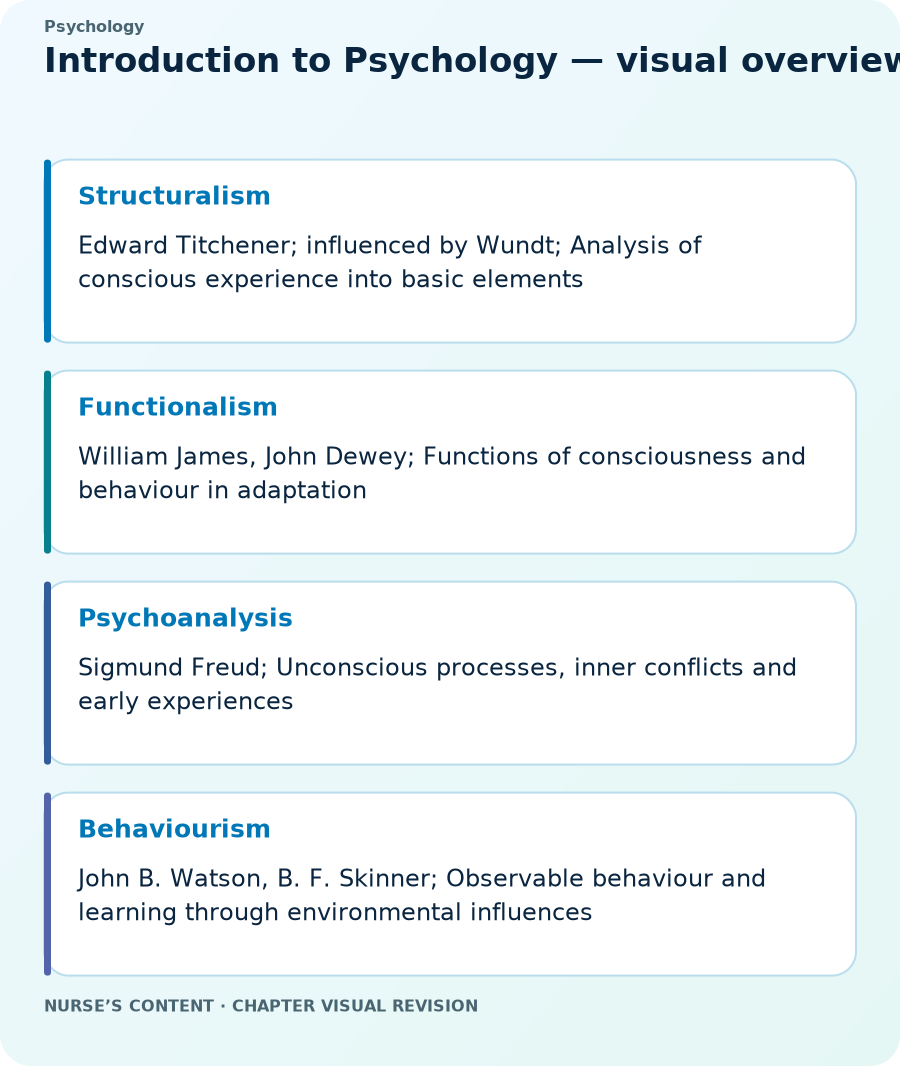
| Structuralism | Edward Titchener; influenced by Wundt | Analysis of conscious experience into basic elements |
| Functionalism | William James, John Dewey | Functions of consciousness and behaviour in adaptation |
| Psychoanalysis | Sigmund Freud | Unconscious processes, inner conflicts and early experiences |
| Behaviourism | John B. Watson, B. F. Skinner | Observable behaviour and learning through environmental influences |
| Gestalt psychology | Max Wertheimer, Wolfgang Köhler, Kurt Koffka | Psychological experiences are organized as meaningful wholes |
| Humanistic psychology | Carl Rogers, Abraham Maslow | Human potential, freedom, personal growth and self-actualization |
| Cognitive psychology | Ulric Neisser and others | Memory, attention, thinking, language and information processing |
C. Modern Psychology
Modern psychology uses multiple scientific perspectives to explain behaviour.
Important approaches include:
Biological approach: Explains behaviour through brain function, genetics, hormones and the nervous system.
Behavioural approach: Studies learning through conditioning, reinforcement and environmental influences.
Cognitive approach: Examines thinking, memory, attention, reasoning and decision-making.
Psychodynamic approach: Emphasizes unconscious influences, relationships and emotional conflicts.
Humanistic approach: Focuses on human potential, dignity, growth and personal meaning.
Sociocultural approach: Examines how society, culture, family and social environments influence behaviour.
Biopsychosocial approach: Explains health and behaviour through the interaction of biological, psychological and social factors.
Evolution of Psychology: Quick Summary
Philosophical study of mind → Experimental psychology → Major psychological schools → Scientific study of behaviour and cognition → Modern interdisciplinary psychology.
6. Scope of Psychology
The scope of psychology refers to the various areas of human behaviour and mental processes studied by psychologists.
1. Individual Behaviour
Psychology studies how people behave in different situations.
It includes:
- Habits
- Attitudes
- Interests
- Personality
- Reactions to stress
2. Cognitive Processes
The study of mental activities, including:
- Attention
- Perception
- Thinking
- Learning
- Memory
- Intelligence
- Reasoning
- Problem-solving
3. Emotional Processes
Psychology examines emotional experiences and regulation.
Examples:
- Happiness
- Fear
- Anxiety
- Anger
- Sadness
- Grief
4. Human Growth and Development
Studies physical, cognitive, emotional and psychosocial changes throughout life.
Major stages:
- Infancy
- Childhood
- Adolescence
- Adulthood
- Older adulthood
5. Personality and Individual Differences
Studies characteristics that make individuals different from one another.
Includes:
- Temperament
- Personality traits
- Intelligence
- Aptitude
- Motivation
- Coping styles
6. Social Behaviour
Studies how people interact within groups and society.
Includes:
- Social influence
- Communication
- Cooperation
- Conflict
- Group behaviour
- Social attitudes
7. Psychological Health and Disorders
Studies psychological well-being, distress and mental disorders.
Examples:
- Anxiety disorders
- Depressive disorders
- Schizophrenia
- Trauma-related disorders
- Substance use disorders
8. Application in Healthcare
Psychology contributes to:
- Patient counselling
- Mental health promotion
- Health education
- Treatment adherence
- Stress management
- Rehabilitation
- Behaviour change
7. Branches of Psychology
Psychology is divided into several branches based on its subject matter and practical applications.
| Branch | Area of study |
|---|---|
| General psychology | Basic principles of behaviour and mental processes |
| Experimental psychology | Behaviour and cognition studied through experiments |
| Developmental psychology | Human development across the lifespan |
| Social psychology | Influence of society and groups on behaviour |
| Clinical psychology | Assessment and psychological treatment of mental and behavioural difficulties |
| Counselling psychology | Emotional, personal, relationship and adjustment difficulties |
| Educational psychology | Learning, motivation and teaching processes |
| Health psychology | Psychological and behavioural factors affecting health and illness |
| Cognitive psychology | Attention, perception, learning, memory and reasoning |
| Biological psychology | Biological bases of behaviour |
| Neuropsychology | Relationship between brain function and cognition or behaviour |
| Industrial and organizational psychology | Human behaviour in workplaces and organizations |
| Personality psychology | Personality traits, patterns and individual differences |
| Community psychology | Community well-being, prevention and social systems |
| Forensic psychology | Application of psychology to legal and justice settings |
Branches Most Relevant to Nursing
Clinical psychology: Helps nurses understand mental health problems and psychological interventions.
Health psychology: Explains how beliefs, stress, behaviour and lifestyle influence health.
Developmental psychology: Helps nurses provide age-appropriate care.
Social psychology: Supports understanding of family influences, communication and group behaviour.
Counselling psychology: Provides a foundation for supportive communication and referral.
Biological psychology: Helps connect brain function, neurological conditions and behaviour.
8. Methods of Psychology
Psychologists use different scientific methods to collect information and understand behaviour.
1. Introspection Method
Meaning: Introspection is the process of examining and reporting one’s own conscious thoughts, feelings and experiences.
Example: A person describes their thoughts and feelings during a stressful situation.
Advantages:
- Provides information about personal experiences.
- Simple for understanding conscious feelings.
- Useful as one form of self-report.
Limitations:
- Subjective.
- Difficult to verify independently.
- Some mental processes occur outside conscious awareness.
2. Observation Method
Meaning: Systematic observation and recording of behaviour.
Types
- Naturalistic observation: Behaviour observed in a natural setting.
- Controlled observation: Behaviour observed in a structured environment.
- Participant observation: Researcher participates in the setting.
- Non-participant observation: Researcher observes without participating.
Example: A nurse observes the behaviour of a child during hospitalization.
Advantages:
- Provides direct behavioural information.
- Useful when individuals cannot describe their experiences.
- Can be performed in natural environments.
Limitations:
- Observer bias may affect interpretation.
- People may change behaviour when observed.
- Observation alone cannot establish cause and effect.
3. Experimental Method
Meaning: A scientific method in which researchers manipulate one variable under controlled conditions to study its effect on another variable.
Important Terms
Independent variable: Variable manipulated by the researcher.
Dependent variable: Outcome measured by the researcher.
Example: A researcher investigates whether a relaxation programme reduces anxiety in patients.
- Independent variable: Relaxation programme.
- Dependent variable: Anxiety score.
Advantages:
- Can provide strong evidence about cause and effect when well designed.
- Allows controlled testing of hypotheses.
Limitations:
- Some experiments may be impractical or unethical.
- Artificial settings may affect natural behaviour.
- Results may not always generalize to real-life situations.
4. Interview Method
Meaning: Collection of psychological information through direct questioning and communication.
Types
- Structured interview
- Semi-structured interview
- Unstructured interview
Example: A nurse interviews a patient to assess emotional distress and coping mechanisms.
Advantages:
- Provides detailed information.
- Allows clarification of responses.
- Helps understand personal experiences.
Limitations:
- Time-consuming.
- Interviewer bias may occur.
- Responses may be influenced by social desirability.
5. Questionnaire and Survey Method
Meaning: Collection of information using a set of written or digital questions.
Example: A questionnaire assessing stress among nursing students.
Advantages:
- Can collect information from large groups.
- Relatively economical.
- Easy to organize and analyse when standardized.
Limitations:
- Responses may be inaccurate or incomplete.
- Misunderstanding of questions may occur.
- Surveys generally cannot establish causation.
6. Case Study Method
Meaning: An intensive and detailed investigation of an individual, group or specific situation.
Example: A detailed study of a patient experiencing psychological changes following a brain injury.
Advantages:
- Provides detailed information.
- Useful for uncommon or complex cases.
- Helps generate research questions.
Limitations:
- Findings may not apply to everyone.
- Researcher interpretation may influence conclusions.
- Usually cannot establish cause and effect.
7. Psychological Testing Method
Meaning: The use of standardized instruments to assess psychological characteristics.
Examples:
- Intelligence tests
- Personality inventories
- Aptitude tests
- Memory assessments
- Anxiety and depression screening scales
Advantages:
- Can provide standardized results.
- Useful for assessment and research.
- Helps identify specific strengths and difficulties.
Limitations:
- Results can be affected by language, culture and testing conditions.
- Poor-quality tests may produce misleading results.
- Professional training may be required for administration and interpretation.
Nursing consideration: Nurses should use only assessments appropriate to their training, professional scope and institutional policies. Screening results alone do not establish a psychiatric diagnosis.
8. Correlational Method
Meaning: Examines the relationship between two or more variables without manipulating them.
Example: Studying the relationship between sleep duration and academic performance among nursing students.
Important: Correlation does not prove causation.
9. Developmental Research Methods
Cross-sectional method: Compares individuals from different age groups at one point in time.
Longitudinal method: Studies the same individuals repeatedly over a period of time.
These methods help researchers understand psychological changes with age and development.
Comparison of Psychological Methods
| Method | Main purpose |
|---|---|
| Introspection | Explore conscious personal experiences |
| Observation | Record behaviour |
| Experiment | Test causal relationships |
| Interview | Obtain detailed verbal information |
| Survey | Collect information from groups |
| Case study | Examine an individual or situation in depth |
| Psychological testing | Assess selected psychological characteristics |
| Correlational study | Examine associations between variables |
| Longitudinal study | Examine change over time |
9. Relationship of Psychology with Other Subjects
Psychology is an interdisciplinary science closely related to many healthcare and social science disciplines.
1. Psychology and Anatomy
Anatomy explains the structure of the human body, particularly the brain, spinal cord and nervous system.
Psychology examines the mental and behavioural functions associated with these structures.
Nursing example: Understanding behavioural changes after a brain injury.
2. Psychology and Physiology
Physiology studies the normal functions of the human body.
Psychology explores the relationship between physiological processes and behaviour.
Nursing example: Understanding how stress influences heart rate, breathing and sleep.
3. Psychology and Sociology
Sociology studies society, social relationships and social institutions.
Psychology studies individual behaviour and how it is influenced by social environments.
Nursing example: Understanding how family beliefs affect treatment decisions.
4. Psychology and Anthropology
Anthropology studies human societies, cultures and human development.
Psychology helps explain the ways culture and social experiences influence thoughts, emotions and behaviour.
Nursing example: Providing culturally responsive patient care.
5. Psychology and Medicine
Medicine focuses on the prevention, diagnosis and treatment of illness.
Psychology contributes knowledge about behaviour, coping, treatment adherence and psychological health.
Nursing example: Supporting patients adjusting to chronic illness.
6. Psychology and Psychiatry
Psychiatry is a medical specialty concerned with the assessment, diagnosis, treatment and prevention of mental disorders.
Psychology studies behaviour and mental processes and contributes psychological assessment, research and evidence-based therapies.
Nursing example: Understanding psychiatric symptoms and assisting in a multidisciplinary care plan.
7. Psychology and Education
Educational psychology studies learning, motivation, memory and teaching strategies.
Nursing example: Applying learning principles during patient education and clinical teaching.
8. Psychology and Pharmacology
Pharmacology studies medicines and their effects on the body.
Psychology helps explain medication-related behaviour, expectations, adherence and the interaction between psychological states and treatment.
Nursing example: Understanding a patient’s fear of medication side effects.
9. Psychology and Community Health
Psychology contributes to health promotion, preventive behaviour, community education and understanding factors influencing health decisions.
Nursing example: Developing behavioural strategies to improve vaccination uptake.
10. Psychology and Ethics
Ethics examines moral principles and responsible conduct.
Psychology provides insight into decision-making, values, emotions and interpersonal behaviour.
Nursing example: Respecting a patient’s autonomy while supporting informed decisions.
10. Importance of Psychology in Nursing
Psychology is essential for understanding patients, families and healthcare professionals.
1. Understanding Patient Behaviour
Patients may react differently to illness, hospitalization and treatment.
Psychological knowledge helps nurses understand fear, anger, sadness, denial and emotional distress.
Example: Understanding why a patient becomes withdrawn after receiving a serious diagnosis.
2. Establishing a Therapeutic Nurse–Patient Relationship
Psychology supports:
- Empathy
- Active listening
- Respect
- Trust
- Non-judgmental communication
- Professional boundaries
Example: Listening attentively to a patient who is worried about surgery.
3. Effective Communication
Psychology helps nurses understand verbal and non-verbal communication.
It improves interactions with patients of different ages, backgrounds and emotional states.
Example: Using simple explanations and visual aids when educating patients.
4. Managing Stress and Anxiety
Psychology provides strategies for recognising and managing stress.
Nurses may use appropriate interventions such as:
- Relaxation techniques
- Emotional support
- Patient education
- Coping-skills education
- Referral to qualified mental health professionals
Example: Supporting a patient who experiences anxiety before a procedure.
5. Understanding Pain Behaviour
Pain is influenced by biological, psychological and social factors.
Psychology helps nurses understand how attention, fear, previous experiences and coping influence pain.
Example: Combining prescribed analgesia with suitable non-pharmacological comfort measures.
6. Providing Holistic Nursing Care
Holistic care considers the patient’s physical, psychological, social and spiritual needs.
Psychology helps nurses plan individualized and patient-centred interventions.
7. Improving Patient Education
Knowledge of learning and motivation helps nurses adapt health education to patients’ needs.
Example: Teaching diabetes self-management using demonstrations, repetition and teach-back.
8. Supporting Mental Health
Psychology helps nurses recognise possible signs of psychological distress.
Examples include:
- Persistent sadness
- Excessive anxiety
- Changes in sleep
- Social withdrawal
- Behavioural changes
Nurses can document findings, provide supportive care and refer for further assessment when indicated.
9. Understanding Child Behaviour
Developmental psychology helps nurses understand the emotional and cognitive needs of children.
Example: Using age-appropriate language and play during paediatric care.
10. Maternal and Reproductive Healthcare
Psychological knowledge helps nurses support women and families during pregnancy, childbirth and postpartum adjustment.
Example: Recognising emotional distress and providing appropriate support and referral.
11. Geriatric Nursing
Older adults may experience changes in cognition, mood, independence and social relationships.
Psychology helps nurses provide respectful, individualized care.
Example: Supporting an older adult experiencing loneliness or adjustment difficulties.
12. Improving Treatment Adherence
Psychology helps identify behavioural and emotional barriers to following a treatment plan.
Example: Exploring reasons why a patient has difficulty taking medicines regularly.
13. Crisis Intervention
Psychological principles support calm, safe and compassionate nursing care during distressing events.
Example: Providing psychological first aid after an emergency, within professional competence.
14. Supporting Patients with Chronic and Terminal Illness
Psychology helps nurses understand adjustment, grief, coping and emotional responses to long-term illness.
Example: Supporting the emotional needs of a patient receiving palliative care.
15. Professional Development of Nurses
Psychology also helps nurses improve their own:
- Emotional regulation
- Stress management
- Communication skills
- Teamwork
- Leadership
- Conflict resolution
- Professional adjustment
11. Psychological Principles Used in Nursing Practice
| Psychological principle | Nursing application |
|---|---|
| Empathy | Understanding and acknowledging patient feelings |
| Motivation | Supporting health behaviour change |
| Reinforcement | Encouraging beneficial behaviours |
| Learning | Providing effective patient education |
| Perception | Understanding how patients interpret illness |
| Emotional regulation | Supporting appropriate responses to distress |
| Individual differences | Individualizing nursing care |
| Development | Delivering age-appropriate care |
| Coping | Supporting adjustment to illness |
| Social influence | Understanding family and community effects on health |
12. Difference Between Psychology and Psychiatry
| Psychology | Psychiatry |
|---|---|
| Scientific discipline studying behaviour and mental processes | Medical specialty focused on mental disorders |
| Includes research, education, health and other applications | Primarily concerned with clinical mental healthcare |
| Clinical psychologists may provide psychological assessment and therapy | Psychiatrists provide medical assessment and treatment |
| Training and legal scope vary by profession and country | Psychiatrists are medically qualified physicians |
| Psychological treatment may include evidence-based psychotherapy | Treatment may include medication, psychotherapy and other medical interventions |
Note: Both professions may contribute to mental health assessment and treatment through multidisciplinary collaboration.
13. Ethical Considerations in Psychology and Nursing
Psychological knowledge must be used responsibly.
Important ethical principles include:
- 1. Respect for dignity: Treat every individual with respect.
- 2. Confidentiality: Protect patient information according to professional and legal requirements.
- 3. Informed consent: Respect informed decision-making.
- 4. Non-maleficence: Avoid preventable harm.
- 5. Beneficence: Promote patient well-being.
- 6. Professional competence: Work within one’s qualifications and scope of practice.
- 7. Non-discrimination: Provide equitable and respectful care.
- 8. Professional boundaries: Maintain appropriate therapeutic relationships.
14. Important University Examination Questions
Long Answer Questions (10–15 Marks)
- 1. Define psychology. Explain its nature, scope and importance in nursing.
- 2. Describe the historical development and major schools of psychology.
- 3. Explain the different methods of psychology with their advantages and limitations.
- 4. Discuss the relationship of psychology with other subjects.
- 5. Explain the importance and applications of psychology in nursing practice.
Short Answer Questions (5 Marks)
- 1. Define psychology and list its goals.
- 2. Write the characteristics of psychology.
- 3. Explain the contributions of Wilhelm Wundt.
- 4. Describe the observation method.
- 5. Explain the experimental method.
- 6. List the major branches of psychology.
- 7. Discuss psychology’s relationship with physiology.
- 8. Explain the importance of psychology in patient care.
- 9. Differentiate between psychology and psychiatry.
- 10. Explain the role of psychology in therapeutic communication.
Very Short Answer Questions (2 Marks)
- 1. Define psychology.
- 2. Who is known as the father of experimental psychology?
- 3. In which year was Wundt’s psychology laboratory established?
- 4. Name the four major goals of psychology.
- 5. Define introspection.
- 6. Define observation.
- 7. What is experimental psychology?
- 8. Name two branches of psychology.
- 9. What is clinical psychology?
- 10. Define behaviour.
15. Multiple-Choice Questions (MCQs)
1. Who is commonly known as the father of experimental psychology?
Answer: B. Wilhelm Wundt
2. The first widely recognized experimental psychology laboratory was established in:
Answer: B. 1879
3. Which branch of psychology studies changes throughout the human lifespan?
Answer: C. Developmental psychology
4. Which method systematically manipulates an independent variable?
Answer: C. Experimental method
5. Which of the following is a major goal of psychology?
Answer: D. All of the above
6. Psychoanalysis is most closely associated with:
Answer: A. Sigmund Freud
7. Which school focuses on observable behaviour?
Answer: B. Behaviourism
8. The main purpose of health psychology is to study:
Answer: B. Psychological and behavioural factors influencing health
9. A nurse uses active listening to understand a patient’s concerns. This demonstrates:
Answer: A. Therapeutic communication
10. Correlation between two variables:
Answer: C. Does not by itself establish causation
16. Quick Revision Notes
- Psychology is the scientific study of behaviour and mental processes.
- The word psychology originated from the Greek words psyche and logos.
- Wilhelm Wundt established an experimental psychology laboratory in Leipzig in 1879.
- Four major goals: description, explanation, prediction and influence.
- Structuralism studied the basic elements of conscious experience.
- Functionalism focused on the purposes of mental processes and behaviour.
- Behaviourism emphasized observable behaviour.
- Psychoanalysis emphasized unconscious processes.
- Humanistic psychology emphasized human potential and growth.
- Cognitive psychology studies thinking, learning, attention and memory.
- Major methods include observation, experiment, interview, survey, case study and psychological testing.
- The experimental method can test causal relationships under controlled conditions.
- Clinical psychology contributes to mental health assessment and psychological treatment.
- Health psychology studies psychological and behavioural influences on health.
- Psychology helps nurses understand patient behaviour, emotions and coping.
- Psychological knowledge improves therapeutic communication and patient-centred care.
17. Conclusion
Psychology is an essential subject in nursing education because it provides a scientific understanding of human behaviour, mental processes, emotions, learning and adjustment.
Knowledge of psychology helps nurses establish effective therapeutic relationships, understand emotional responses to illness, improve patient education, support mental health and deliver holistic nursing care.
Understanding the fundamentals of psychology provides the foundation for studying mental health, developmental psychology, personality, learning, motivation and other important areas of nursing practice.
Chapter reference images