Psychology
Developmental Psychology
Life-span development, physical, psychosocial and cognitive development, psychological needs of different age groups, child psychology and vulnerable individuals.
Open quizzes and study tools Download PDF
CHAPTER 04: DEVELOPMENTAL PSYCHOLOGY
1. Introduction
Developmental psychology is the branch of psychology that studies physical, cognitive, emotional, social and behavioural changes throughout the human lifespan, from conception to death.
It examines how heredity, environment, maturation, learning and social experiences influence human development.
2. Growth and Development
Growth: Quantitative changes in the physical size and structure of the body.
Development: Progressive changes in physical abilities, mental processes, emotional functioning and social behaviour.
Maturation: Biologically influenced progression towards functional maturity.
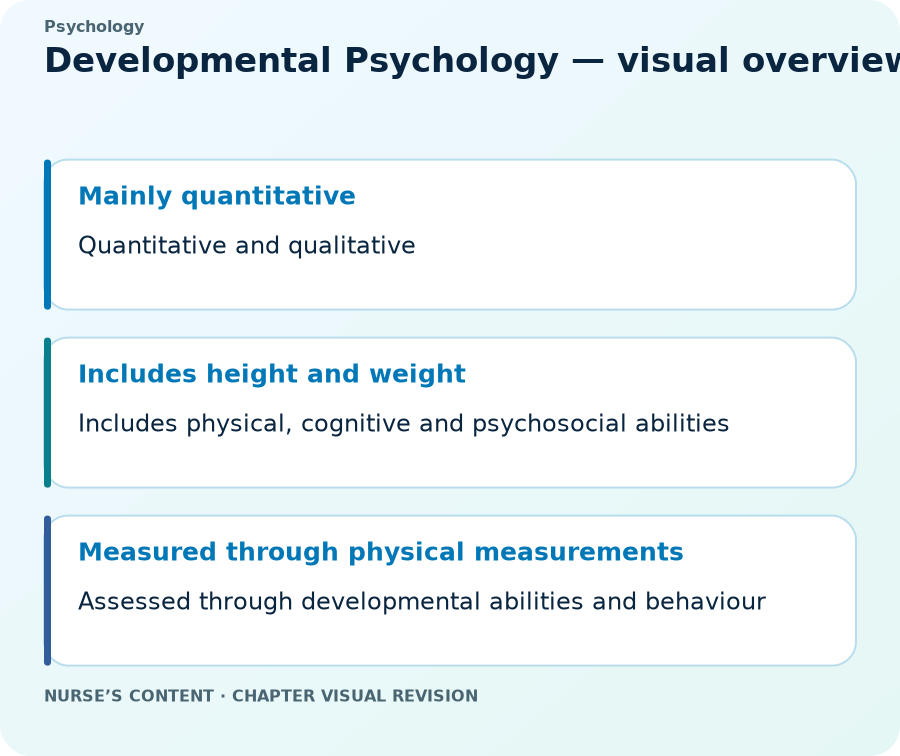
| Growth | Development |
|---|---|
| Mainly quantitative | Quantitative and qualitative |
| Includes height and weight | Includes physical, cognitive and psychosocial abilities |
| Physical growth largely stabilizes after maturity | Continues throughout life |
| Measured through physical measurements | Assessed through developmental abilities and behaviour |
3. Principles of Development
- Development is a continuous, lifelong process.
- Development generally follows recognizable patterns.
- The rate of development varies among individuals.
- Cephalocaudal development progresses from head towards feet.
- Proximodistal development progresses from the centre towards the extremities.
- Development generally progresses from simpler to more complex abilities.
- Different developmental domains are interrelated.
- Heredity and environment interact throughout development.
- Development includes both gains and losses.
4. Domains of Development
| Domain | Description |
|---|---|
| Physical | Growth, motor abilities and physiological maturation |
| Cognitive | Thinking, memory, language, intelligence and reasoning |
| Emotional | Expression and regulation of emotions |
| Social | Relationships, cooperation and social adjustment |
| Moral | Development of values and ethical reasoning |
| Psychosocial | Interaction between psychological development and social experiences |
5. Factors Influencing Development
- Genetic inheritance
- Prenatal health
- Nutritional status
- Hormonal activity
- Physical health
- Family relationships
- Education
- Cultural environment
- Socioeconomic conditions
- Childhood experiences
- Social support
6. Stages of Life-Span Development
The following age ranges are approximate and may vary between developmental frameworks.
| Stage | Approximate age |
|---|---|
| Prenatal period | Conception to birth |
| Neonatal period | Birth to 28 days |
| Infancy | Birth to 1 year |
| Toddlerhood | 1–3 years |
| Preschool age | 3–6 years |
| School age | 6–12 years |
| Adolescence | 10–19 years, according to WHO |
| Early adulthood | Approximately 20–40 years |
| Middle adulthood | Approximately 40–65 years |
| Older adulthood | Approximately 65 years and above |
7. Prenatal Development
Prenatal development occurs between conception and birth.
Stages
- 1. Germinal stage: First two weeks after fertilization; cell division and implantation occur.
- 2. Embryonic stage: Third to eighth week after fertilization; formation of major organ systems.
- 3. Fetal stage: Ninth week after fertilization until birth; growth and maturation of organ systems.
Factors Affecting Prenatal Development
- Maternal nutrition
- Genetic abnormalities
- Maternal infections
- Alcohol and tobacco exposure
- Certain medications and environmental toxins
- Maternal illnesses
- Access to antenatal care
Nursing Responsibilities
- Promote regular antenatal assessment.
- Educate regarding nutrition and prescribed supplements.
- Encourage avoidance of harmful substances.
- Provide emotional support.
- Identify maternal and fetal risk factors.
8. Infancy
Physical Development
- Rapid increase in height and weight.
- Development of head control and motor coordination.
- Gradual acquisition of sitting, crawling and standing abilities.
Cognitive Development
- Learning through sensory experiences and movement.
- Recognition of familiar people.
- Development of object permanence.
- Early language development.
Psychosocial Development
- Formation of attachment to caregivers.
- Development of trust and emotional security.
- Emerging stranger and separation anxiety.
Psychological Needs
- Affection
- Security
- Responsive caregiving
- Consistent attention
- Sensory stimulation
Nursing Care
Encourage caregiver presence, appropriate feeding, responsive caregiving, developmental stimulation and safe attachment.
9. Toddlerhood
Physical Development
- Improved walking and running.
- Increased independence in movement.
- Development of fine motor abilities.
- Gradual acquisition of toileting skills.
Cognitive Development
- Rapid vocabulary development.
- Beginning symbolic thinking.
- Exploration of the environment.
Psychosocial Development
- Desire for independence.
- Increasing autonomy.
- Possible temper tantrums.
- Emerging self-awareness.
Psychological Needs
- Independence
- Safe exploration
- Consistent boundaries
- Reassurance
- Parental affection
Nursing Care
Offer simple choices, maintain familiar routines, encourage safe play and avoid punitive responses to developmental behaviour.
10. Preschool Age
Physical Development
- Improved balance and coordination.
- Increasing fine motor control.
- Development of self-care abilities.
Cognitive Development
- Imaginative and symbolic thinking.
- Increased language skills.
- Early understanding of numbers and concepts.
- Egocentric thinking may remain prominent.
Psychosocial Development
- Development of initiative.
- Increased social play.
- Understanding of social rules.
- Possible fears of injury and separation.
Nursing Care
Use play, pictures, simple explanations and positive reinforcement. Reassure children that illness is not a punishment.
11. School-Age Children
Physical Development
- Steady physical growth.
- Improved strength and coordination.
Cognitive Development
- Increasing logical thinking about concrete situations.
- Improved memory and attention.
- Development of academic abilities.
Psychosocial Development
- Importance of achievement.
- Peer relationships.
- Development of competence and self-esteem.
Psychological Needs
- Recognition
- Achievement
- Friendship
- Encouragement
- Opportunities to develop skills
Nursing Care
Explain procedures, encourage participation in self-care and support educational continuity during hospitalization.
12. Adolescence
Adolescence is the transitional developmental period between childhood and adulthood.
Physical Changes
- Puberty
- Growth spurt
- Development of secondary sexual characteristics
- Reproductive maturation
Cognitive Changes
- Increasing abstract thinking.
- Development of reasoning and decision-making abilities.
- Increased awareness of future goals.
Psychosocial Changes
- Identity formation
- Increased independence
- Importance of peer relationships
- Body-image concerns
- Sexual and emotional development
Psychological Needs
- Privacy
- Acceptance
- Emotional support
- Autonomy
- Accurate sexuality education
- Guidance without unnecessary judgment
Nursing Care
Provide confidential, age-appropriate communication, promote healthy decision-making, assess emotional distress and respect emerging autonomy within applicable consent and safeguarding requirements.
13. Early Adulthood
Developmental Characteristics
- Career and educational development.
- Formation of intimate relationships.
- Increasing independence.
- Establishment of personal and professional goals.
Psychological Needs
- Intimacy
- Independence
- Social belonging
- Financial security
- Professional development
Nursing Care
Respect autonomous decision-making, provide health education and support adjustment to illness, relationships and occupational responsibilities.
14. Middle Adulthood
Developmental Characteristics
- Changing family and occupational responsibilities.
- Possible physiological changes associated with ageing.
- Menopause in women.
- Reassessment of personal goals.
- Contribution to family and society.
Psychological Needs
- Recognition
- Stability
- Meaningful work
- Family support
- Health maintenance
Nursing Care
Support preventive healthcare, chronic disease management, emotional adjustment and healthy lifestyle practices.
15. Older Adulthood
Physical Development
- Possible reduction in muscle strength and sensory function.
- Increased vulnerability to chronic diseases.
- Changes in mobility and physiological reserve.
Cognitive Development
- Processing speed may decrease.
- Accumulated knowledge may remain relatively well preserved.
- Dementia is not a normal or inevitable part of ageing.
Psychosocial Development
- Retirement adjustment.
- Changes in social roles.
- Experiences of bereavement.
- Reflection on life experiences.
Psychological Needs
- Dignity
- Independence
- Companionship
- Security
- Meaningful activities
- Emotional support
Nursing Care
Promote independence, assess cognition and sensory needs, prevent falls, encourage social participation and avoid age-based discrimination.
16. Erik Erikson’s Psychosocial Development Theory
Erikson proposed eight stages of psychosocial development.
| Stage | Psychosocial conflict | Positive developmental quality |
|---|---|---|
| Infancy | Trust vs mistrust | Hope |
| Toddlerhood | Autonomy vs shame and doubt | Will |
| Preschool | Initiative vs guilt | Purpose |
| School age | Industry vs inferiority | Competence |
| Adolescence | Identity vs role confusion | Fidelity |
| Early adulthood | Intimacy vs isolation | Love |
| Middle adulthood | Generativity vs stagnation | Care |
| Older adulthood | Integrity vs despair | Wisdom |
These stages describe theoretical developmental challenges rather than mandatory outcomes.
17. Jean Piaget’s Cognitive Development Theory
| Stage | Approximate age | Characteristics |
|---|---|---|
| Sensorimotor | Birth–2 years | Learning through senses and actions; object permanence |
| Preoperational | 2–7 years | Symbolic thinking, imagination and egocentrism |
| Concrete operational | 7–11 years | Logical reasoning about concrete objects; conservation |
| Formal operational | 12 years onward | Increasing ability for abstract and hypothetical reasoning |
Important Piagetian Concepts
- Schema: Mental framework used to organize information.
- Assimilation: Incorporating new information into existing schemas.
- Accommodation: Modifying existing schemas to incorporate new information.
- Equilibration: Balancing assimilation and accommodation.
- Object permanence: Understanding that objects continue to exist when not visible.
- Conservation: Understanding that quantity remains unchanged despite changes in appearance.
18. Freud’s Psychosexual Development Theory
| Stage | Approximate age | Main theoretical focus |
|---|---|---|
| Oral | Birth–1 year | Mouth-related satisfaction |
| Anal | 1–3 years | Bowel control |
| Phallic | 3–6 years | Genital awareness |
| Latency | 6 years–puberty | Social and intellectual development |
| Genital | Puberty onward | Mature sexuality and relationships |
Freud’s stages are historically important but are not strongly supported as a universal scientific explanation of personality development.
19. Kohlberg’s Moral Development Theory
| Level | Characteristics |
|---|---|
| Preconventional | Decisions influenced by punishment and personal reward |
| Conventional | Decisions influenced by social expectations, rules and duties |
| Postconventional | Decisions influenced by broader ethical principles and rights |
The framework has cultural limitations and should not be used to judge a person’s overall morality.
20. Child Psychology
Child psychology studies the behaviour, emotions, cognition and development of children.
Major Areas
- Attachment
- Emotional development
- Language development
- Learning
- Play
- Socialization
- Behavioural adjustment
Types of Play
| Type | Description |
|---|---|
| Solitary play | Playing independently |
| Parallel play | Playing alongside other children |
| Associative play | Sharing activities without fully coordinated goals |
| Cooperative play | Playing together towards shared goals |
| Therapeutic play | Structured play that facilitates expression and preparation for healthcare |
Psychological Effects of Hospitalization
- Separation anxiety
- Fear of unfamiliar people
- Fear of pain and procedures
- Loss of control
- Regression
- Disturbed sleep
- Emotional withdrawal
Nursing Management
- Encourage caregiver involvement.
- Provide age-appropriate explanations.
- Use therapeutic play.
- Maintain familiar routines.
- Provide comfort and pain management.
- Encourage developmentally appropriate independence.
21. Psychology of Vulnerable Individuals
Vulnerability may arise from illness, disability, age, financial hardship, discrimination, violence or limited social support.
| Vulnerable group | Important psychological considerations |
|---|---|
| Children | Security, protection and emotional support |
| Adolescents | Identity, privacy and acceptance |
| Women facing discrimination or violence | Safety, autonomy, dignity and access to support |
| Persons with disabilities | Accessibility, inclusion and independence |
| Older adults | Dignity, companionship and adjustment |
| Chronically ill patients | Coping, treatment burden and emotional support |
| Terminally ill patients | Comfort, meaning and psychosocial support |
| Survivors of abuse | Safety, trust and trauma-informed care |
Role of the Nurse
- Assess individual physical and psychological needs.
- Provide accessible communication.
- Maintain privacy and dignity.
- Promote informed decision-making.
- Identify safeguarding concerns.
- Avoid discrimination.
- Facilitate appropriate referrals and rehabilitation.
22. Psychology of Death and Dying
Death and dying may involve fear, sadness, anticipatory grief and changes in family relationships.
Kübler-Ross Model
The model describes five possible responses:
- 1. Denial
- 2. Anger
- 3. Bargaining
- 4. Depression
- 5. Acceptance
These responses are not universal, sequential or compulsory.
Nursing Responsibilities
- Provide compassionate communication.
- Respect cultural and spiritual preferences.
- Support symptom management.
- Preserve dignity and privacy.
- Encourage family involvement according to patient preferences.
- Provide bereavement support and appropriate referral.
23. Important Examination Questions
Long Answer Questions
- 1. Explain physical, cognitive and psychosocial development across the lifespan.
- 2. Describe Erikson’s psychosocial development theory.
- 3. Explain Piaget’s cognitive development theory.
- 4. Discuss the psychological needs of different age groups.
- 5. Explain the role of nurses in caring for vulnerable individuals.
Short Answer Questions
- 1. Principles of growth and development.
- 2. Stages of prenatal development.
- 3. Psychological effects of hospitalization on children.
- 4. Types of play.
- 5. Adolescent psychological needs.
- 6. Kohlberg’s moral development theory.
- 7. Psychological care of older adults.
- 8. Psychology of death and dying.
24. Quick Revision
- Erikson: Eight psychosocial stages.
- Piaget: Four cognitive stages.
- Freud: Five psychosexual stages.
- Kohlberg: Three levels of moral development.
- Infancy: Trust and attachment.
- Toddlerhood: Autonomy.
- Preschool: Initiative.
- School age: Industry and competence.
- Adolescence: Identity formation.
- Early adulthood: Intimacy.
- Middle adulthood: Generativity.
- Older adulthood: Integrity.
Chapter reference images