Psychology
Cognitive Processes
Attention, perception, intelligence, learning, memory, forgetting, thinking, reasoning, problem-solving and aptitude.
Open quizzes and study tools Download PDF
CHAPTER 06: COGNITIVE PROCESSES
Subject: Applied Psychology
Course: B.Sc. Nursing
1. Introduction
Cognition refers to the mental processes involved in acquiring, processing, storing and using information.
Cognitive processes enable individuals to understand their environment, learn new information, remember experiences, make decisions and solve problems.
Major Cognitive Processes
- Attention
- Perception
- Intelligence
- Learning
- Memory
- Thinking
- Reasoning
- Problem-solving
- Aptitude
2. Attention
Definition
Attention is the process of selectively focusing mental resources on particular stimuli, activities or information.
Characteristics
- Selective
- Limited in capacity
- Influenced by motivation and interest
- May be voluntary or involuntary
- Changes according to environmental conditions
Types of Attention
| Type | Meaning |
|---|---|
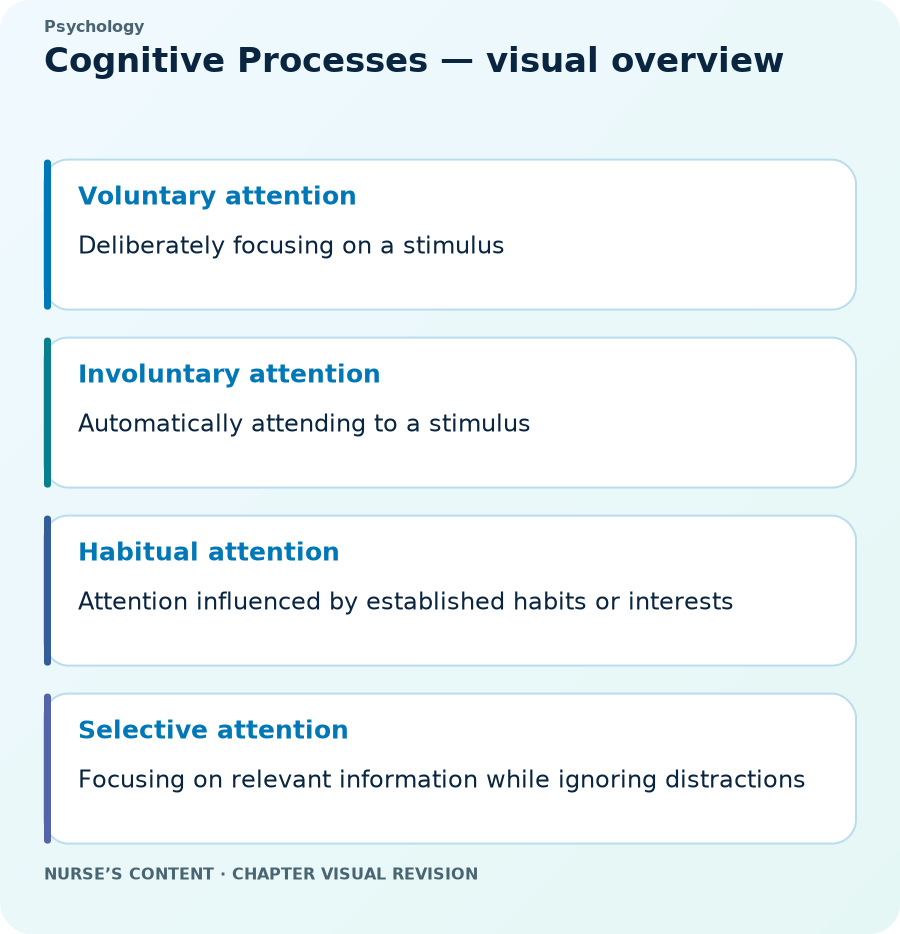
| Voluntary attention | Deliberately focusing on a stimulus |
| Involuntary attention | Automatically attending to a stimulus |
| Habitual attention | Attention influenced by established habits or interests |
| Selective attention | Focusing on relevant information while ignoring distractions |
| Sustained attention | Maintaining concentration over time |
| Divided attention | Distributing attention across multiple tasks |
| Alternating attention | Shifting attention between tasks |
Determinants of Attention
External factors:
- Intensity
- Size
- Movement
- Novelty
- Contrast
- Repetition
- Environmental stimulation
Internal factors:
- Interest
- Motivation
- Emotional condition
- Previous experiences
- Needs
- Fatigue
- Physical health
Duration and Degree of Attention
Duration: Length of time an individual can maintain attention.
Degree: Intensity or concentration of attention.
Span of attention: Amount of information that can be attended to within a limited period.
These vary according to task demands and individual circumstances.
Alterations in Attention
- Distractibility
- Reduced concentration
- Excessive fixation on particular stimuli
- Difficulty sustaining attention
- Impaired ability to shift attention
Nursing Applications
- Reduce environmental distractions.
- Give short and clear instructions.
- Provide information in manageable sections.
- Assess acute changes in attention.
- Allow adequate rest during patient education.
Acute inattention with fluctuating awareness may indicate delirium and requires prompt assessment.
3. Perception
Definition
Perception is the mental process of organizing and interpreting sensory information to understand the environment.
Process of Perception
Stimulus → Sensory reception → Neural processing → Organization → Interpretation.
Sensation vs Perception
| Sensation | Perception |
|---|---|
| Detection of stimuli | Interpretation of stimuli |
| Begins at sensory receptors | Involves central nervous system processing |
| Example: Detecting a sound | Example: Recognizing the sound as a voice |
Gestalt Principles of Perception
| Principle | Meaning |
|---|---|
| Figure–ground | Separating an object from its background |
| Proximity | Grouping nearby objects together |
| Similarity | Grouping similar objects |
| Closure | Perceiving incomplete figures as complete |
| Continuity | Perceiving continuous patterns |
| Common fate | Grouping objects moving together |
Perceptual Constancy
The tendency to perceive objects as relatively stable despite changes in sensory input.
Types:
- Size constancy
- Shape constancy
- Colour constancy
- Brightness constancy
Factors Affecting Perception
- Previous experiences
- Expectations
- Motivation
- Emotional state
- Cultural background
- Attention
- Sensory functioning
- Environmental conditions
Alterations in Perception
Illusion: Misinterpretation of an existing external stimulus.
Example: Mistaking a hanging coat for a person in dim lighting.
Hallucination: A perception-like experience occurring without a corresponding external stimulus.
Types include auditory, visual, tactile, olfactory and gustatory hallucinations.
Agnosia: Difficulty recognizing familiar stimuli despite sufficient basic sensory functioning.
Depersonalization: Feeling detached from one's own self or experiences.
Derealization: Experiencing surroundings as unreal or unfamiliar.
Nursing Responsibilities
- Assess sensory functioning.
- Maintain adequate lighting and a safe environment.
- Communicate clearly.
- Acknowledge distress without reinforcing false perceptions.
- Assess safety when hallucinations occur.
- Report sudden perceptual abnormalities.
4. Intelligence
Definition
Intelligence is the ability to learn, reason, solve problems, understand complex information and adapt to changing circumstances.
Characteristics
- Involves learning and understanding.
- Supports problem-solving.
- Helps individuals adapt to situations.
- Is influenced by genetics and environmental experiences.
- Includes multiple cognitive abilities.
Determinants of Intelligence
- Genetic inheritance
- Nutrition
- Brain development
- Education
- Environmental stimulation
- Physical and psychological health
- Socioeconomic circumstances
- Learning opportunities
Genetic influence does not mean that intellectual development is fixed or unaffected by the environment.
5. Theories of Intelligence
Spearman's Two-Factor Theory
Charles Spearman proposed:
- General factor (g): Broad cognitive ability contributing to performance across different tasks.
- Specific factor (s): Ability required for a particular task.
Thurstone's Primary Mental Abilities
Seven major abilities were proposed:
- Verbal comprehension
- Word fluency
- Number ability
- Spatial visualization
- Associative memory
- Perceptual speed
- Reasoning
Cattell's Theory
Fluid intelligence: Ability to reason and solve unfamiliar problems.
Crystallized intelligence: Knowledge and skills acquired through education and experience.
Gardner's Multiple Intelligences Theory
Howard Gardner proposed several forms of intelligence:
- Linguistic
- Logical-mathematical
- Spatial
- Musical
- Bodily-kinesthetic
- Interpersonal
- Intrapersonal
- Naturalistic
This framework is educationally influential, although the proposed abilities are not all established as independent intelligences by psychometric research.
Sternberg's Triarchic Theory
Robert Sternberg proposed:
- Analytical intelligence
- Creative intelligence
- Practical intelligence
6. Measurement of Intelligence
Intelligence Quotient (IQ)
IQ is a standardized score representing performance on selected cognitive tasks relative to an appropriate reference population.
Historical IQ Formula
IQ = Mental age ÷ Chronological age × 100.
Example: Mental age of 12 years and chronological age of 10 years gives a historical ratio IQ of 120.
Modern intelligence tests generally use age-standardized deviation IQ scores rather than this historical formula.
Illustrative IQ Score Classification
| IQ score | Approximate description |
|---|---|
| 130 and above | Very high |
| 120–129 | High |
| 110–119 | High average |
| 90–109 | Average |
| 80–89 | Low average |
| 70–79 | Very low or borderline range |
| Below 70 | Extremely low range |
Terminology and score boundaries vary between instruments. Scores must be interpreted with measurement uncertainty and clinical context.
Common Intelligence Tests
- Stanford–Binet Intelligence Scales
- Wechsler Adult Intelligence Scale (WAIS)
- Wechsler Intelligence Scale for Children (WISC)
- Raven's Progressive Matrices
- Malin's Intelligence Scale for Indian Children (MISIC)
Intellectual Disability
Intellectual disability involves significant limitations in intellectual functioning and adaptive functioning, beginning during the developmental period.
Adaptive functioning includes:
- Conceptual skills
- Social skills
- Practical daily living skills
Severity Levels
- Mild
- Moderate
- Severe
- Profound
Severity is determined primarily through adaptive functioning and support needs, not solely by IQ.
The historical terms mental retardation and mental deficiency are outdated and should be replaced by respectful, contemporary terminology.
Nursing Responsibilities
- Identify developmental and learning difficulties.
- Use accessible communication.
- Encourage independence.
- Adapt patient education to individual abilities.
- Support families and caregivers.
- Facilitate specialized assessment and rehabilitation.
7. Learning
Definition
Learning is a relatively enduring change in knowledge, skills or behaviour resulting from experience, practice or training.
Characteristics
- Influenced by experience.
- May occur intentionally or unintentionally.
- May modify knowledge and behaviour.
- Can occur throughout life.
- Is influenced by motivation and reinforcement.
8. Types and Theories of Learning
A. Classical Conditioning
Associated with Ivan Pavlov.
Learning occurs when one stimulus becomes associated with another stimulus.
Pavlov's experiment:
| Component | Example |
|---|---|
| Unconditioned stimulus (UCS) | Food |
| Unconditioned response (UCR) | Salivation in response to food |
| Neutral stimulus | Tone before conditioning |
| Conditioned stimulus (CS) | Tone after association with food |
| Conditioned response (CR) | Salivation in response to tone |
Important Concepts
- Acquisition
- Extinction
- Spontaneous recovery
- Stimulus generalization
- Stimulus discrimination
Nursing application: A patient may develop anxiety towards clinical settings after repeated unpleasant procedures.
B. Operant Conditioning
Associated particularly with B. F. Skinner.
Behaviour is influenced by its consequences.
| Process | Effect on behaviour |
|---|---|
| Positive reinforcement | Adding a desirable consequence increases behaviour |
| Negative reinforcement | Removing an unpleasant condition increases behaviour |
| Positive punishment | Adding an aversive consequence decreases behaviour |
| Negative punishment | Removing a desirable consequence decreases behaviour |
Important: Negative reinforcement is not punishment. Both positive and negative reinforcement increase behaviour.
Use ethical, supportive reinforcement rather than coercive approaches in nursing care.
C. Trial-and-Error Learning
Associated with Edward Thorndike.
Learning occurs through repeated attempts, with successful responses becoming more likely.
Thorndike's Classical Laws
- Law of readiness: Motivation and readiness influence learning.
- Law of exercise: Practice may strengthen learning.
- Law of effect: Satisfying consequences tend to strengthen responses.
D. Insight Learning
Associated with Wolfgang Köhler.
Learning involves recognizing relationships within a problem and developing a solution through understanding.
E. Observational Learning
Associated with Albert Bandura.
Individuals learn by observing other people's behaviour and its consequences.
Four Processes
- Attention
- Retention
- Reproduction
- Motivation
Example: A nursing student learns a clinical procedure by observing an instructor and practising under supervision.
F. Other Forms of Learning
- Verbal learning
- Motor learning
- Concept learning
- Discrimination learning
- Problem-solving learning
- Experiential learning
9. Factors Influencing Learning
- Motivation
- Attention
- Previous knowledge
- Physical health
- Emotional condition
- Interest
- Teaching methods
- Feedback
- Practice
- Reinforcement
- Learning environment
- Adequate rest
10. Learning Process
- Identify the learning need.
- Establish objectives.
- Maintain motivation and attention.
- Acquire information or skills.
- Practise and receive feedback.
- Retain and apply learning.
- Evaluate performance.
11. Habit Formation
A habit is a learned pattern of behaviour that may become relatively automatic through repetition in stable circumstances.
Habit Formation Cycle
Cue → Behaviour → Consequence or reward → Repetition.
Methods of Developing Healthy Habits
- Set realistic behavioural goals.
- Identify reliable cues.
- Practise consistently.
- Modify the environment.
- Use appropriate reinforcement.
- Monitor progress.
- Adjust strategies when necessary.
There is no universal fixed number of days required to form a habit.
12. Memory
Definition
Memory is the cognitive process through which information is encoded, stored and retrieved.
Stages of Memory
- Encoding: Processing information into a form that can be retained.
- Storage: Maintaining information over time.
- Retrieval: Accessing previously stored information.
13. Types of Memory
Sensory Memory
Brief retention of incoming sensory information.
- Iconic memory: Visual sensory memory.
- Echoic memory: Auditory sensory memory.
Short-Term Memory
Temporary retention of a limited amount of information.
Working Memory
Active maintenance and manipulation of information during ongoing mental tasks.
Long-Term Memory
Retention of information over extended periods.
Classification of Long-Term Memory
| Type | Meaning | Example |
|---|---|---|
| Episodic | Memory of personal experiences | Remembering a clinical posting |
| Semantic | Knowledge and facts | Remembering anatomy terminology |
| Procedural | Memory supporting learned skills | Performing a practised procedure |
| Priming | Previous exposure influences later processing | Faster recognition of a familiar word |
| Conditioning-related memory | Learned associations | Anxiety associated with a clinical stimulus |
Episodic and semantic memory are commonly classified as explicit memory. Procedural memory and priming are forms of implicit memory.
14. Factors Influencing Memory
- Attention
- Motivation
- Meaningfulness of information
- Repetition and retrieval practice
- Organization
- Emotional state
- Sleep
- Age
- Neurological health
- Medication effects
15. Methods to Improve Memory
- Spaced repetition
- Active recall
- Retrieval practice
- Mnemonics
- Chunking
- Association
- Visualization
- Meaningful organization
- Practice questions
- Adequate sleep
- Teaching information to others
Example of Mnemonics
OCEAN for the Big Five personality traits.
16. Forgetting
Definition
Forgetting refers to difficulty retaining, accessing or retrieving previously learned information.
Causes and Theories of Forgetting
| Cause or theory | Explanation |
|---|---|
| Encoding failure | Information was not adequately learned |
| Trace decay | Some memory representations weaken over time |
| Interference | Other learning disrupts retrieval |
| Retrieval failure | Appropriate retrieval cues are unavailable |
| Motivated forgetting | Cognitive or emotional processes reduce accessibility |
| Neurological impairment | Disease or injury affects memory functioning |
Types of Interference
Proactive interference: Earlier learning interferes with new learning.
Retroactive interference: New learning interferes with previously learned information.
Ebbinghaus Forgetting Curve
Hermann Ebbinghaus demonstrated that memory retention may decline rapidly after learning, particularly without review, followed by a slower decline.
The rate of forgetting varies according to material, learning conditions and individual differences.
17. Alterations in Memory
| Alteration | Description |
|---|---|
| Anterograde amnesia | Difficulty forming new long-term memories after onset |
| Retrograde amnesia | Loss or impairment of memories formed before onset |
| Hypomnesia | Reduced memory ability |
| Hypermnesia | Unusually increased recall under certain circumstances |
| Confabulation | Unintentional production of inaccurate memories without deliberate deception |
Sudden memory disturbances require assessment for neurological, metabolic, medication-related and other possible causes.
18. Thinking
Definition
Thinking is the mental process of manipulating information, concepts, images and ideas to understand situations and make decisions.
Types of Thinking
| Type | Meaning |
|---|---|
| Concrete | Thinking about specific objects and experiences |
| Abstract | Thinking about concepts and hypothetical situations |
| Logical | Thinking based on relationships and reasoning |
| Critical | Evaluating evidence and arguments |
| Creative | Producing original or useful ideas |
| Convergent | Identifying a single best solution |
| Divergent | Generating multiple possible solutions |
| Reflective | Reviewing experiences and judgments |
19. Levels of Cognitive Thinking
The revised Bloom taxonomy describes six educational cognitive levels:
- Remember
- Understand
- Apply
- Analyze
- Evaluate
- Create
Nursing application: A student progresses from remembering symptoms to evaluating patient findings and developing an appropriate care plan.
20. Reasoning
Reasoning is the mental process of using information and evidence to reach conclusions.
Types of Reasoning
Deductive reasoning: Applying general principles to specific cases.
Inductive reasoning: Developing general conclusions from specific observations.
Analogical reasoning: Applying similarities between situations to understand or solve a problem.
Abductive reasoning: Identifying a plausible explanation for available observations.
Nursing Application
Clinical reasoning involves interpreting assessment findings, identifying possible problems, evaluating risks and selecting appropriate nursing interventions.
Conclusions must be reassessed as new clinical information becomes available.
21. Problem-Solving
Definition
Problem-solving is the cognitive process of identifying a difficulty and developing an effective solution.
Steps
- Identify the problem.
- Collect relevant information.
- Analyze contributing factors.
- Generate possible solutions.
- Evaluate available alternatives.
- Select an appropriate solution.
- Implement the solution.
- Evaluate the outcome.
Problem-Solving Methods
- Trial and error
- Algorithms
- Heuristics
- Insight
- Brainstorming
- Critical analysis
Common Barriers
- Functional fixedness
- Mental set
- Confirmation bias
- Emotional stress
- Insufficient information
- Time pressure
Nursing Application
Problem-solving is central to assessment, nursing diagnosis, planning, implementation and evaluation.
22. Aptitude
Definition
Aptitude refers to an individual's potential or capacity to acquire particular skills or perform certain activities following learning and training.
Types of Aptitude
- Verbal aptitude
- Numerical aptitude
- Mechanical aptitude
- Spatial aptitude
- Clerical aptitude
- Artistic aptitude
- Musical aptitude
- Scientific aptitude
- Psychomotor aptitude
Factors Influencing Aptitude
- Genetic predispositions
- Education
- Previous experiences
- Motivation
- Opportunities
- Practice
- Physical and psychological health
Aptitude vs Intelligence vs Achievement
| Concept | Meaning |
|---|---|
| Intelligence | Broad cognitive abilities |
| Aptitude | Potential to learn or perform specific skills |
| Achievement | Knowledge or skills already acquired |
| Interest | Preference for particular activities |
Aptitude Tests
- Differential Aptitude Tests (DAT)
- General Aptitude Test Battery (GATB)
- Specific verbal, numerical and spatial aptitude tests
Aptitude tests provide estimates of performance potential rather than guarantees of future success.
23. Psychometric Assessment of Cognitive Processes
| Assessment area | Examples |
|---|---|
| General intelligence | Stanford–Binet, Wechsler scales |
| Nonverbal reasoning | Raven's Progressive Matrices |
| Cognitive screening | MMSE, MoCA |
| Attention and executive function | Digit Span, Trail Making Test |
| Memory | Wechsler Memory Scale |
| Aptitude | Differential Aptitude Tests |
Appropriate training, permissions, standardized procedures and population-specific norms are required.
Cognitive screening scores do not independently establish a medical or psychiatric diagnosis.
24. Alterations in Cognitive Processes
| Alteration | Description |
|---|---|
| Delirium | Acute, fluctuating disturbance in attention and awareness |
| Dementia | Acquired cognitive decline interfering with independent functioning |
| Aphasia | Acquired impairment of language |
| Apraxia | Difficulty performing learned purposeful actions |
| Agnosia | Difficulty recognizing familiar sensory information |
| Amnesia | Significant impairment of memory |
| Executive dysfunction | Difficulties in planning, organization or inhibition |
| Disorganized thinking | Disturbance in the organization of thoughts |
Nursing Responsibilities
- Assess baseline cognitive functioning.
- Monitor changes in orientation, attention and memory.
- Identify possible reversible causes.
- Reduce environmental distractions.
- Provide simple, individualized instructions.
- Support patient safety.
- Maintain accurate documentation.
- Arrange urgent assessment for sudden cognitive changes.
25. Nursing Applications of Cognitive Psychology
- Patient education
- Clinical decision-making
- Neurological assessment
- Cognitive screening
- Rehabilitation
- Medication education
- Improving treatment understanding
- Supporting patients with cognitive impairment
- Preventing communication errors
- Enhancing nursing students' clinical learning
26. Important Examination Questions
Long Answer Questions
- Define attention and explain its types, determinants and alterations.
- Describe perception and the Gestalt principles.
- Explain intelligence, its theories and measurement.
- Define learning and describe major theories of learning.
- Explain memory, its types and methods of improvement.
- Define forgetting and explain its causes.
- Explain thinking, reasoning and problem-solving.
- Discuss aptitude and its assessment.
Short Answer Questions
- Selective and sustained attention.
- Illusion and hallucination.
- Spearman's two-factor theory.
- Fluid and crystallized intelligence.
- Classical conditioning.
- Operant conditioning.
- Observational learning.
- Habit formation.
- Short-term and long-term memory.
- Proactive and retroactive interference.
- Ebbinghaus forgetting curve.
- Deductive and inductive reasoning.
- Intellectual disability.
- Cognitive screening.
- Alterations in cognitive processes.
27. Quick Revision
| Concept | Key examination point |
|---|---|
| Attention | Selective mental focus |
| Perception | Interpretation of sensory information |
| Intelligence | Learning, reasoning and adaptation |
| Spearman | General and specific intelligence factors |
| Pavlov | Classical conditioning |
| Skinner | Operant conditioning |
| Thorndike | Trial-and-error learning |
| Köhler | Insight learning |
| Bandura | Observational learning |
| Memory | Encoding, storage and retrieval |
| Ebbinghaus | Forgetting curve |
| Reasoning | Drawing conclusions |
| Aptitude | Potential for specific learning or performance |
| Delirium | Acute, fluctuating inattention and altered awareness |
Conclusion
Cognitive processes form the foundation of learning, memory, perception, reasoning and intelligent behaviour. Understanding cognition helps nurses provide effective education, recognize abnormalities, support rehabilitation and make safe clinical decisions.
Chapter reference images