Psychology
Application of Soft Skills
Communication skills, interpersonal relationships, time management, stress management, resilience, teamwork, presentation and professional etiquette.
Open quizzes and study tools Download PDF
CHAPTER 09: APPLICATION OF SOFT SKILLS
Subject: Applied Psychology
Course: B.Sc. Nursing
1. Introduction
Soft skills are personal, interpersonal and behavioural abilities that enable individuals to communicate effectively, establish relationships, manage responsibilities and work successfully with others.
In nursing, soft skills are essential for patient-centred care, teamwork, leadership, conflict management and professional development.
2. Definition
Soft skills are non-technical abilities that influence how individuals communicate, interact, adapt, solve problems and manage professional responsibilities.
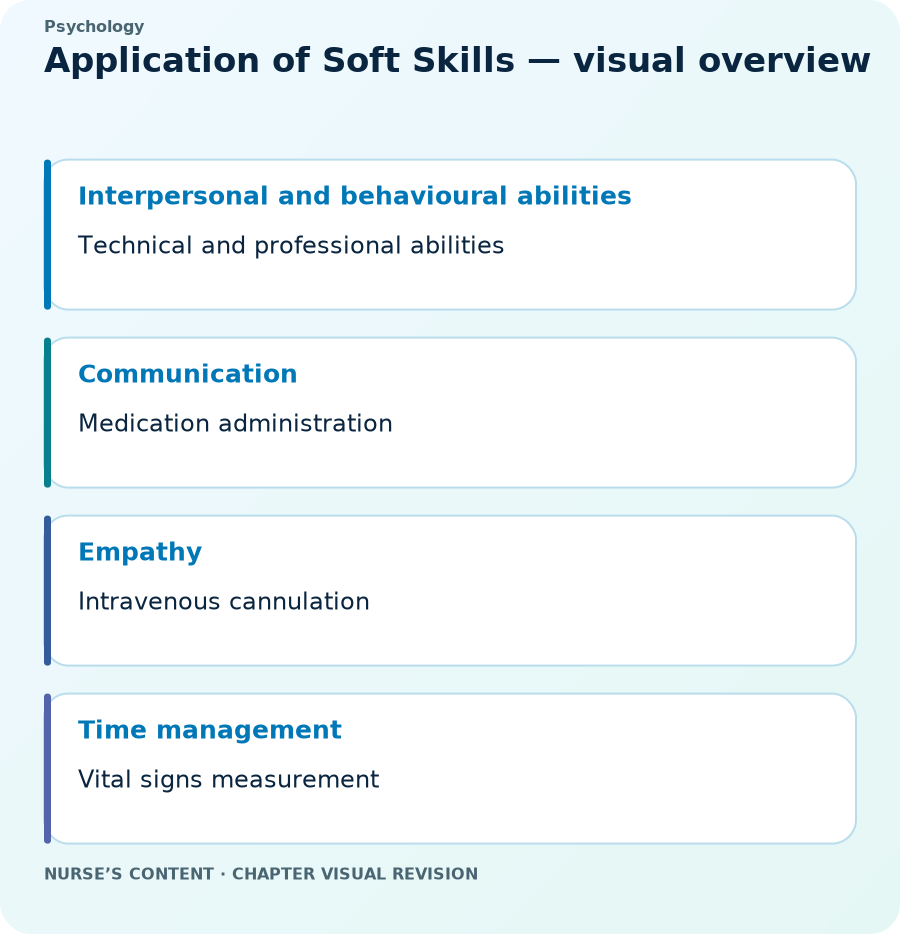
3. Soft Skills vs Hard Skills
| Soft skills | Hard skills |
|---|---|
| Interpersonal and behavioural abilities | Technical and professional abilities |
| Communication | Medication administration |
| Empathy | Intravenous cannulation |
| Teamwork | Wound dressing |
| Leadership | Catheterization |
| Time management | Vital signs measurement |
| Emotional intelligence | Clinical procedures |
Both are essential for competent nursing practice.
4. Types of Soft Skills
- Communication skills
- Visual communication skills
- Aural and listening skills
- Interpersonal skills
- Leadership skills
- Teamwork
- Time management
- Stress management
- Critical thinking
- Problem-solving
- Adaptability
- Emotional intelligence
- Presentation skills
- Professional etiquette
5. Communication Skills
Definition
Communication is the process of exchanging information, ideas, thoughts and feelings between individuals.
Elements of Communication
- Sender
- Message
- Encoding
- Communication channel
- Receiver
- Decoding
- Feedback
- Noise or interference
Communication Process
Sender → Encoding → Message → Channel → Receiver → Decoding → Feedback.
6. Types of Communication
Verbal Communication
Communication through spoken words.
Examples:
- Patient interviews
- Health education
- Nursing handovers
- Clinical discussions
Non-Verbal Communication
Communication through behaviours and expressions.
Examples:
- Facial expressions
- Gestures
- Eye contact
- Posture
- Body movements
- Tone of voice
Non-verbal behaviours should be interpreted with consideration of cultural and individual differences.
Written Communication
Exchange of information through written or digital records.
Examples:
- Nursing documentation
- Patient reports
- Discharge instructions
- Professional emails
Visual Communication
Exchange of information using visual materials.
Examples:
- Posters
- Charts
- Diagrams
- Educational presentations
- Patient instruction cards
Aural Communication
Communication involving listening to and interpreting spoken or auditory information.
Examples:
- Listening to patient concerns.
- Receiving clinical handovers.
- Understanding verbal instructions.
- Recognizing changes in tone.
7. Principles of Effective Communication
Seven Cs of Communication
| Principle | Meaning |
|---|---|
| Clear | Easy to understand |
| Concise | Avoid unnecessary information |
| Concrete | Specific and factual |
| Correct | Accurate information |
| Coherent | Logically organized |
| Complete | Includes essential details |
| Courteous | Respectful and professional |
Additional Principles in Nursing
- Maintain privacy.
- Use accessible language.
- Verify understanding.
- Listen without unnecessary interruption.
- Respect cultural differences.
- Document important clinical information.
8. Communication Styles
| Style | Characteristics |
|---|---|
| Passive | Difficulty expressing personal needs or concerns |
| Aggressive | Expresses demands while disregarding others' rights |
| Passive-aggressive | Expresses dissatisfaction indirectly |
| Assertive | Expresses needs and concerns clearly while respecting others |
Assertive communication is particularly important for patient advocacy and clinical safety.
9. Therapeutic Communication
Therapeutic communication is purposeful professional communication that promotes patient well-being and understanding.
Therapeutic Communication Techniques
| Technique | Example |
|---|---|
| Active listening | Providing full attention to the patient's concerns |
| Open-ended questions | Asking how the patient feels about treatment |
| Clarification | Confirming the meaning of a statement |
| Reflection | Encouraging the patient to identify feelings |
| Restating | Repeating relevant information to confirm understanding |
| Therapeutic silence | Allowing time for thought and emotional expression |
| Summarizing | Reviewing important points |
| Providing information | Explaining a procedure accurately |
| Empathy | Acknowledging the patient's emotional experience |
Non-Therapeutic Communication
- False reassurance
- Unnecessary criticism
- Judgmental statements
- Giving unsolicited personal advice
- Interrupting repeatedly
- Dismissing patient concerns
- Arguing
- Making unrealistic promises
10. Barriers to Communication
Physical Barriers
- Noise
- Poor lighting
- Distance
- Lack of privacy
Psychological Barriers
- Anxiety
- Fear
- Anger
- Prejudice
- Emotional distress
Language Barriers
- Different languages
- Medical terminology
- Limited literacy
- Unclear instructions
Physiological Barriers
- Hearing impairment
- Visual impairment
- Speech difficulties
- Cognitive impairment
Cultural Barriers
- Differences in beliefs
- Social customs
- Communication preferences
Strategies to Overcome Barriers
- Use simple language.
- Provide qualified interpreters when needed.
- Maintain privacy.
- Reduce environmental distractions.
- Use accessible communication aids.
- Confirm understanding.
- Respect cultural differences.
- Encourage clarification and feedback.
11. Interpersonal Relationships (IPR)
Definition
An interpersonal relationship is a social or emotional connection established between two or more individuals through communication and interaction.
Types of Interpersonal Relationships
- Family relationships
- Friendships
- Professional relationships
- Nurse–patient relationships
- Nurse–nurse relationships
- Nurse–physician relationships
- Community relationships
Purposes of Interpersonal Relationships
- Promote effective communication.
- Establish trust.
- Provide emotional support.
- Encourage cooperation.
- Improve teamwork.
- Facilitate problem-solving.
- Support psychological well-being.
Essential Interpersonal Skills
- Empathy
- Active listening
- Respect
- Cooperation
- Assertiveness
- Emotional regulation
- Negotiation
- Conflict resolution
12. Nurse–Patient Relationship
A nurse–patient relationship is a professional therapeutic relationship established to support the patient's health and well-being.
Phases of the Therapeutic Relationship
| Phase | Activities |
|---|---|
| Pre-interaction | Review information and prepare for patient contact |
| Orientation | Establish trust, define roles and identify patient needs |
| Working | Implement nursing interventions and address patient concerns |
| Termination | Evaluate outcomes and conclude the therapeutic relationship |
These four phases are commonly taught in nursing. Peplau's original interpersonal relations framework described orientation, identification, exploitation and resolution.
Principles
- Confidentiality
- Trust
- Respect
- Professional boundaries
- Empathy
- Patient autonomy
- Non-discrimination
13. Time Management
Definition
Time management is the effective planning, organization and utilization of available time to achieve objectives.
Importance in Nursing
- Improves clinical efficiency.
- Supports timely patient care.
- Reduces avoidable delays.
- Helps prioritize responsibilities.
- Reduces unnecessary stress.
- Supports work–life balance.
Principles of Time Management
- Establish clear objectives.
- Prioritize tasks.
- Prepare a realistic schedule.
- Avoid unnecessary interruptions.
- Delegate appropriately.
- Complete urgent activities first.
- Review and adjust plans.
14. Eisenhower Priority Matrix
| Category | Action |
|---|---|
| Urgent and important | Complete first |
| Important but not urgent | Schedule |
| Urgent but less important | Delegate appropriately |
| Neither urgent nor important | Reduce or eliminate where possible |
Clinical Prioritization
In healthcare, prioritization must consider:
- Airway, breathing and circulation.
- Immediate safety threats.
- Acute clinical deterioration.
- Time-critical treatment.
- Patient acuity.
- Professional responsibilities.
Clinical emergencies take priority over routine scheduling frameworks.
15. SMART Goals
Effective goals should be:
- S: Specific
- M: Measurable
- A: Achievable
- R: Relevant
- T: Time-bound
16. Stress Management
Stress management involves identifying stressful demands and using appropriate strategies to maintain psychological and physical functioning.
Common Sources of Nursing Stress
- Heavy workload
- Clinical responsibilities
- Night shifts
- Emergencies
- Interpersonal conflicts
- Emotional demands
- Academic pressure
- Inadequate resources
Management Techniques
- Time management
- Appropriate rest
- Physical activity
- Relaxation techniques
- Mindfulness
- Peer support
- Professional supervision
- Constructive coping
- Access to psychological support
Workplace stress also requires organizational measures such as adequate staffing, safe working conditions and supportive leadership.
17. Resilience
Definition
Resilience is the process or capacity of adapting to adversity, recovering from difficulties and maintaining functioning during challenging circumstances.
Characteristics of Resilience
- Flexibility
- Emotional awareness
- Problem-solving ability
- Realistic optimism
- Social support
- Ability to seek assistance
- Capacity to learn from difficulties
Methods to Develop Resilience
- Develop supportive relationships.
- Establish realistic goals.
- Practise emotional regulation.
- Maintain healthy routines.
- Reflect on experiences.
- Seek constructive feedback.
- Access professional help when needed.
Resilience does not mean tolerating unsafe workplaces or suppressing emotional distress.
18. Work–Life Balance
Work–life balance refers to managing professional responsibilities alongside personal needs, relationships, rest and recreation.
Methods
- Maintain reasonable schedules.
- Establish professional boundaries.
- Prioritize sleep.
- Schedule recreational activities.
- Seek support when responsibilities become excessive.
- Use available leave and workplace support appropriately.
19. Teamwork
Definition
Teamwork is the coordinated effort of individuals working together towards a common goal.
Characteristics of Effective Teams
- Shared goals
- Clear responsibilities
- Effective communication
- Mutual respect
- Trust
- Accountability
- Cooperation
- Supportive leadership
Tuckman's Stages of Team Development
| Stage | Description |
|---|---|
| Forming | Team members become familiar with one another |
| Storming | Differences and conflicts may emerge |
| Norming | Shared expectations and cooperation develop |
| Performing | Team works effectively towards objectives |
| Adjourning | Team completes its purpose and concludes activities |
Teams do not always progress through these stages in a fixed sequence.
20. SBAR Communication
SBAR is a structured communication technique used to exchange important clinical information.
| Component | Meaning |
|---|---|
| S – Situation | Current problem |
| B – Background | Relevant clinical history |
| A – Assessment | Current assessment findings |
| R – Recommendation | Required action or recommendation |
Example
Situation: The patient has developed sudden breathlessness.
Background: The patient was admitted with pneumonia.
Assessment: Oxygen saturation has decreased, and respiratory effort has increased.
Recommendation: Request urgent clinical assessment and activate the appropriate escalation pathway.
21. Closed-Loop Communication
Closed-loop communication confirms that important instructions or information have been received and understood.
Process
Sender communicates → Receiver repeats or confirms → Sender verifies accuracy.
This helps reduce misunderstanding during emergencies, clinical procedures and multidisciplinary care.
Teach-Back Method
The patient explains healthcare instructions in their own words to demonstrate how clearly the information was communicated.
Teach-back assesses communication effectiveness rather than testing or blaming the patient.
22. Presentation Skills
Presentation skills involve organizing and communicating information clearly to an audience.
Steps of an Effective Presentation
- Define the objective.
- Identify the audience.
- Collect accurate information.
- Organize the content.
- Prepare suitable visual aids.
- Practise delivery.
- Maintain clear speech.
- Encourage relevant questions.
- Summarize key points.
Qualities of a Good Presenter
- Confidence
- Clear pronunciation
- Accurate knowledge
- Good organization
- Appropriate body language
- Time management
- Audience awareness
23. Motivational Skills
Motivational skills help individuals encourage engagement, confidence and goal-directed behaviour.
Important Techniques
- Set achievable goals.
- Provide constructive feedback.
- Recognize progress.
- Encourage participation.
- Understand barriers.
- Support autonomy.
- Demonstrate professional role modelling.
24. Professional Etiquette
Professional etiquette refers to standards of respectful and appropriate conduct in professional settings.
Nursing Professional Etiquette
- Maintain punctuality.
- Wear the prescribed professional uniform.
- Maintain personal hygiene.
- Communicate respectfully.
- Address patients appropriately.
- Respect confidentiality.
- Avoid gossip.
- Maintain professional boundaries.
- Demonstrate accountability.
- Follow institutional policies.
25. Telephone Etiquette
- Identify yourself and your department.
- Verify the identity of the intended recipient.
- Speak clearly and professionally.
- Protect confidential information.
- Record important details.
- Confirm critical information.
- Follow institutional policy for telephone orders.
- End the conversation respectfully.
26. Digital and Social Etiquette
- Use professional language.
- Protect patient information.
- Avoid unauthorized patient photographs.
- Do not disclose confidential clinical information online.
- Verify information before sharing it.
- Maintain appropriate professional boundaries.
- Follow organizational social media policies.
27. Application of Soft Skills in Nursing
| Soft skill | Nursing application |
|---|---|
| Communication | Patient education and handover |
| Empathy | Emotional support |
| Teamwork | Multidisciplinary patient care |
| Time management | Prioritization of responsibilities |
| Leadership | Coordination of nursing activities |
| Assertiveness | Patient advocacy and safety |
| Resilience | Managing professional challenges |
| Critical thinking | Clinical judgment |
| Adaptability | Responding to changing patient needs |
| Presentation skills | Health education and academic presentations |
28. Important Examination Questions
Long Answer Questions
- Define soft skills and discuss their importance in nursing.
- Explain the communication process, types and barriers.
- Describe interpersonal relationships and their application in nursing.
- Discuss time management, stress management and resilience.
- Explain teamwork and professional etiquette.
Short Answer Questions
- Seven Cs of communication
- Therapeutic communication
- Assertiveness
- Nurse–patient relationship
- SMART goals
- Time management
- Resilience
- SBAR communication
- Presentation skills
- Telephone etiquette
- Work–life balance
29. Quick Revision
- Soft skills are interpersonal and behavioural abilities.
- Communication includes sender, message, receiver and feedback.
- Assertive communication respects both personal and others' rights.
- Therapeutic communication supports patient well-being.
- SBAR: Situation, Background, Assessment, Recommendation.
- SMART: Specific, Measurable, Achievable, Relevant, Time-bound.
- Resilience involves adaptation to adversity.
- Effective teamwork improves coordination and patient safety.
- Professional etiquette supports accountability and ethical conduct.
Conclusion
Soft skills are essential for competent and professional nursing practice. Effective communication, interpersonal relationships, teamwork, resilience and time management improve patient safety, professional performance and healthcare outcomes.
Chapter reference images