Pharmacology
Nursing Responsibilities in Drug Administration
Medication rights, prescription verification, patient identification, medication preparation, administration, monitoring, documentation, patient education and prevention of medication errors.
Open quizzes and study tools Download PDF
CHAPTER 25 / PHARMACOLOGY 25. Nursing Responsibilities in Drug Administration
1. Introduction
Medication administration is a continuous process of assessment, prescription verification, preparation, delivery, monitoring, education and documentation. The nurse plays a major role in identifying errors before medicines reach the patient and recognizing adverse responses after administration. Safe practice depends on both individual competence and reliable systems.
2. Medication administration rights
| Right | Application in clinical practice |
|---|---|
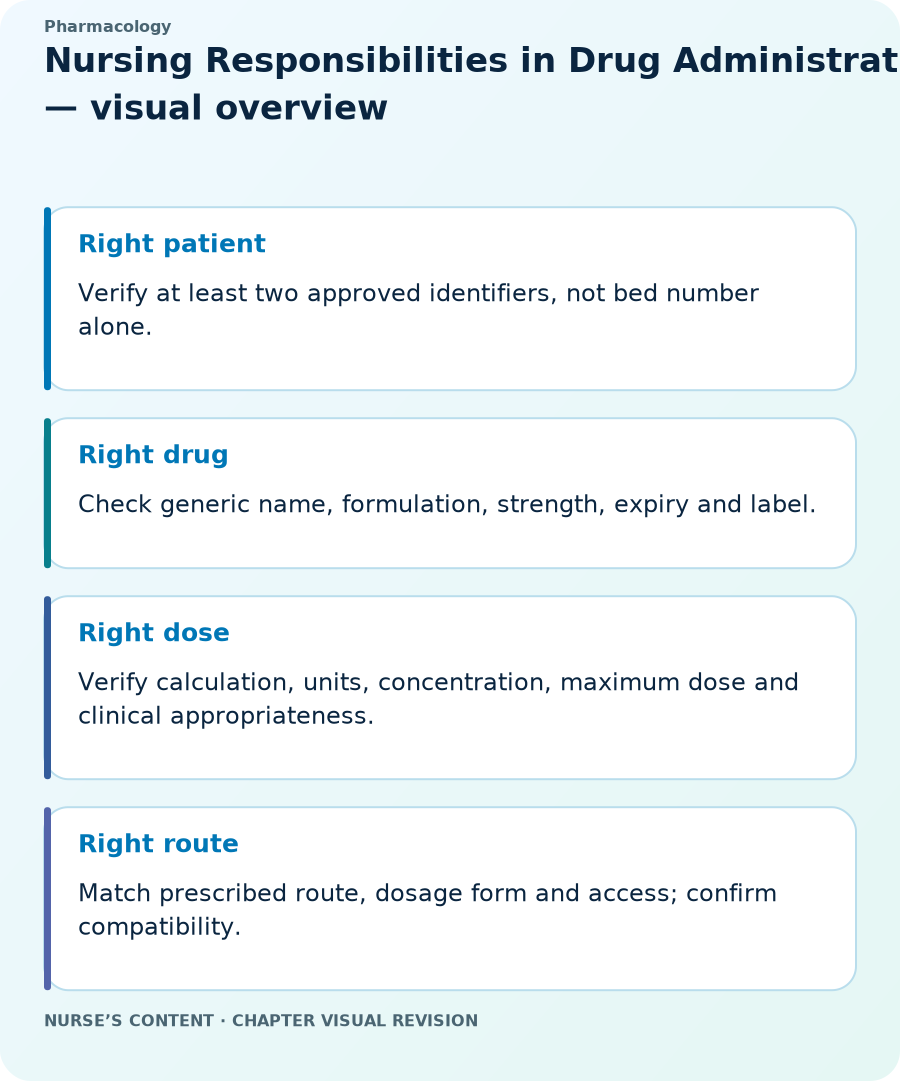
| Right patient | Verify at least two approved identifiers, not bed number alone. |
| Right drug | Check generic name, formulation, strength, expiry and label. |
| Right dose | Verify calculation, units, concentration, maximum dose and clinical appropriateness. |
| Right route | Match prescribed route, dosage form and access; confirm compatibility. |
| Right time | Check frequency, last dose, time-critical medicines, meal timing and monitoring. |
| Right documentation | Record actual administration, not planned or assumed administration. |
| Right reason | Understand indication and treatment goal. |
| Right assessment | Check relevant allergies, vital signs, laboratory tests and patient status. |
| Right education | Explain purpose, benefits, precautions and expected response. |
| Right evaluation | Monitor therapeutic and adverse outcomes; act on findings. |
Respect refusal, assess concerns and escalate/document as appropriate. Medication rights are a teaching framework, not a guarantee of safety; institutional policies may use additional rights.
3. Prescription verification and reconciliation
A clear order includes patient identity, medicine, strength or dose, route, frequency/timing, indication for PRN and authorized prescriber information. Infusions need relevant concentration, rate and titration parameters. Verify date/time and applicable duration. Clarify illegible, incomplete, conflicting or inappropriate orders before administration; use appropriate read-back for authorized verbal orders. Medication reconciliation compares the best available medication history with current orders at admission, transfer and discharge, resolving discrepancies collaboratively. Include OTC medicines, supplements and traditional products.
4. Preparation and infection prevention
- 1. Review order, indication, allergy and current assessment.
- 2. Perform hand hygiene and prepare in a suitable clean area.
- 3. Check label when selecting, preparing and returning/discarding the product according to policy.
- 4. Confirm expiry, integrity, concentration, diluent, stability, compatibility and calculations.
- 5. Label syringes, containers and infusions immediately according to approved practice.
- 6. Perform independent double checks for designated high-alert medicines; avoid group confirmation that bypasses independent review.
- 7. Use sterile single-use needle and syringe for each injection. Never reuse a syringe for another patient, including when the needle is changed [15].
5. Administration and monitoring
Explain the procedure and ensure appropriate privacy and consent. Assess ability to swallow, access patency and correct position. Administer using the authorized technique and device; confirm pump settings against prescription, line tracing and concentration. Monitor relevant clinical outcomes: for example, BP and pulse after selected cardiovascular drugs, glucose with insulin, respiratory rate and sedation after opioids, bleeding with anticoagulants, and infusion site with IV vesicants. Report significant abnormalities and reassess after intervention.
6. High-alert and look-alike/sound-alike medicines
High-alert medicines carry an increased risk of serious harm when errors occur. Examples include insulin, opioids, anticoagulants, neuromuscular blockers, chemotherapy, concentrated electrolytes and IV vasopressors [16]. Safeguards include standardized concentrations, restricted storage, clear labels, pharmacy preparation when indicated, appropriate pump libraries and independent verification. Look-alike/sound-alike (LASA) risks may involve drug names, packaging or strengths. Use separated storage, readable labels and verification of the active ingredient. Do not rely solely on colour or packaging.
7. Documentation and reporting
Document the medicine, actual dose, route/site where required, date/time, relevant assessment, response, omissions/refusals, communication and your identification. For PRN medicine, record indication and reassessment. Never sign before administration. Correct errors according to record policy without obscuring the original entry. Maintain confidentiality and use approved electronic systems. When a medication error occurs, assess harm immediately, ensure clinical care, inform the responsible team, document the facts and submit a safety report. Report suspected ADRs through the pharmacovigilance pathway as appropriate [2].
8. Patient education and discharge safety
Explain the medicine's generic name, purpose, prescribed dose, schedule, technique, storage, missed-dose advice specific to the product, expected effects and warning symptoms. Confirm comprehension using teach-back. Explain when a follow-up test is required. Provide an updated medicine list at transitions of care and address affordability, literacy, device use and access. Do not advise patients to independently stop or double doses; contact the responsible care team for uncertainties.
9. Practical medication administration checklist
| Stage | Essential actions |
|---|---|
| Before | Identify patient; verify order and allergies; assess relevant observations; calculate and check; prepare and label. |
| During | Explain; confirm route/site; maintain asepsis; use appropriate technique and infusion device; observe patient. |
| After | Dispose safely; monitor response; document actual administration; provide education; report abnormalities. |
Clinical example: A prescription for methotrexate in rheumatoid arthritis is written as a daily dose. Because the usual inflammatory arthritis schedule is weekly, the nurse stops the preparation process and clarifies the order with the prescriber and pharmacist before administration. This prevents a potentially severe overdose and should be reported as a near miss through the appropriate system.
10. Examination questions
Long answer questions
- 1. Explain medication rights and responsibilities before, during and after administration.
- 2. Discuss prevention and management of medication errors.
- 3. Describe prescription verification, documentation and patient education.
Short answer questions
- • Medication reconciliation; high-alert drugs; LASA medicines; teach-back; independent double checks; ADR reporting.
Very short answer questions
- • How many approved identifiers should generally be used? — At least two.
- • Should a nurse document administration before it occurs? — No.
- • What is a near miss? — An error intercepted before reaching the patient.
11. Quick revision
Verify patient, drug, dose, route, timing and clinical context. Clarify doubtful orders. Use aseptic technique, correct concentration and approved high-alert safeguards. Monitor and document actual response. Report errors and suspected ADRs without delay.
Conclusion
Medication safety is a shared professional responsibility. Accurate assessment, verification, clinical monitoring, education and transparent reporting are essential to protect patients from preventable harm.
Chapter reference images