Pharmacology
Anaesthetic Drugs
General anaesthetics, local anaesthetics, regional anaesthesia, pre-anaesthetic medications, muscle relaxants and postoperative considerations.
Open quizzes and study tools Download PDF
CHAPTER 24 / PHARMACOLOGY 24. Anaesthetic Drugs
1. Introduction
Anaesthesia is a controlled reduction or loss of sensation, sometimes with unconsciousness, to enable procedures. General anaesthesia, regional anaesthesia, local anaesthesia and procedural sedation differ in intended depth, physiological effect and monitoring requirements. Sedation can unintentionally deepen and compromise airway or respiration; qualified personnel and rescue capability are essential.
2. Components of general anaesthesia
Balanced anaesthesia may combine hypnosis/unconsciousness, amnesia, analgesia, immobility and suppression of selected autonomic responses. No single drug reliably supplies all components in every situation. Neuromuscular blockade produces immobility but no analgesia, amnesia or unconsciousness.
3. General anaesthetic drugs
| Class / drug | Clinical role and mechanism | Important adverse effects |
|---|---|---|
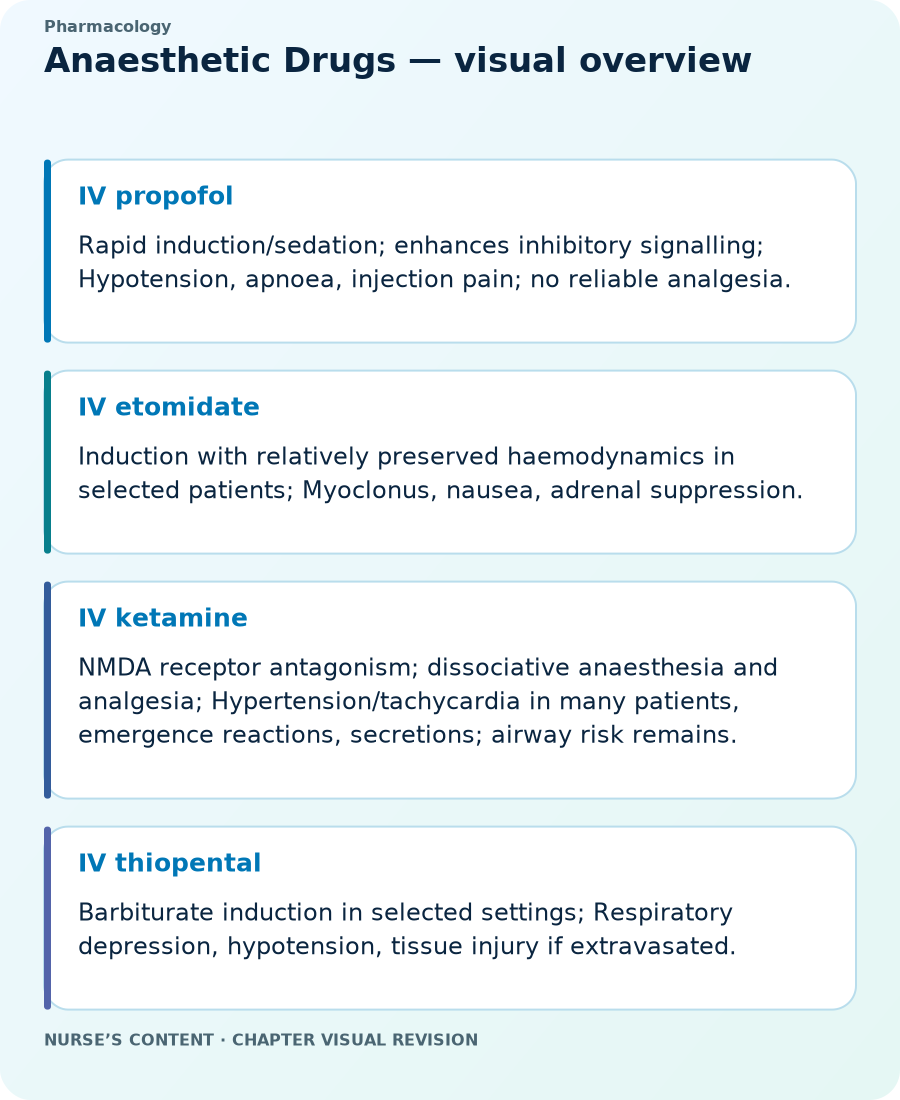
| IV propofol | Rapid induction/sedation; enhances inhibitory signalling | Hypotension, apnoea, injection pain; no reliable analgesia. |
| IV etomidate | Induction with relatively preserved haemodynamics in selected patients | Myoclonus, nausea, adrenal suppression. |
| IV ketamine | NMDA receptor antagonism; dissociative anaesthesia and analgesia | Hypertension/tachycardia in many patients, emergence reactions, secretions; airway risk remains. |
| IV thiopental | Barbiturate induction in selected settings | Respiratory depression, hypotension, tissue injury if extravasated. |
| Inhalational sevoflurane, isoflurane, desflurane | Volatile agents used for maintenance/selected induction | Dose-related respiratory and cardiovascular depression; malignant hyperthermia triggers. |
| Nitrous oxide | Inhalational analgesic/anaesthetic adjunct | Expands closed gas spaces; prolonged exposure affects B12-related pathways. |
4. Local and regional anaesthetic drugs
Local anaesthetics reversibly block voltage-gated sodium channels, reducing nerve impulse conduction. Local infiltration acts near the procedure site; nerve blocks target peripheral nerves; spinal and epidural anaesthesia act near the neuraxis through different techniques.
| Class | Examples | Important properties |
|---|---|---|
| Amides | Lidocaine (lignocaine), bupivacaine, ropivacaine, prilocaine | Hepatic metabolism for many agents; bupivacaine cardiovascular toxicity is important. |
| Esters | Procaine, chloroprocaine, tetracaine | Often hydrolysed by plasma esterases; different allergy profiles. |
Onset, duration and maximum dose vary by drug, concentration, route, use of vasoconstrictor, patient mass and condition. There is no universal maximum safe dose for all formulations. Adding adrenaline may reduce local absorption in suitable settings; verify site-specific and clinical precautions. Do not mix local anaesthetics without considering additive toxicity.
5. Regional techniques
| Technique | Description and nursing considerations |
|---|---|
| Local infiltration | Injection near surgical site; monitor allergy, dose and tissue effects. |
| Peripheral nerve block | Injection near selected nerve/plexus; protect insensate limb and monitor motor/sensory recovery. |
| Spinal anaesthesia | Injection into subarachnoid CSF; rapid block, hypotension and block-height monitoring. |
| Epidural anaesthesia | Administration into epidural space, sometimes via catheter; monitor haemodynamics, sensory level and catheter safety. |
Verify anticoagulant timing and neurological risk for neuraxial procedures with the anaesthesia team. New severe back pain, progressive weakness or bladder/bowel dysfunction after neuraxial techniques can indicate serious complications and requires urgent evaluation.
6. Pre-anaesthetic medications
Benzodiazepines may reduce anxiety and provide amnesia; opioids provide analgesia; anticholinergics can reduce secretions or modify vagal responses; selected antiemetics and acid-related medicines reduce specific perioperative risks. Antibiotic prophylaxis may be indicated according to the procedure and timing. Pre-anaesthetic medication does not replace airway evaluation, consent, individualized fasting guidance or review of chronic medicines. Verify perioperative instructions for anticoagulants, diabetes drugs and other high-risk medicines with the authorized team.
7. Neuromuscular blocking agents
| Group | Examples and mechanism | Main risks / reversal |
|---|---|---|
| Depolarizing | Succinylcholine (suxamethonium); persistent depolarization at neuromuscular junction | Hyperkalaemia in susceptible states, malignant hyperthermia, prolonged apnoea. |
| Nondepolarizing | Rocuronium, vecuronium, atracurium; competitive nicotinic receptor antagonism | Paralysis and residual block; specialized monitoring and reversal. |
Neostigmine increases acetylcholine and can reverse selected nondepolarizing blocks with appropriate antimuscarinic coadministration. Sugammadex binds rocuronium and vecuronium under indicated conditions. Confirm adequate neuromuscular recovery and ventilation before extubation decisions. These drugs must never be administered without airway, ventilation and appropriate anaesthesia capability.
8. Major anaesthetic emergencies
Local anaesthetic systemic toxicity (LAST): May present with circumoral numbness, tinnitus, metallic taste, seizures, altered consciousness, hypotension or arrhythmias; presentations vary and early symptoms may be absent. Stop local anaesthetic administration, call for help, support airway and circulation and use the specialist LAST checklist, including lipid emulsion when indicated [14].
Malignant hyperthermia: Susceptible patients may develop hypermetabolism after triggering volatile anaesthetics or succinylcholine. Rising end-tidal CO2, tachycardia, rigidity and later
hyperthermia are concerning. Stop triggering agents, activate the emergency protocol and administer dantrolene under direction, with intensive monitoring and supportive care.
9. Perioperative nursing responsibilities
Before anaesthesia, verify identity, procedure, allergies, fasting status, baseline observations, medicines, consent and access. During care, support monitoring and sterile/aseptic practice within role, and communicate changes promptly. After anaesthesia, assess airway, ventilation, oxygenation, circulation, consciousness, pain, nausea, temperature and surgical site. Monitor residual sedation, respiratory depression and block recovery. Use institutional discharge criteria and document handover. An unconscious patient must not receive oral intake until safe swallowing and appropriate readiness are established.
10. Examination questions
Long answer questions
- 1. Classify general and local anaesthetics with mechanisms and adverse effects.
- 2. Explain neuromuscular blocking agents and perioperative nursing responsibilities.
- 3. Discuss regional anaesthetic techniques and major complications.
Short answer questions
- • Propofol; ketamine; lidocaine; spinal versus epidural; succinylcholine; LAST; malignant hyperthermia.
Very short answer questions
- • Main target of local anaesthetic action? — Voltage-gated sodium channels.
- • Specific drug used to treat malignant hyperthermia? — Dantrolene.
- • Do neuromuscular blockers provide unconsciousness? — No.
11. Quick revision
General anaesthesia can combine hypnosis, analgesia and other components. Local anaesthetics block sodium channels. Neuromuscular blockers cause paralysis only. Regional blocks require monitoring for haemodynamic and neurological complications.
Conclusion
Anaesthetic medicines require specialist administration, reliable physiological monitoring, airway rescue capability and structured postoperative nursing care.
Chapter reference images