Pharmacology
Anticancer and Immunosuppressive Drugs
Antineoplastic drugs, chemotherapy principles, immunosuppressive agents, adverse effects and nursing care during treatment.
Open quizzes and study tools Download PDF
CHAPTER 21 / PHARMACOLOGY 21. Anticancer and Immunosuppressive Drugs
1. Introduction
Antineoplastic medicines aim to destroy malignant cells, inhibit their growth or interfere with specific tumour pathways. Treatment may be curative, adjuvant (after primary treatment), neoadjuvant (before primary treatment), disease-controlling or palliative. Drug selection is based on cancer type, stage, molecular markers, previous treatment, organ function and patient goals. Cytotoxic chemotherapy also damages rapidly dividing normal cells, particularly bone marrow, gastrointestinal mucosa and hair follicles.
2. Classification of cytotoxic chemotherapy
| Class / examples | Mechanism | Characteristic toxicities |
|---|---|---|
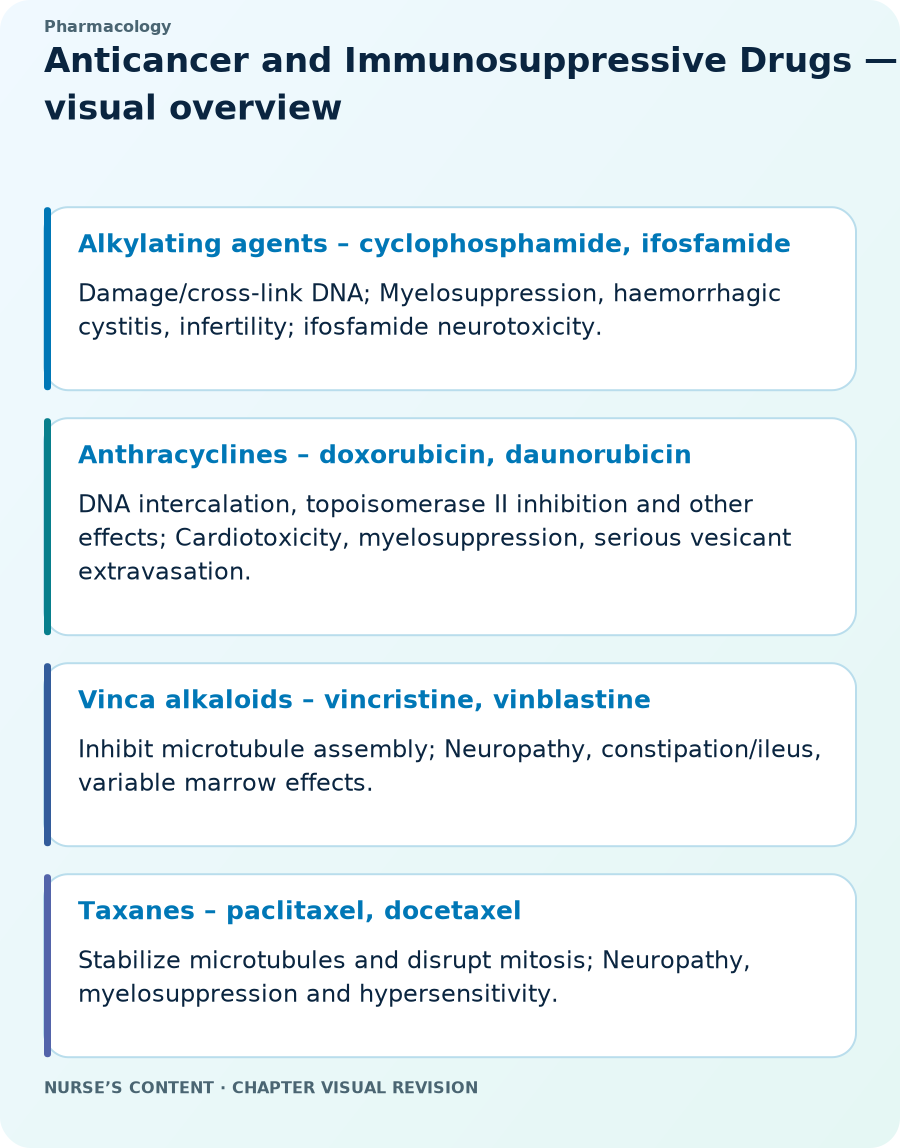
| Alkylating agents – cyclophosphamide, ifosfamide | Damage/cross-link DNA | Myelosuppression, haemorrhagic cystitis, infertility; ifosfamide neurotoxicity. |
| Platinum compounds – cisplatin, carboplatin, oxaliplatin | DNA cross-linking | Cisplatin renal/ear toxicity; carboplatin marrow suppression; oxaliplatin neuropathy. |
| Antimetabolites – methotrexate, fluorouracil, cytarabine | Interfere with nucleotide synthesis or DNA replication | Mucositis, marrow suppression, agent-specific hepatic or neurological injury. |
| Anthracyclines – doxorubicin, daunorubicin | DNA intercalation, topoisomerase II inhibition and other effects | Cardiotoxicity, myelosuppression, serious vesicant extravasation. |
| Vinca alkaloids – vincristine, vinblastine | Inhibit microtubule assembly | Neuropathy, constipation/ileus, variable marrow effects. |
| Taxanes – paclitaxel, docetaxel | Stabilize microtubules and disrupt mitosis | Neuropathy, myelosuppression and hypersensitivity. |
| Topoisomerase inhibitors – etoposide, irinotecan | Interfere with DNA strand processing | Marrow suppression; irinotecan can cause severe diarrhoea. |
Bleomycin may cause pulmonary toxicity, while many other agents have cumulative organ-specific risks. Do not assume every chemotherapy drug produces the same pattern of adverse effects.
3. Targeted, hormonal and immunological cancer therapy
| Group | Example and action | Important nursing considerations |
|---|---|---|
| Endocrine therapy | Tamoxifen, aromatase inhibitors; hormone-sensitive cancers | Thrombosis/endometrial effects or bone loss; agent-specific monitoring. |
| Tyrosine kinase inhibitors | Imatinib and others; inhibit selected signalling pathways | Drug-specific hepatic, skin, cardiac and haematological effects. |
| HER2-targeting antibody | Trastuzumab | Monitor cardiac function and infusion reactions. |
| Anti-CD20 antibody | Rituximab | Infusion reactions, infection, hepatitis B reactivation risk. |
| Immune checkpoint inhibitors | Pembrolizumab, nivolumab; PD-1 blockade | Immune-related pneumonitis, colitis, hepatitis, endocrinopathies and other organ inflammation. |
Targeted therapy is not free of toxicity. Immune-related adverse events may occur during or after immunotherapy and require early reporting. Molecular testing may determine eligibility.
4. Principles of chemotherapy and supportive treatment
Many regimens are given in planned cycles to allow recovery of normal tissues. Dose intensity, sequence, route and timing depend on the authorized protocol. Some regimens use BSA or body-weight calculations; renal, hepatic and marrow status may require specialist modifications. Assess treatment intent and consent, verify laboratory eligibility and confirm the current cycle/day. Antiemetics, hydration, growth factors and other supportive medicines may be prescribed. Mesna reduces urothelial exposure to selected toxic metabolites; leucovorin rescue is used in selected methotrexate protocols. These supportive agents have exact timing and indication requirements.
5. Common toxicities and nursing management
| Toxicity | Nursing assessment and intervention |
|---|---|
| Myelosuppression | Monitor CBC and infection/bleeding signs; fever during neutropenia is an emergency. |
| Mucositis | Assess oral mucosa, pain and intake; gentle oral care and prescribed symptom relief. |
| Nausea and vomiting | Administer prophylaxis as ordered; monitor hydration and electrolytes. |
| Peripheral neuropathy | Assess sensation, gait, fine motor function and fall risk. |
| Extravasation | Stop infusion; do not flush; retain access for approved aspiration or antidote pathway; contact oncology team. |
| Tumour lysis syndrome | Monitor urate, potassium, phosphate, calcium and renal function; urgent management for abnormalities. |
6. Immunosuppressive drugs
| Class | Examples | Major monitoring |
|---|---|---|
| Calcineurin inhibitors | Tacrolimus, ciclosporin | Drug levels, kidney function, potassium, BP, interactions. |
| Antimetabolites | Azathioprine, mycophenolate | CBC, hepatic function, infection; reproductive safety and interactions. |
| mTOR inhibitors | Sirolimus, everolimus | Lipids, marrow counts, wound healing, interactions. |
| Glucocorticoids | Prednisolone, methylprednisolone | Glucose, infection, bone and adrenal effects. |
| Biologics | Selected monoclonal antibodies and fusion proteins | Infection screening, infusion monitoring, agent-specific risks. |
Immunosuppressants are used for transplant rejection prevention and autoimmune diseases. Tacrolimus formulations are not automatically interchangeable. Severe infections may require treatment review, but transplant medicines must not be stopped without urgent specialist guidance. Live vaccines may be unsuitable during significant immunosuppression.
7. Occupational and administration safety
Hazardous medicines require trained personnel, appropriate engineering controls, protective equipment, dedicated handling procedures, safe spill management and disposal [13]. Verify exact route and formulation: vincristine is for IV use only; intrathecal administration is fatal. Follow institutional segregation and route safeguards. Check identity, protocol, BSA/weight, dose, cycle, access, infusion rate, compatibility and required independent verification. Monitor infusion reactions and never administer chemotherapy outside an authorized specialist process.
8. Examination questions
Long answer questions
- 1. Classify antineoplastic drugs and explain their mechanisms and adverse effects.
- 2. Describe chemotherapy nursing care and prevention of occupational exposure.
- 3. Discuss immunosuppressive agents with monitoring requirements.
Short answer questions
- • Myelosuppression; vesicant extravasation; tumour lysis syndrome; anthracycline cardiotoxicity; tacrolimus; checkpoint inhibitors.
Very short answer questions
- • Which drug must never be given intrathecally? — Vincristine.
- • Main concern with fever during neutropenia? — Serious infection requiring urgent assessment.
- • Name a calcineurin inhibitor. — Tacrolimus.
9. Quick revision
Cytotoxic and targeted drugs have different mechanisms and toxicities. Check protocol, cycle, route, counts and organ function. Neutropenic fever and vesicant extravasation demand immediate escalation. Immunosuppression increases infection risk.
Conclusion
Oncology nursing combines protocol verification, close monitoring, patient education, hazard control and rapid response to potentially life-threatening treatment complications.
Chapter reference images