Pharmacology
Immunological and Biological Preparations
Vaccines, immunoglobulins, sera, immunosuppressants, immunostimulants and principles of immunisation.
Open quizzes and study tools Download PDF
CHAPTER 19 / PHARMACOLOGY 19. Immunological and Biological Preparations
1. Introduction
Immunological preparations induce, supply, stimulate or suppress immune responses. Biological medicines include products such as vaccines, antibodies, recombinant proteins and selected cell-derived therapies. Their storage, handling and adverse-effect profiles may differ from small-molecule drugs.
2. Types of immunity
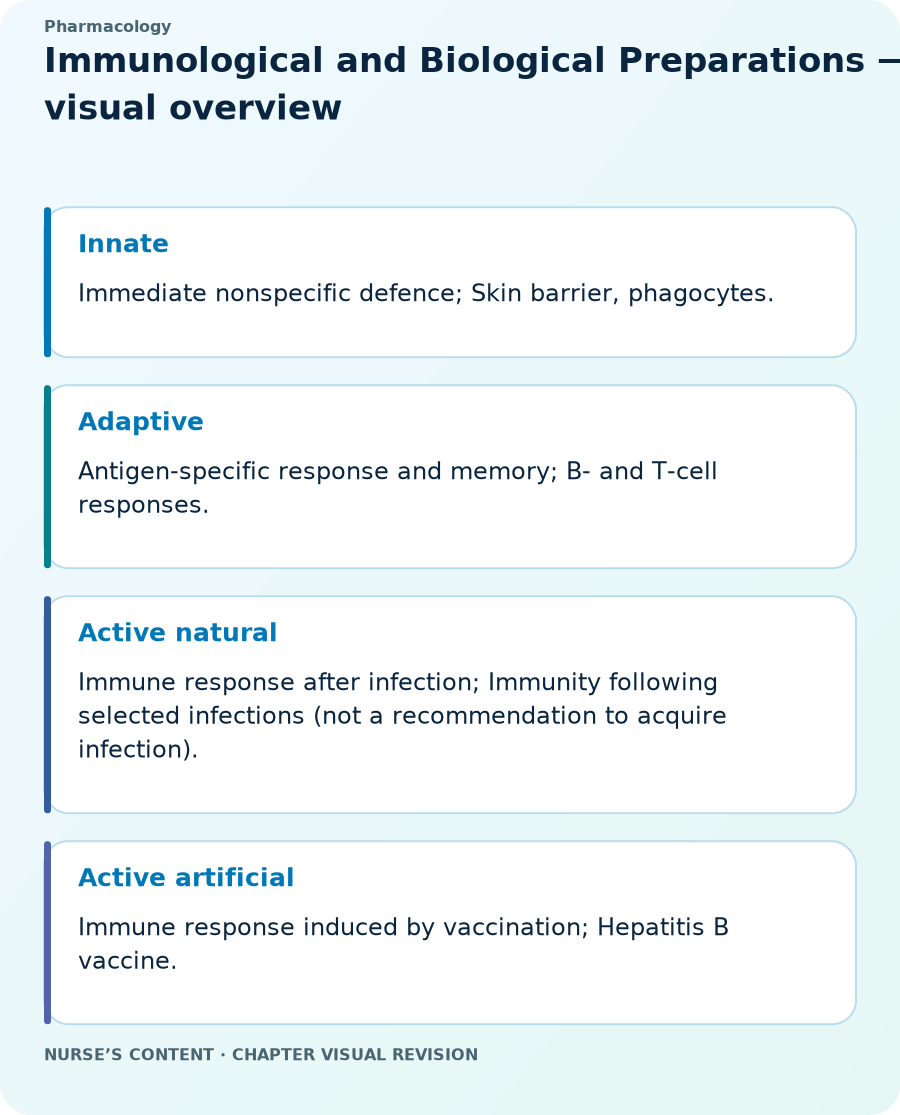
| Type | Description | Example |
|---|---|---|
| Innate | Immediate nonspecific defence | Skin barrier, phagocytes. |
| Adaptive | Antigen-specific response and memory | B- and T-cell responses. |
| Active natural | Immune response after infection | Immunity following selected infections (not a recommendation to acquire infection). |
| Active artificial | Immune response induced by vaccination | Hepatitis B vaccine. |
| Passive natural | Transfer of maternal antibodies | Placental IgG transfer. |
| Passive artificial | Administration of preformed antibodies | Rabies immunoglobulin. |
Active immunity usually develops over time and may establish memory. Passive immunity is more immediate but generally temporary and does not itself establish the same memory response.
3. Vaccines and classification
| Vaccine type | Examples | Characteristics |
|---|---|---|
| Live attenuated | BCG, MMR, oral polio in relevant programmes | Weakened organisms; induce immune response; special pregnancy and immunocompromise precautions. |
| Inactivated | IPV, inactivated hepatitis A | Nonreplicating pathogen components; may need repeated doses. |
| Toxoid | Tetanus, diphtheria | Inactivated toxin induces antitoxin immunity. |
| Subunit / recombinant | Hepatitis B, HPV | Selected antigen components. |
| Conjugate | Hib, pneumococcal conjugate vaccine | Polysaccharide linked to carrier protein improves immune response. |
| Viral vector / mRNA | Selected modern vaccines | Deliver genetic instructions or antigen via defined platform; product-specific indications. |
4. Principles of immunisation
Use the current national schedule, approved product, patient age, medical eligibility, interval and route/site. A delayed series usually does not require restarting, but follow specific schedule guidance. Screen for serious allergy to prior dose or components and relevant immunosuppression. Mild illness is not generally a reason for unnecessary deferral. Live vaccines require special assessment during pregnancy and significant immunosuppression; contraindications are product-specific. Explain benefits and potential reactions and obtain appropriate consent.
5. Vaccine storage and administration
Many routinely used vaccines are stored at +2 to +8°C, but requirements vary by product and stage of distribution. Some are freeze-sensitive; others have different temperature and light requirements. Use temperature-monitored equipment, protect from inappropriate freezing or heat, check expiry and vaccine vial monitor where applicable. During a temperature excursion, quarantine affected stock, label it not for use and obtain authorized guidance; do not automatically discard or use it. Use only supplied/authorized diluent and observe reconstitution and open-vial policies. Storage guidance should follow India's UIP and product instructions [11].
Nursing care after vaccination
Record patient details, product, batch, dose, route/site, time and vaccinator according to programme. Give a return date and expected reaction advice. Observe according to protocol and maintain emergency preparedness. An adverse event following immunisation (AEFI) is an event after vaccination, not proof that the vaccine caused it. Report serious or relevant events promptly; assess and manage anaphylaxis immediately if suspected.
6. Immunoglobulins, antisera and antitoxins
| Preparation | Role | Precautions |
|---|---|---|
| Human normal immunoglobulin / IVIG | Replacement for selected immune deficiencies or immunomodulation | Infusion reactions, thrombosis, renal injury and haemolysis risks; monitor product rate. |
| Specific immunoglobulins | Rabies, tetanus, hepatitis B immunoglobulin | Selected post-exposure protection; timing and administration are indication-specific. |
| Anti-D immunoglobulin | Prevention of RhD alloimmunisation | Verify eligibility and obstetric/transfusion protocol. |
| Antiserum / antivenom | Antibodies against selected toxins or venoms | Specialist emergency use; anaphylaxis and serum sickness risk. |
Rabies post-exposure care combines appropriate wound care, vaccination and immunoglobulin or indicated monoclonal product for eligible exposures. Infiltration technique and dose depend on approved protocol; do not substitute vaccine for immunoglobulin or vice versa where both are indicated. Severe envenomation needs emergency assessment; not every bite requires antivenom. Never use an unapproved serum product.
7. Immunosuppressants
Glucocorticoids, calcineurin inhibitors (tacrolimus, ciclosporin), antimetabolites (azathioprine, mycophenolate) and selected biological agents reduce immune activity. Uses include transplant rejection prevention and autoimmune conditions. Risks include infection, malignancy, marrow suppression, renal injury or metabolic effects depending on agent. Tacrolimus and ciclosporin require carefully timed levels in relevant settings. Do not stop transplant medicines abruptly. See Chapter 21 for additional classification.
8. Immunostimulants and biological response modifiers
G-CSF (filgrastim) increases neutrophil production in selected settings. Interferons modify immune signalling and have specific antiviral or oncological uses, although many indications now use other therapies. Immune checkpoint inhibitors enhance antitumour responses and can cause immune-related inflammation (Chapter 21). These are not general immunity boosters and should not be used without a defined indication.
9. Examination questions
Long answer questions
- 1. Classify vaccines and explain principles of immunisation, storage and nursing care.
- 2. Discuss immunoglobulins, antisera and immunomodulatory agents.
Short answer questions
- • Active/passive immunity; toxoids; cold chain; AEFI; IVIG; tacrolimus.
Very short answer questions
- • Example of passive artificial immunity? — Rabies immunoglobulin.
- • Example of a toxoid vaccine? — Tetanus toxoid-containing vaccine.
- • Does an AEFI automatically prove vaccine causation? — No.
10. Quick revision
Vaccines induce active immunity; immunoglobulins provide passive protection. Live and inactivated vaccines differ in eligibility. Verify cold-chain requirements for each product. Biological agents require indication-specific reaction monitoring.
Conclusion
Safe immunological pharmacotherapy requires correct product selection, storage, administration, surveillance and informed communication.
Chapter reference images