Pharmacology
Adverse Drug Reactions and Drug Interactions
Side effects, adverse drug reactions, toxicity, allergy, anaphylaxis, contraindications, drug interactions, pharmacovigilance and reporting of medication errors.
Open quizzes and study tools Download PDF
CHAPTER 05 / PHARMACOLOGY 05. Adverse Drug Reactions and Drug Interactions
1. Definition and basic terms
An adverse drug reaction (ADR) is a harmful and unintended response associated with a medicinal product. A side effect is an additional effect related to drug action; it may or may not be harmful. An adverse drug event is harm associated with medication use, including harm from errors. A medication error is a preventable event that may lead to inappropriate use or harm; a near miss is intercepted before reaching the patient.
2. Classification of ADRs
| Type | Meaning | Example |
|---|---|---|
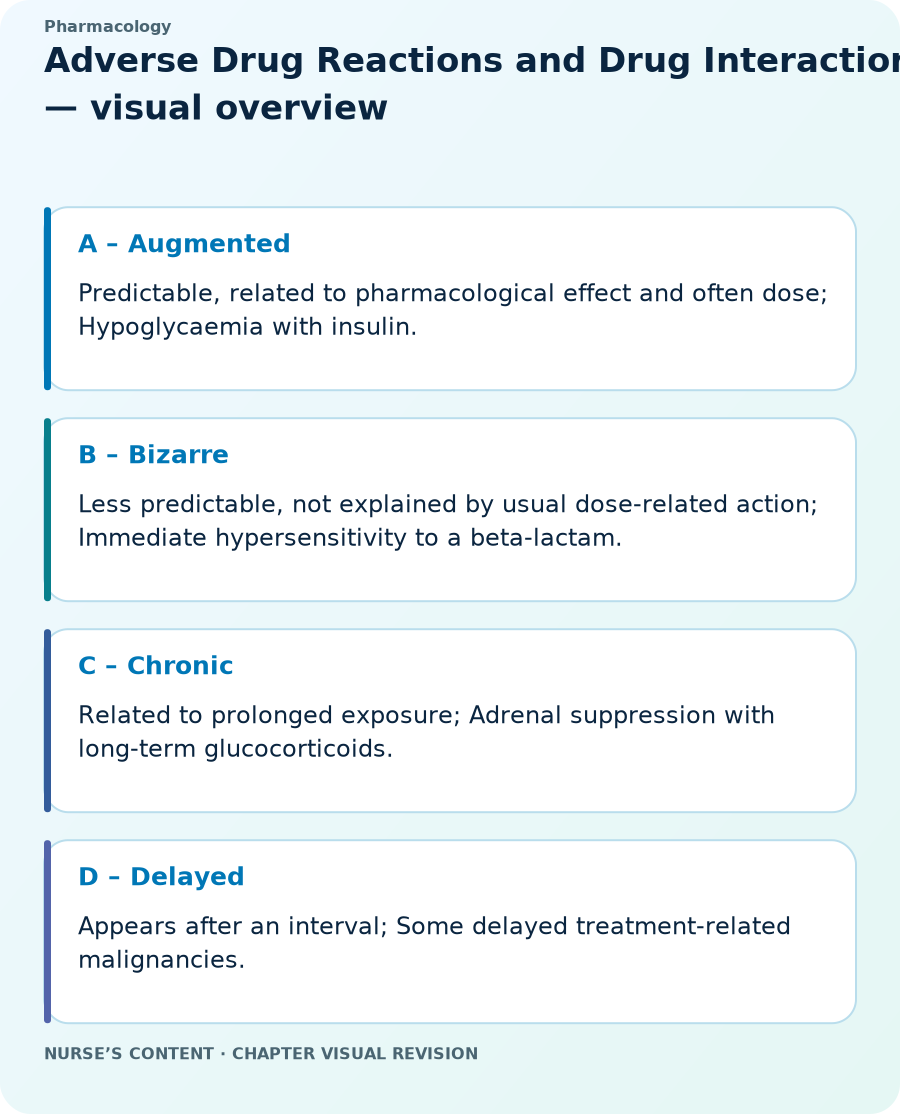
| A – Augmented | Predictable, related to pharmacological effect and often dose | Hypoglycaemia with insulin. |
| B – Bizarre | Less predictable, not explained by usual dose-related action | Immediate hypersensitivity to a beta-lactam. |
| C – Chronic | Related to prolonged exposure | Adrenal suppression with long-term glucocorticoids. |
| D – Delayed | Appears after an interval | Some delayed treatment-related malignancies. |
| E – End-of-use | Related to withdrawal | Rebound symptoms after abrupt discontinuation of selected drugs. |
| F – Failure | Failure of expected therapy | Reduced contraceptive effect with a relevant enzyme inducer. |
Type A–F is an educational system; many reactions do not fit perfectly into one category. Seriousness (death, life-threatening event, hospitalization, disability or other important medical event) differs from symptom severity.
3. Allergy, intolerance, toxicity and contraindications
- • Drug allergy involves immune-mediated hypersensitivity; immediate reactions may involve IgE, while delayed reactions can involve T cells. Record the actual reaction, timing and suspected substance, not just the word allergy.
- • Intolerance is an undesirable response at a usual dose that is not necessarily immune-mediated, such as gastrointestinal upset.
- • Toxicity is a harmful effect related to excessive exposure or individual susceptibility, such as aminoglycoside-associated nephrotoxicity.
- • An absolute contraindication is a situation in which a medicine should not be used according to relevant guidance. A relative contraindication requires individualized risk-benefit assessment. A precaution indicates a need for increased care or monitoring.
4. Anaphylaxis
Anaphylaxis is a potentially life-threatening systemic hypersensitivity reaction. Suspect it with sudden airway swelling, wheezing, respiratory difficulty, hypotension, collapse or rapidly progressing symptoms after exposure. Skin signs may be absent. Immediately activate emergency help, stop the suspected infusion if relevant, assess airway/breathing/circulation and follow the anaphylaxis protocol. IM adrenaline into the anterolateral thigh is first-line; antihistamines or corticosteroids are not substitutes. Adult guideline teaching dose is 0.5 mg IM of 1 mg/mL adrenaline, repeated after 5 minutes if needed under the Resuscitation Council UK protocol [4]. Children require age/weight-specific guidance. Do not confuse this with cardiac arrest dosing. IV adrenaline for anaphylaxis is restricted to trained specialist care with monitoring.
5. Drug interactions
| Interaction type | Mechanism | Example |
|---|---|---|
| Pharmacokinetic | Alters absorption, distribution, metabolism or excretion | Iron reduces absorption of some tetracyclines; rifampicin induces enzymes. |
| Pharmacodynamic | Alters effect at physiological or receptor level | Opioid plus benzodiazepine increases sedation and respiratory depression. |
| Drug–food | Food changes exposure or effect | Grapefruit can increase exposure to selected CYP3A4 substrates. |
| Drug–disease | Drug worsens a coexisting condition | Nonselective beta-blockers can worsen bronchospasm. |
| Pharmaceutical | Physical or chemical incompatibility before administration | Precipitation when incompatible IV drugs are mixed. |
Synergism occurs when combined effect exceeds the expected additive effect; antagonism reduces an effect. Interactions can be beneficial when planned, but require clinical monitoring. Verify interactions including OTC medicines, supplements and traditional preparations using an approved reference.
6. Pharmacovigilance in India
Pharmacovigilance aims to identify, evaluate and prevent medicine-related harms. The Pharmacovigilance Programme of India (PvPI), coordinated by the Indian Pharmacopoeia Commission, accepts suspected ADR reports from healthcare professionals and patients [2]. Proof of causality is not required before reporting. Record patient information with privacy safeguards, suspected medicine, dose, route, indication, dates, reaction, relevant tests, outcome, concomitant medicines and reporter details. Submit through the approved reporting route or ADR Monitoring Centre. Report medication errors and near misses through the institutional patient-safety system as well. Reporting does not replace immediate clinical care.
7. Nursing management of suspected adverse reactions
- 1. Assess immediate severity and vital signs; activate emergency response for instability.
- 2. Stop the suspected infusion if clinically appropriate; maintain safe access and seek guidance.
- 3. Inform prescriber and pharmacist, communicate exact medication and timeline.
- 4. Preserve relevant labels and records, document assessment and authorized interventions.
- 5. Monitor recovery and communicate allergy or adverse reaction status during handovers and discharge.
- 6. Submit the appropriate safety report. Do not deliberately rechallenge a patient to prove allergy.
8. Important examination questions
Long answer questions
- 1. Define and classify ADRs with examples and nursing management.
- 2. Explain drug interactions and pharmacovigilance.
- 3. Describe recognition and initial response to anaphylaxis.
Short answer questions
- • Type A versus Type B; toxicity; contraindications; drug–food interactions; PvPI; near miss.
Very short answer questions
- • First-line medicine for anaphylaxis? — IM adrenaline.
- • What does PvPI stand for? — Pharmacovigilance Programme of India.
- • Is proof of causality needed to report suspected ADR? — No.
9. Quick revision
ADR is not the same as every adverse drug event. Distinguish allergy from intolerance. Check interacting medicines and disease. Anaphylaxis is an emergency; prioritize IM adrenaline and urgent assistance. Report suspected reactions and errors separately as appropriate.
Conclusion
Early recognition, clear documentation, immediate clinical response and reporting are central to safe pharmacotherapy.
Chapter reference images