Pharmacology
Drug Dosage and Calculations
Units of measurement, drug dose calculations, conversion of units, dosage formulas, IV flow rate, infusion calculations, paediatric dosage calculations and medication safety.
Open quizzes and study tools Download PDF
CHAPTER 04 / PHARMACOLOGY 04. Drug Dosage and Calculations
1. Introduction
Dosage is the amount and schedule of medicine administered to produce the intended effect safely. Calculation is a nursing competency, but a mathematically correct result can still be unsafe if the order, concentration or clinical dose is inappropriate. All examples in this chapter are fictional arithmetic exercises, not treatment recommendations.
2. Units and conversions
| Unit | Equivalent |
|---|---|
| 1 kilogram (kg) | 1,000 grams (g) |
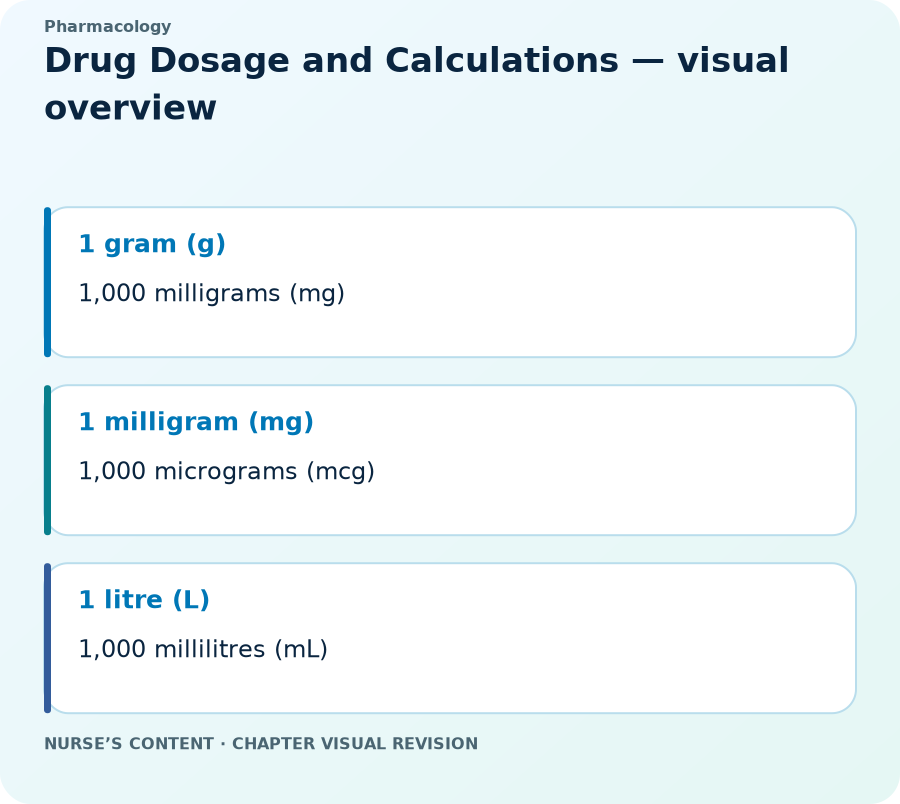
| 1 gram (g) | 1,000 milligrams (mg) |
| 1 milligram (mg) | 1,000 micrograms (mcg) |
| 1 litre (L) | 1,000 millilitres (mL) |
| 1 hour | 60 minutes |
International units (IU or units) measure biological activity and cannot be converted to milligrams without drug-specific information. Avoid the abbreviation U or IU in orders where it can be misread; write units. Use a leading zero (0.5 mg) and no trailing zero (5 mg, not 5.0 mg).
3. Basic dose formula
Volume required = prescribed dose / available dose × available volume. Both doses must be in the same units. Number of tablets = prescribed dose / strength per tablet. Do not round tablet fractions unless the product can be safely divided.
Solved examples
- • Ordered 750 mg; stock 250 mg per tablet. Tablets = 750 / 250 = 3 tablets.
- • Ordered 125 mg; stock 250 mg/5 mL. Volume = 125 / 250 × 5 = 2.5 mL.
- • Ordered 0.4 mg; stock 200 mcg/mL. Convert 0.4 mg to 400 mcg; volume = 400 / 200 = 2 mL.
- • Reconstituted final concentration is 100 mg/mL; ordered 350 mg. Volume = 350 / 100 = 3.5 mL. Verify actual final concentration rather than assuming diluent volume equals final volume.
4. Concentration and dilution
A 1% weight/volume solution contains 1 g per 100 mL, equivalent to 10 mg/mL. A 0.1% weight/volume solution contains 1 mg/mL. Ratio strengths can be confusing; use mg/mL instead whenever possible. Dilution equation C1 × V1 = C2 × V2 applies when amount of solute is conserved and units agree.
Example: For a practice solution of 20 mg/mL, 2 mL contains 40 mg. A final volume of 10 mL gives 4 mg/mL. Clinical dilutions must be compatible, authorized and prepared according to product guidance.
5. Intravenous flow rates
Pump rate (mL/hour) = total volume (mL) / time (hours).
Gravity flow (drops/minute) = volume (mL) × administration-set drop factor (drops/mL) / time (minutes).
| Practice problem | Calculation | Answer |
|---|---|---|
| 500 mL over 4 hours | 500 / 4 | 125 mL/h |
| 1,000 mL over 8 hours, 20 drops/mL | 1,000 × 20 / 480 | About 42 drops/min |
| 250 mL over 2 hours, 60 drops/mL | 250 × 60 / 120 | 125 drops/min |
Use the actual tubing drop factor. Gravity flow varies with patient position, resistance and bag height; reassess. Use a pump for drugs requiring precise delivery.
6. Weight-based infusion calculations
Rate (mL/h) = prescribed dose (mcg/kg/min) × weight (kg) × 60 / concentration (mcg/mL).
Fictional example: Ordered Drug X at 0.1 mcg/kg/min, weight 60 kg, concentration 100 mcg/mL. Dose = 6 mcg/min = 360 mcg/h. Pump rate = 360 / 100 = 3.6 mL/h. Perform dimensional analysis to ensure units cancel. For actual titratable medicines, follow prescribed parameters and pump library limits.
7. Paediatric dosage
Use a current weight in kilograms and a validated paediatric dose source. Verify whether the prescribed dosage is mg/kg/dose or mg/kg/day; divide a daily total only as instructed. Check the maximum single and daily doses, renal or hepatic adjustments, concentration and minimum measurable volume. Neonatal dosing often depends on gestational and postnatal age.
- • Example A: Order 10 mg/kg/dose for an 18 kg child. Dose = 180 mg per dose. Stock 120 mg/5 mL gives 7.5 mL per dose.
- • Example B: Order 30 mg/kg/day in three equal doses, child 15 kg. Total = 450 mg/day; each dose = 150 mg. Stock 100 mg/5 mL gives 7.5 mL per dose.
- • Body surface area (Mosteller) in m² = square root of [height (cm) × weight (kg) / 3600]. BSA dosing is used for selected specialist medicines only. Traditional age-based formulas such as Young's and Fried's rules are historical and should not replace validated paediatric dosing.
8. Medication safety checks
- • Reconcile units, decimal positions and drug concentration. Label syringes and infusions promptly.
- • Use actual patient weight and approved dosing-weight method; some medicines require ideal or adjusted weight.
- • Compare calculated result against the prescribed and independently verified safe range. Clarify discrepancies rather than automatically adjusting the order.
- • Use independent double checks as required for insulin, chemotherapy, concentrated electrolytes, paediatric infusions and other high-alert drugs.
- • Do not give concentrated potassium chloride by IV push. Use authorized dilutions and infusion rates.
9. Examination practice
Long answer questions
- 1. Explain dosage calculation, unit conversion and medication safety.
- 2. Describe IV flow and paediatric weight-based calculations with examples.
Short answer questions
- • Drop factor; reconstitution; mg/kg/day versus mg/kg/dose; BSA; high-alert medicines.
Very short answer questions
- • 0.25 g equals how many mg? — 250 mg.
- • 0.05 mg equals how many mcg? — 50 mcg.
- • 300 mL over 3 hours equals? — 100 mL/h.
- • 100 mg/5 mL, required 60 mg: volume? — 3 mL.
10. Quick revision
Convert before calculating. Check per-dose versus daily dose. Confirm final concentration, drop factor and pump units. An arithmetic answer must always be checked against the clinical order and reference.
Conclusion
Safe calculations require accurate units, sound clinical verification, reliable equipment and appropriate independent checks.
Chapter reference images