Pharmacology
Routes of Drug Administration
Oral, sublingual, buccal, topical, inhalational, rectal, intradermal, subcutaneous, intramuscular and intravenous routes; advantages, disadvantages and nursing responsibilities.
Open quizzes and study tools Download PDF
CHAPTER 03 / PHARMACOLOGY 03. Routes of Drug Administration
1. Definition and classification
A route of administration is the path by which a medicine is introduced into or applied to the body. Enteral routes use the gastrointestinal tract or related mucosal surfaces; parenteral routes bypass the gastrointestinal tract, particularly injections. Topical, transdermal and inhalational administration have distinct local or systemic purposes. Route changes can alter bioavailability and risk even when the generic name is unchanged.
2. Enteral and mucosal routes
| Route | Advantages | Disadvantages and nursing points |
|---|---|---|
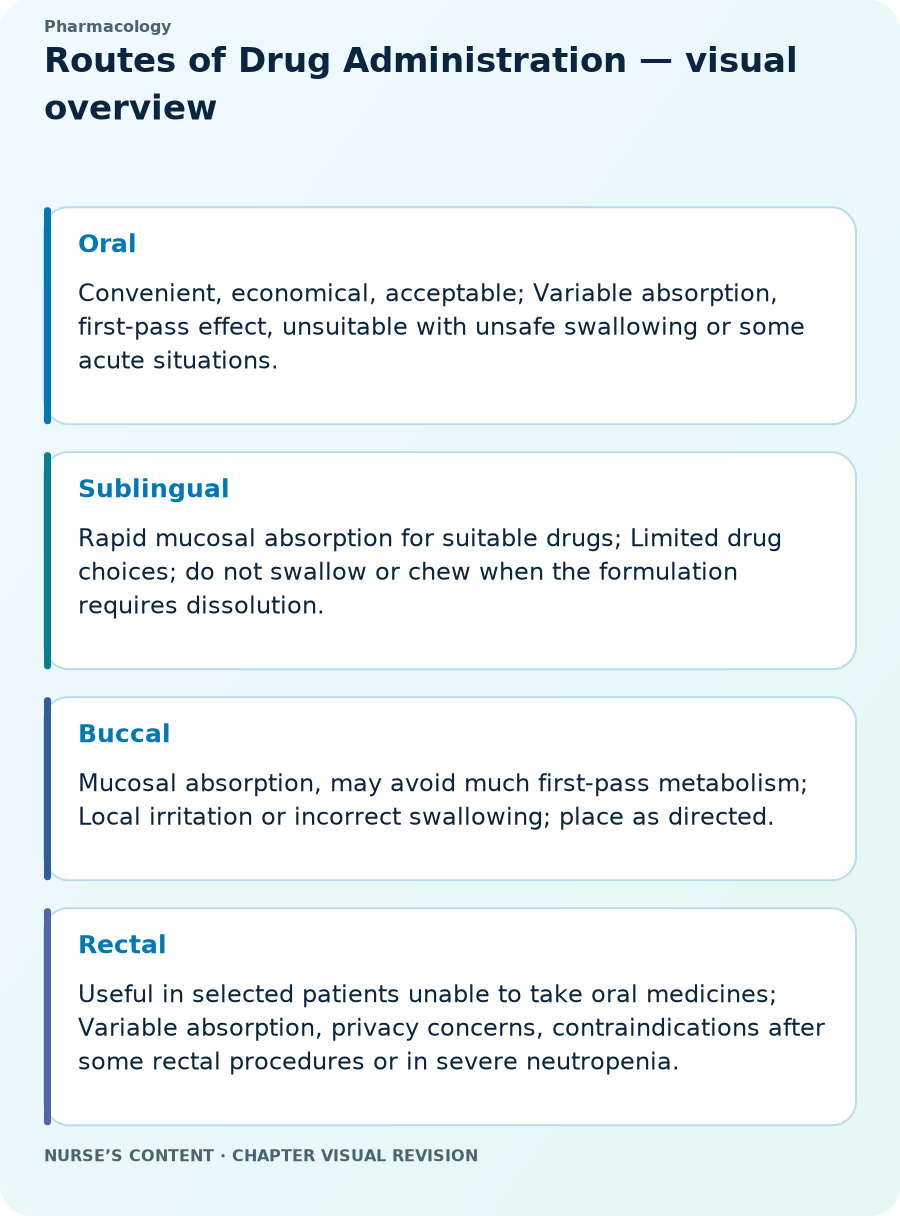
| Oral | Convenient, economical, acceptable | Variable absorption, first-pass effect, unsuitable with unsafe swallowing or some acute situations. |
| Sublingual | Rapid mucosal absorption for suitable drugs | Limited drug choices; do not swallow or chew when the formulation requires dissolution. |
| Buccal | Mucosal absorption, may avoid much first-pass metabolism | Local irritation or incorrect swallowing; place as directed. |
| Rectal | Useful in selected patients unable to take oral medicines | Variable absorption, privacy concerns, contraindications after some rectal procedures or in severe neutropenia. |
Oral medication administration
Check the prescription, allergies, swallowing ability, NPO instructions and relevant observations. Ensure the correct formulation and offer suitable fluid if permitted. Do not crush enteric-coated, modified-release, hazardous or other unsuitable tablets. Consult pharmacy for dispersible or liquid alternatives. Observe swallowing if necessary and document administration. For enteral tubes, confirm placement by approved methods, check compatibility and administer medicines separately with prescribed flushes. Do not mix medicines directly into feed unless explicitly authorized.
3. Topical, transdermal and inhalational routes
| Route | Examples | Nursing responsibilities |
|---|---|---|
| Topical | Hydrocortisone cream, eye preparations | Apply to correct site; avoid contaminating applicators; verify skin integrity and amount. |
| Transdermal | Nicotine or fentanyl patch | Remove previous patch, rotate sites, date/time per policy, avoid heat, dispose safely. |
| Inhalational | Salbutamol, inhaled corticosteroid | Teach correct device technique, observe response, rinse mouth after corticosteroids as directed. |
| Nasal / ocular / otic | Nasal sprays, eye or ear drops | Check correct organ and preparation; do not interchange eye and ear medicines. |
Transdermal medicines provide systemic delivery over time. A topical medicine usually targets the application site but can sometimes be absorbed systemically. Inhalation delivers drugs directly to the airway; systemic absorption and adverse effects are still possible.
4. Parenteral administration
| Route | Typical site or approach | Usual angle for injection |
|---|---|---|
| Intradermal (ID) | Dermis, commonly inner forearm | 5–15° |
| Subcutaneous (SC) | Abdomen, thigh or upper arm according to product | 45° or 90°, based on needle and tissue |
| Intramuscular (IM) | Deltoid, vastus lateralis, ventrogluteal | 90° |
| Intravenous (IV) | Patent peripheral or central venous access | Access/device dependent |
Intradermal and subcutaneous routes
ID administration is used for selected diagnostic tests and vaccines. A small superficial wheal may be expected with correct technique. SC administration is commonly used for insulin and selected anticoagulants. Rotate injection sites appropriately, assess skin and follow product-specific needle and technique instructions. Do not massage heparin injection sites.
Intramuscular route
IM delivery can provide systemic action or depot release. Select the muscle, needle length and maximum volume using patient age, size, formulation and local protocol. Vaccines generally do not require aspiration at recommended sites; other injection instructions vary. Avoid injured tissue and assess bleeding risk. Incorrect placement may cause pain, nerve injury or inadequate absorption.
Intravenous route
IV medication enters the circulation directly and can produce rapid, irreversible exposure. Verify the correct preparation, dilution, compatibility, administration rate, vascular access and monitoring. Assess catheter patency and signs of infiltration, phlebitis and extravasation. Never administer an IM-only formulation intravenously. Use smart pumps when indicated and follow the drug-specific extravasation protocol if leakage occurs.
5. Advantages and disadvantages of parenteral routes
Advantages include rapid onset for appropriate IV drugs, use when gastrointestinal delivery is unsafe and predictable delivery of many agents. Disadvantages include infection risk, pain, tissue injury, need for trained staff, equipment requirements and greater consequences of preparation errors. Absorption from SC or IM tissue may be unreliable in shock.
6. Safe administration procedure
- 1. Verify patient identity, medicine, dose, route, time and clinical indication.
- 2. Review allergies, relevant observations, laboratory tests and contraindications.
- 3. Perform hand hygiene; select appropriate equipment and maintain asepsis.
- 4. Prepare the medicine according to the label and approved reference, including concentration and compatibility.
- 5. Explain the procedure, position the patient and obtain cooperation or appropriate consent.
- 6. Administer using trained technique. Do not reuse needles or syringes across patients.
- 7. Observe the patient, dispose of sharps immediately in approved containers, document and reassess.
7. Complications and prevention
| Complication | Prevention or initial nursing action |
|---|---|
| Aspiration | Check swallowing safety; withhold unsafe oral administration and seek guidance. |
| Injection-site infection | Hand hygiene, aseptic non-touch technique and single-use equipment. |
| Haematoma | Recognize bleeding risk; apply appropriate pressure without trauma. |
| Extravasation | Stop infusion; keep access if required for aspiration/antidote, do not flush, obtain urgent drug-specific guidance. |
| Anaphylaxis | Recognize airway, breathing or circulatory compromise and activate emergency response. |
8. Important examination questions
Long answer questions
- 1. Classify routes of administration and explain advantages, disadvantages and nursing care.
- 2. Describe precautions for IM, SC, ID and IV administration.
Short answer questions
- • Sublingual route; transdermal patch; inhaler technique; enteral tube administration; extravasation.
Very short answer questions
- • Usual IM angle? — 90°.
- • Which route has complete bioavailability? — IV.
- • Name one SC medicine. — Insulin.
9. Quick revision
Verify formulation and route together; assess swallowing before oral medicines; never crush unsuitable tablets. ID, SC and IM angles differ. IV drugs require compatibility, rate and access checks. Monitor after all routes.
Conclusion
The safest route is the authorized route suited to the medicine, clinical condition and patient needs. Correct preparation and surveillance reduce preventable harm.
Chapter reference images