Pharmacology
Basic Principles of Pharmacology
Pharmacokinetics, pharmacodynamics, absorption, distribution, metabolism, excretion, drug receptors, dose-response relationship, half-life and bioavailability.
Open quizzes and study tools Download PDF
CHAPTER 02 / PHARMACOLOGY 02. Basic Principles of Pharmacology
1. Introduction
Drug response depends on both drug exposure and the sensitivity of the biological target. Pharmacokinetics describes what the body does to the drug; pharmacodynamics describes what the drug does to the body. Understanding the distinction helps explain onset, duration, dose adjustment, treatment failure and toxicity.
2. Pharmacokinetics – ADME
| Process | Description | Factors influencing it |
|---|---|---|
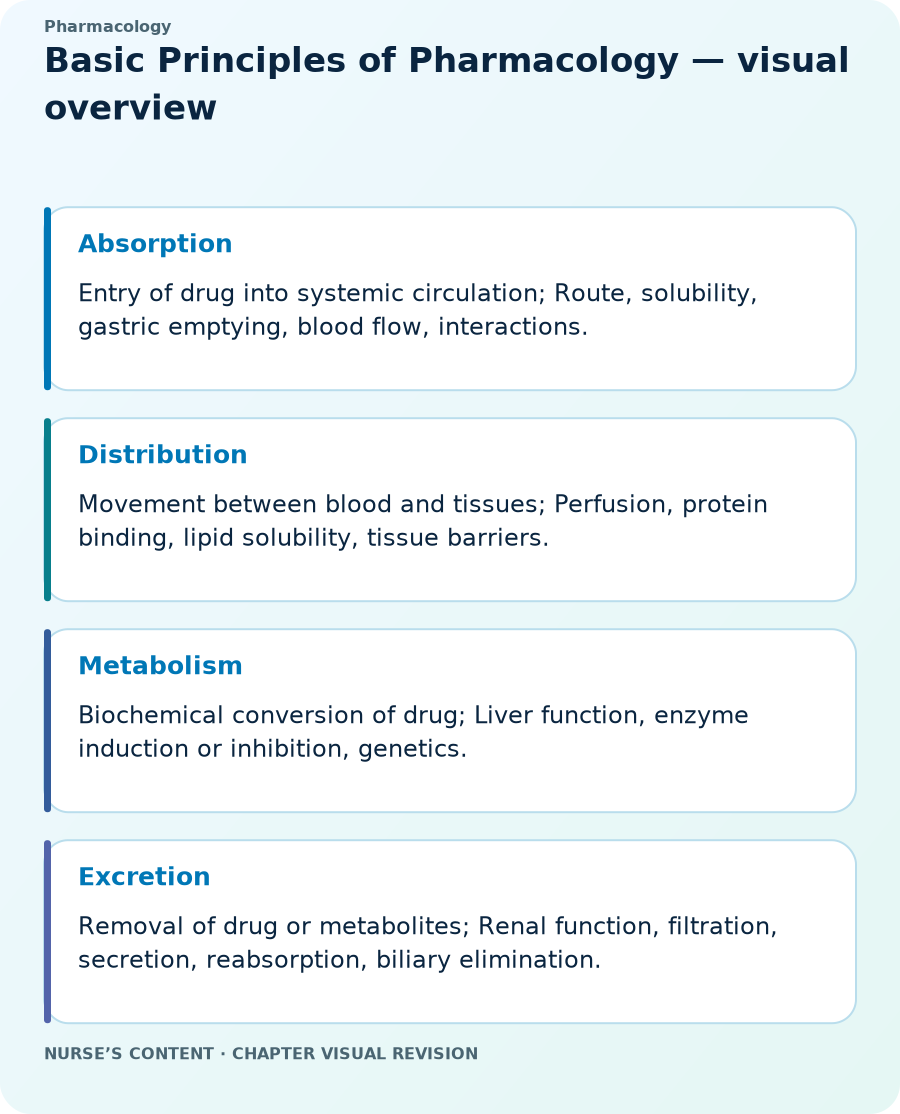
| Absorption | Entry of drug into systemic circulation | Route, solubility, gastric emptying, blood flow, interactions. |
| Distribution | Movement between blood and tissues | Perfusion, protein binding, lipid solubility, tissue barriers. |
| Metabolism | Biochemical conversion of drug | Liver function, enzyme induction or inhibition, genetics. |
| Excretion | Removal of drug or metabolites | Renal function, filtration, secretion, reabsorption, biliary elimination. |
Absorption and bioavailability
Oral medicines usually dissolve and are absorbed in the gastrointestinal tract. Some undergo presystemic metabolism in the gut and liver before reaching systemic circulation, known as the first-pass effect. IV administration bypasses absorption and has bioavailability of 100%. Oral bioavailability can be reduced by incomplete absorption or first-pass metabolism. Modified-release formulations change the rate of release. Food may improve or reduce absorption depending on the drug.
Distribution
Albumin binds many acidic drugs, while alpha-1 acid glycoprotein binds many basic drugs. Unbound drug is generally available to interact with targets and undergo elimination. Low albumin, oedema and pregnancy may affect distribution. The apparent volume of distribution (Vd) relates the amount of drug in the body to its plasma concentration; it is a theoretical volume, not necessarily an anatomical space.
Metabolism
Phase I reactions include oxidation, reduction and hydrolysis; cytochrome P450 enzymes are important in many oxidative reactions. Phase II reactions include conjugation, such as glucuronidation. Metabolism may inactivate a drug, activate a prodrug or generate active or toxic metabolites. Enzyme induction can reduce exposure to susceptible drugs; inhibition can increase exposure. Effects may differ when the drug is a prodrug.
Excretion and clearance
Renal elimination includes filtration of unbound drug, tubular secretion and reabsorption. Other routes include bile, faeces and exhaled air. Clearance is the theoretical volume of plasma cleared of drug per unit time. Impaired kidney or liver function may prolong exposure. Follow the specific product's renal dosing method rather than assuming all drugs use the same estimated filtration value.
3. Half-life, steady state and dose timing
Half-life is the time for plasma drug concentration to fall to half its previous value during the relevant elimination phase. With linear first-order kinetics, t½ = 0.693 × Vd / clearance. Approximately four to five half-lives are needed to approach steady state with regular dosing or to eliminate most of a drug after stopping. Some drugs have nonlinear kinetics, active metabolites or prolonged tissue effects, so these rules are approximations.
Worked example: A concentration of 80 mg/L and half-life of 4 hours gives 40 mg/L after 4 hours, 20 mg/L after 8 hours, and 10 mg/L after 12 hours, assuming first-order elimination and no further dose.
Loading doses aim to reach a target concentration promptly. Maintenance doses replace eliminated drug. The conceptual relationships are loading dose = target concentration × Vd / bioavailability; maintenance dose rate = target concentration × clearance / bioavailability. These equations require clinically validated parameters and are not a substitute for a prescription.
4. Pharmacodynamics and receptors
| Target type | Example of mechanism |
|---|---|
| Ligand-gated ion channel | Nicotinic acetylcholine receptors control ion flow. |
| G-protein-coupled receptor | Beta-adrenergic receptors alter intracellular signalling. |
| Enzyme-linked receptor | Insulin receptor has tyrosine kinase activity. |
| Intracellular receptor | Steroid hormones alter gene expression. |
| Enzyme / transporter | ACE inhibitors inhibit an enzyme; SSRIs inhibit a transporter. |
An agonist activates a receptor. A partial agonist produces a lower maximal effect in a given system. An antagonist reduces agonist action without activating the receptor in the conventional sense. Competitive antagonism may be overcome by increasing agonist concentration under appropriate conditions; noncompetitive inhibition often reduces maximum response.
5. Dose-response relationship
- • Potency is the dose or concentration needed to produce a specified effect; efficacy is the maximum effect obtainable in a given system.
- • ED50 is a median effective dose in a defined population or experimental context. TD50 is a median toxic dose.
- • Therapeutic index = TD50 / ED50 (or LD50 / ED50 in preclinical contexts). It is an approximate safety measure, not an individualized dosing rule.
- • A narrow therapeutic window requires careful monitoring. Examples include lithium, digoxin and some antiepileptics.
- • Tolerance is reduced response after repeated exposure. Tachyphylaxis is a rapid reduction in response. Dependence is physiological adaptation that may produce withdrawal on discontinuation; it is not identical to addiction.
6. Factors modifying drug response
Age, body composition, pregnancy, genetic variation, kidney and liver function, nutrition, disease severity, drug interactions, adherence and timing all influence response. Pharmacogenetic examples include variable CYP2D6 metabolism of codeine and increased risk of selected adverse reactions with particular genetic variants. Testing decisions follow clinical guidance.
7. Nursing importance and clinical application
A patient receiving a renally eliminated medicine develops oliguria and rising creatinine. Review the prescription and recent laboratory results, assess toxicity, communicate with the prescriber and pharmacist before the next dose when safety is uncertain, and document the action. Do not make an unapproved dose change. For therapeutic drug monitoring, collect samples at the specified time relative to dosing; document the last administration time, sample time and current regimen.
8. Important examination questions
Long answer questions
- 1. Describe ADME and factors affecting each process.
- 2. Explain drug receptors, dose-response curves, potency and efficacy.
- 3. Explain half-life, clearance and bioavailability with clinical examples.
Short answer questions
- • First-pass metabolism; enzyme induction and inhibition; therapeutic index; loading and maintenance dose; agonist and antagonist.
Very short answer questions
- • What is IV bioavailability? — 100%.
- • What is Vd? — Apparent volume relating total drug amount to plasma concentration.
- • How long to approach steady state in linear kinetics? — About four to five half-lives.
9. Quick revision
ADME = absorption, distribution, metabolism, excretion. Drug effect is influenced by receptor activity and exposure. First-pass metabolism may reduce oral bioavailability. Potency is not efficacy. Renal and hepatic impairment may require individualized treatment.
Conclusion
Pharmacokinetic and pharmacodynamic principles explain medicine timing, variability and toxicity, helping nurses make appropriately informed monitoring and escalation decisions.
Chapter reference images