Pharmacology
Introduction to Pharmacology
Definition, history, branches, scope and importance of pharmacology, drugs, sources of drugs, nomenclature and classification of drugs.
Open quizzes and study tools Download PDF
CHAPTER 01 / PHARMACOLOGY 01. Introduction to Pharmacology
1. Introduction and definition
Pharmacology is the scientific study of medicines and other chemical substances that alter the functions of living organisms. It examines where medicines come from, how they act, how the body handles them, their therapeutic uses and their potential harmful effects.
A drug is a chemical or biological substance that modifies a physiological or pathological process. A medicine is a preparation containing an active substance, formulated for prevention, diagnosis or treatment of disease or relief of symptoms. An excipient is a formulation ingredient that helps stability, delivery or manufacture; excipients may occasionally cause intolerance or allergy.
2. Historical development
- • Early medicine used plant, animal and mineral preparations. Traditional systems such as Ayurveda contributed to knowledge of medicinal substances.
- • William Withering published his work on digitalis in 1785. Friedrich Sertürner isolated morphine in the early nineteenth century.
- • Rudolf Buchheim established an early experimental pharmacology institute in the nineteenth century; Oswald Schmiedeberg helped establish pharmacology as a distinct scientific discipline.
- • Paul Ehrlich developed concepts of selective toxicity and chemotherapy. Alexander Fleming observed the antibacterial activity of penicillin in 1928; its later therapeutic development involved Florey, Chain and colleagues.
- • Modern pharmacology incorporates molecular receptors, biotechnology, clinical trials, pharmacogenomics and post-marketing safety surveillance.
3. Branches of pharmacology
| Branch | Meaning and example |
|---|---|
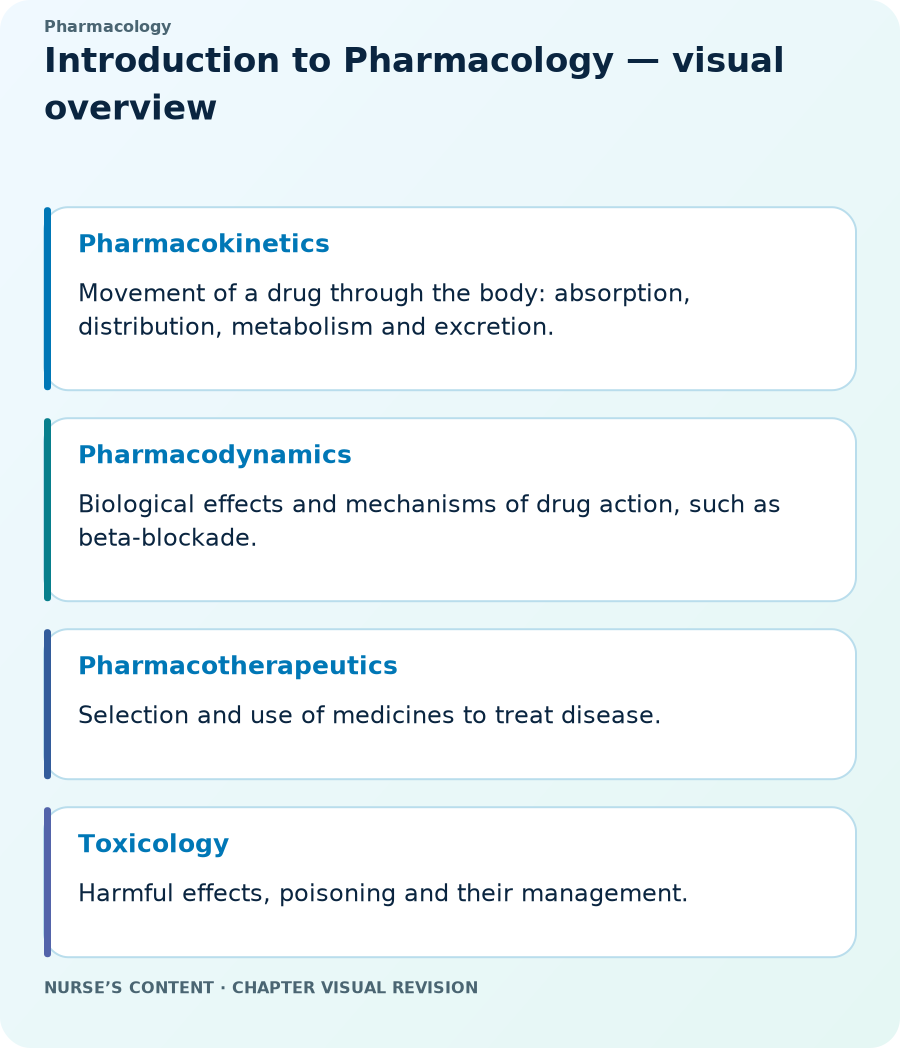
| Pharmacokinetics | Movement of a drug through the body: absorption, distribution, metabolism and excretion. |
| Pharmacodynamics | Biological effects and mechanisms of drug action, such as beta-blockade. |
| Pharmacotherapeutics | Selection and use of medicines to treat disease. |
| Toxicology | Harmful effects, poisoning and their management. |
| Clinical pharmacology | Study of medicines in humans, including efficacy and safety. |
| Chemotherapy | Use of chemicals against infectious agents or malignant cells. |
| Pharmacognosy | Study of medicines and bioactive substances from natural sources. |
| Pharmaceutics | Design and preparation of medicinal dosage forms. |
| Pharmacogenetics / pharmacogenomics | Influence of genetic variation on drug response. |
| Pharmacovigilance | Detection, assessment and prevention of medicine-related harm. |
4. Sources of drugs
| Source | Representative example | Significance |
|---|---|---|
| Plant | Digoxin, atropine, morphine | Natural substances may be purified or chemically modified. |
| Microbial | Penicillin | Products of microorganisms or their derivatives. |
| Animal | Some heparin preparations | Biological origin requires appropriate quality control. |
| Mineral | Ferrous salts, magnesium salts | Used for replacement or specific therapeutic effects. |
| Synthetic | Paracetamol, lidocaine | Produced by chemical synthesis. |
| Semisynthetic | Amoxicillin | Natural compounds modified to improve properties. |
| Recombinant / biological | Human insulin, monoclonal antibodies | Manufactured using biotechnology. |
5. Drug nomenclature
- • Chemical name describes molecular structure; it is often complex.
- • Generic or nonproprietary name identifies the active substance, for example paracetamol. International Nonproprietary Names support consistent communication.
- • Trade or brand name identifies a marketed product. Different brands may contain the same active substance.
- • Pharmacopoeial standards describe identity, strength, purity and quality. The Indian Pharmacopoeia is an important official reference in India.
Clinical example: Two cold and fever preparations may both contain paracetamol. Checking only the brand name can lead to accidental duplication. Verify every active ingredient, strength and dosage form.
6. Classification of drugs
| Basis | Examples |
|---|---|
| Therapeutic use | Antihypertensives, analgesics, antidiabetics. |
| Pharmacological action | Beta-blockers, calcium channel blockers. |
| Chemical structure | Benzodiazepines, beta-lactam antibiotics. |
| Organ system | CNS, respiratory, cardiovascular drugs. |
| Source | Natural, synthetic, biological. |
| Legal supply category | Prescription, non-prescription or specially controlled medicines under applicable local rules. |
The WHO Anatomical Therapeutic Chemical (ATC) classification organizes medicines by the organ or system and by therapeutic, pharmacological and chemical characteristics. The same medicine can have several clinical uses; classification depends on context.
7. Dosage forms and essential medicines
Tablets, capsules, solutions, suspensions, injections, creams, ointments, patches, inhalers and suppositories are common dosage forms. Immediate-release and modified-release formulations have different release characteristics and must not be substituted without verification. Medicines are selected according to clinical evidence, patient factors, quality, availability and cost. Essential medicines are those intended to meet priority healthcare needs; consult the applicable national list and formulary.
8. Scope and nursing importance
- • Understand the prescribed indication and mechanism before administration.
- • Identify allergies, contraindications, interactions and high-risk situations.
- • Calculate doses accurately, verify the route and formulation, and monitor therapeutic and adverse responses.
- • Educate patients about purpose, technique, adherence and warning symptoms.
- • Document administration and any omissions or adverse reactions; participate in pharmacovigilance.
- • Work with pharmacists and prescribers to clarify doubtful orders. Nursing competence does not imply independent prescribing authority.
9. Important examination questions
Long answer questions
- 1. Define pharmacology and describe its history, branches and scope.
- 2. Explain the sources, nomenclature and classification of drugs with examples.
- 3. Discuss the importance of pharmacology in safe nursing practice.
Short answer questions
- • Pharmacokinetics versus pharmacodynamics; pharmacognosy; pharmacovigilance; essential medicines; generic and trade names.
Very short answer questions
- • Who observed penicillin activity in 1928? — Alexander Fleming.
- • What is toxicology? — Study of harmful effects of substances.
- • Give one recombinant drug. — Human insulin.
10. Quick revision
Pharmacology links the drug, body and clinical outcome. Generic name identifies the active substance; formulation and strength remain essential. Therapeutic classes group medicines by clinical purpose. Safe drug use requires assessment, verification, administration, monitoring and education.
Conclusion
Knowledge of drug origins, classification and scientific principles allows the nurse to identify medication risks and provide informed, evidence-based care.
Chapter reference images