Nursing Management & Leadership
Ward Management and Patient Care Administration
Ward organization, admission and discharge procedures, patient assignment, nursing rounds, handover, records and reports, ward inventory and infection control.
Open quizzes and study tools Download PDF
CHAPTER 14 / NURSING MANAGEMENT AND LEADERSHIP 14. Ward Management and Patient Care Administration
1. Meaning and objectives
Ward management is the coordination of personnel, patients, equipment, supplies, environment and records to provide safe continuous care. A ward manager organizes the unit, supervises staff, monitors patient safety, communicates with departments and evaluates standards. Effective management balances individual patient needs with overall service capacity.
2. Ward organization and shift preparation
Maintain a clean, accessible environment with safe lighting, ventilation, privacy, infection-prevention facilities, functioning call systems and clearly arranged equipment. At shift commencement review census, acuity, isolation needs, high-risk medications, planned admissions and procedures, staff skill mix and equipment readiness. Assign a responsible nurse to each patient and ensure staffing gaps are escalated.
3. Admission, transfer and discharge
| Stage | Essential nursing responsibilities |
|---|---|
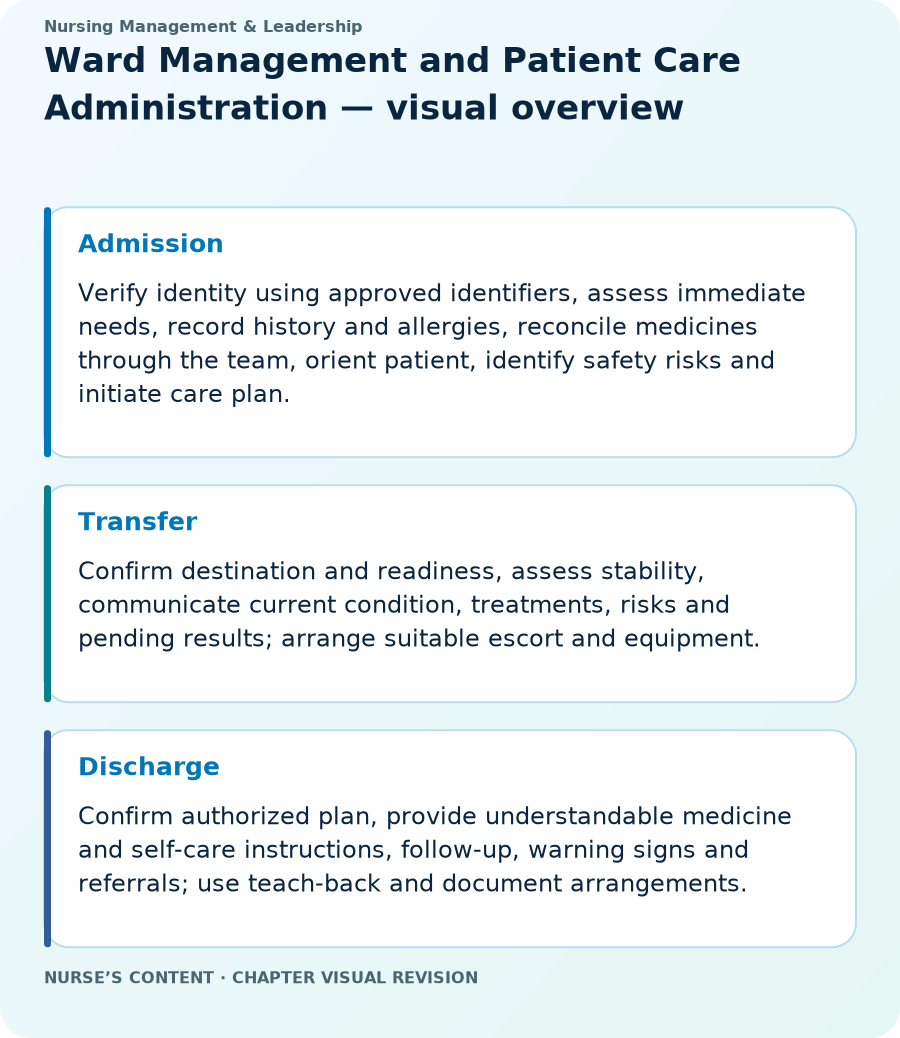
| Admission | Verify identity using approved identifiers, assess immediate needs, record history and allergies, reconcile medicines through the team, orient patient, identify safety risks and initiate care plan. |
| Transfer | Confirm destination and readiness, assess stability, communicate current condition, treatments, risks and pending results; arrange suitable escort and equipment. |
| Discharge | Confirm authorized plan, provide understandable medicine and self-care instructions, follow-up, warning signs and referrals; use teach-back and document arrangements. |
Begin discharge planning early. Protect confidentiality during handovers and ensure necessary care information reaches the receiving team securely. Escalate concerns if discharge appears unsafe.
4. Patient assignment and nursing rounds
Allocate patients according to acuity, dependence, staff competence, isolation requirements and work distribution. Reassess when new patients arrive or conditions change. Rounds may include clinical assessment, interdisciplinary review, nursing supervision and safety/environmental checks. Prioritize pain, vital signs and deterioration, skin integrity, mobility, nutrition, elimination, medication, emotional support and patient questions. Document actions rather than treating a round as a checklist alone.
5. Shift handover, records and reports
Handover should establish patient identity, current problem, relevant history, assessment findings, recent changes, treatment plan, allergies, risks, pending investigations and tasks requiring follow-up. Use SBAR or locally approved format and provide opportunity for clarification. Bedside handover may involve patients with consent and privacy safeguards. Maintain admission/discharge registers, clinical records, duty rosters, incident reports, stock registers and equipment logs in approved systems. Never share identifiable records outside authorized channels.
6. Ward inventory and infection control
Check emergency equipment, oxygen supply, medicines, dressings and essential consumables; reconcile stock and isolate expired or damaged materials. Follow standardized checks for emergency trolleys and document restocking after use. Apply standard precautions to all patients and transmission-based precautions as indicated. Provide supplies for hand hygiene, safe sharps disposal, appropriate PPE and waste segregation. Monitor device necessity, cleaning, safe injection practices and environmental risks; coordinate with infection-control staff. Follow current biomedical waste rules and local segregation procedures.
7. Example daily workflow
| Time/phase | Ward manager activity |
|---|---|
| Start of shift | Review handover, staffing, high-risk patients and equipment readiness. |
| Early shift | Coordinate clinical rounds, investigations, treatments and procedures. |
| Mid-shift | Reassess workload, admissions and discharges, patient concerns and inventory. |
| Before handover | Check unresolved risks, pending results, documentation and continuity of care. |
8. Evaluation
Monitor patient incidents, infection rates, falls, pressure injury prevention, medication safety, complaints, staff competency and stock availability. Use trends to identify improvement opportunities; provide feedback and assign action responsibilities. If staffing, equipment or isolation capacity is insufficient, escalate to the appropriate clinical and administrative leaders promptly.
9. Important Examination Questions
Long Answer Questions
- 1. Describe the principles and functions of ward management.
- 2. Explain nursing responsibilities in admission, transfer, discharge, rounds and handover.
Short Answer Questions
- 1. Patient assignment.
- 2. Ward inventory.
- 3. Bedside handover.
- 4. Infection prevention.
- 5. Records and reports.
Very Short Answer Questions (with answers)
- 1. What is patient acuity? — Degree of care complexity and clinical need.
- 2. What is a ward round? — Structured review of patients or care services.
- 3. When does discharge planning begin? — Early in the admission process.
10. Quick Revision
- • Ward management organizes safe care throughout the patient journey.
- • Assign work by patient need and staff competence.
- • Accurate handover, stock management and infection prevention are essential.
11. Conclusion
Ward management organizes safe care throughout the patient journey. Assign work by patient need and staff competence. Accurate handover, stock management and infection prevention are essential.
Chapter reference images