Nursing Management & Leadership
Communication and Interpersonal Relationships
Communication process, types and barriers, therapeutic and professional communication, teamwork, interdepartmental coordination and conflict resolution.
Open quizzes and study tools Download PDF
CHAPTER 13 / NURSING MANAGEMENT AND LEADERSHIP 13. Communication and Interpersonal Relationships
1. Definition and communication process
Communication is the exchange of information, ideas and feelings to achieve understanding. The process includes sender, encoding, message, channel, receiver, decoding and feedback. Noise may be physical, linguistic, psychological, technological or organizational. Effective communication in nursing is timely, accurate, respectful, understandable and appropriate to privacy requirements.
2. Types and channels
| Type | Example |
|---|---|
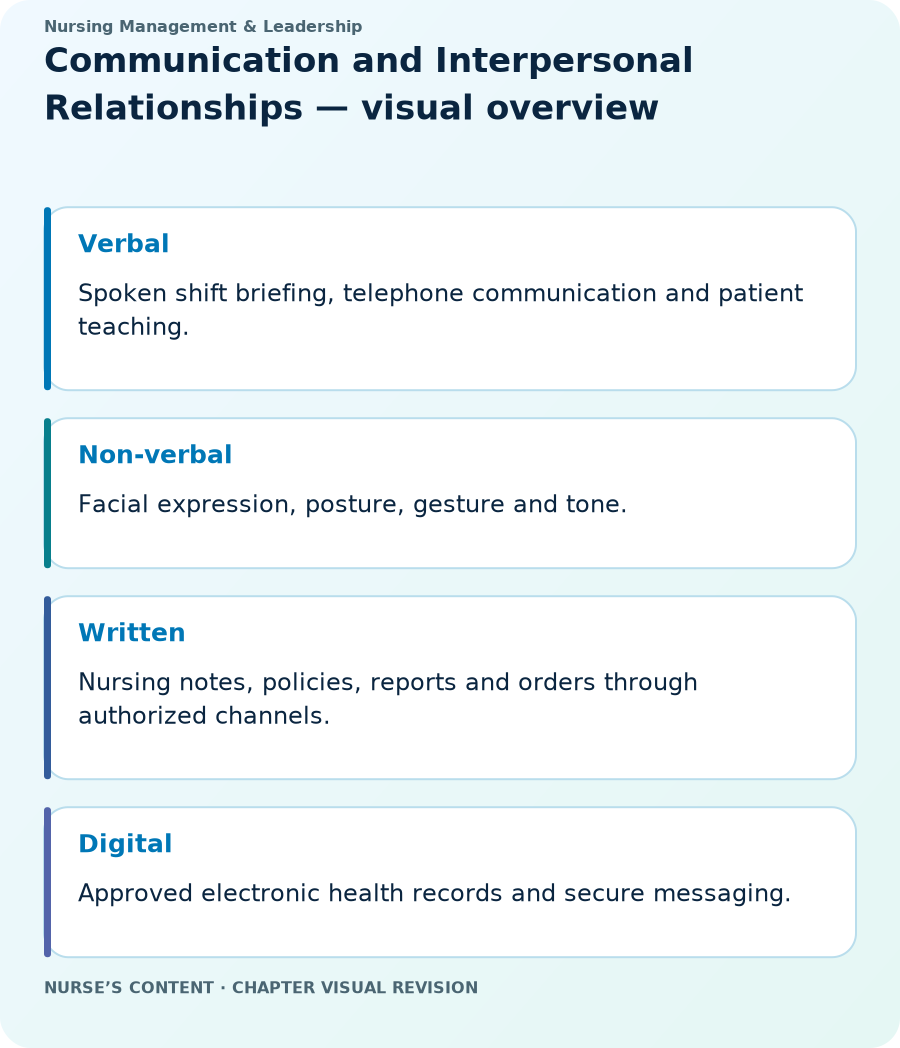
| Verbal | Spoken shift briefing, telephone communication and patient teaching. |
| Non-verbal | Facial expression, posture, gesture and tone. |
| Written | Nursing notes, policies, reports and orders through authorized channels. |
| Digital | Approved electronic health records and secure messaging. |
| Formal | Structured reporting, meetings and official communication. |
| Informal | Everyday interpersonal exchange; verify information before clinical action. |
Downward communication conveys policies or instructions; upward communication conveys staff concerns and reports; horizontal communication coordinates colleagues and departments. Interdisciplinary communication is essential when responsibilities cross professional boundaries.
3. Barriers and therapeutic communication
Barriers include language differences, hearing loss, medical jargon, workload, interruptions, poor handover structure, assumptions, fear of criticism and information overload. Use qualified interpreters when needed, plain language, appropriate sensory aids, active listening and teach-back. Therapeutic communication includes open-ended questions, reflection, clarification, empathy, appropriate silence and summarizing. Avoid judgment, false reassurance, unnecessary personal disclosure and dismissing patient concerns.
4. Structured professional communication
SBAR: Situation (current problem), Background (relevant history), Assessment (findings and clinical concern), Recommendation (requested action). AHRQ TeamSTEPPS describes SBAR and check-back as structured tools to strengthen communication. Closed-loop communication requires the receiver to repeat or acknowledge a message and the sender to verify accuracy, particularly for critical instructions. Use approved read-back procedures for verbal orders and critical results. Document escalation, response and further monitoring.
5. Teamwork and interdepartmental coordination
Shared patient goals, clear roles, reliable handover, mutual support, situation awareness and respect facilitate teamwork. Conduct briefings before complex work, huddles when conditions change and debriefings afterwards. Coordinate pharmacy, laboratory, dietary, rehabilitation and discharge services using designated communication pathways. Provide a clear escalation route when a response is delayed.
6. Conflict resolution
Conflict may arise from role ambiguity, workload, unequal resources, communication failure or differing priorities. Identify the issue, listen to each party, distinguish facts from assumptions, explore interests, agree safe solutions and review progress. Common styles include avoiding, accommodating, competing, compromising and collaborating. Collaboration is appropriate when there is time to address underlying needs; immediate safety threats require prompt escalation rather than prolonged negotiation. Do not require informal mediation when abuse, harassment or violence demands formal action.
7. Example: critical result communication
A nurse receives a critical laboratory result. Verify patient identity and the reported value according to policy, assess the patient, notify the responsible clinician using SBAR, confirm the response and act within the authorized plan. If the clinician is unavailable, activate local escalation procedures. Record times, findings and actions. Never rely on an unacknowledged message for a time-critical result.
8. Important Examination Questions
Long Answer Questions
- 1. Explain the communication process, types, barriers and methods of improvement.
- 2. Discuss teamwork and conflict resolution in nursing administration.
Short Answer Questions
- 1. SBAR.
- 2. Therapeutic communication.
- 3. Closed-loop communication.
- 4. Interdepartmental coordination.
- 5. Conflict styles.
Very Short Answer Questions (with answers)
- 1. What is feedback? — Response confirming or clarifying a message.
- 2. What does SBAR stand for? — Situation, Background, Assessment, Recommendation.
- 3. What is teach-back? — Asking a person to explain information in their own words to verify understanding.
9. Quick Revision
- • Reliable communication links assessment with timely action.
- • Structured handover and closed-loop communication reduce ambiguity.
- • Respectful conflict resolution and safe escalation support teamwork.
10. Conclusion
Reliable communication links assessment with timely action. Structured handover and closed-loop communication reduce ambiguity. Respectful conflict resolution and safe escalation support teamwork.
Chapter reference images