Nursing Management & Leadership
Legal and Ethical Aspects of Nursing Administration
Nursing ethics, professional accountability, legal responsibilities, documentation, informed consent, negligence, malpractice, professional regulations and nursing standards.
Open quizzes and study tools Download PDF
CHAPTER 12 / NURSING MANAGEMENT AND LEADERSHIP 12. Legal and Ethical Aspects of Nursing Administration
1. Concepts and ethical principles
Ethics concerns moral principles guiding professional conduct; law consists of enforceable rules established through authorized legal processes. Nursing administrators should promote safe, ethical care, uphold patient rights and ensure staff practise within authorized competence. The ICN Code of Ethics for Nurses provides an international ethical framework emphasizing responsibilities towards people requiring care, practice, the profession and global health.
| Principle | Nursing application |
|---|---|
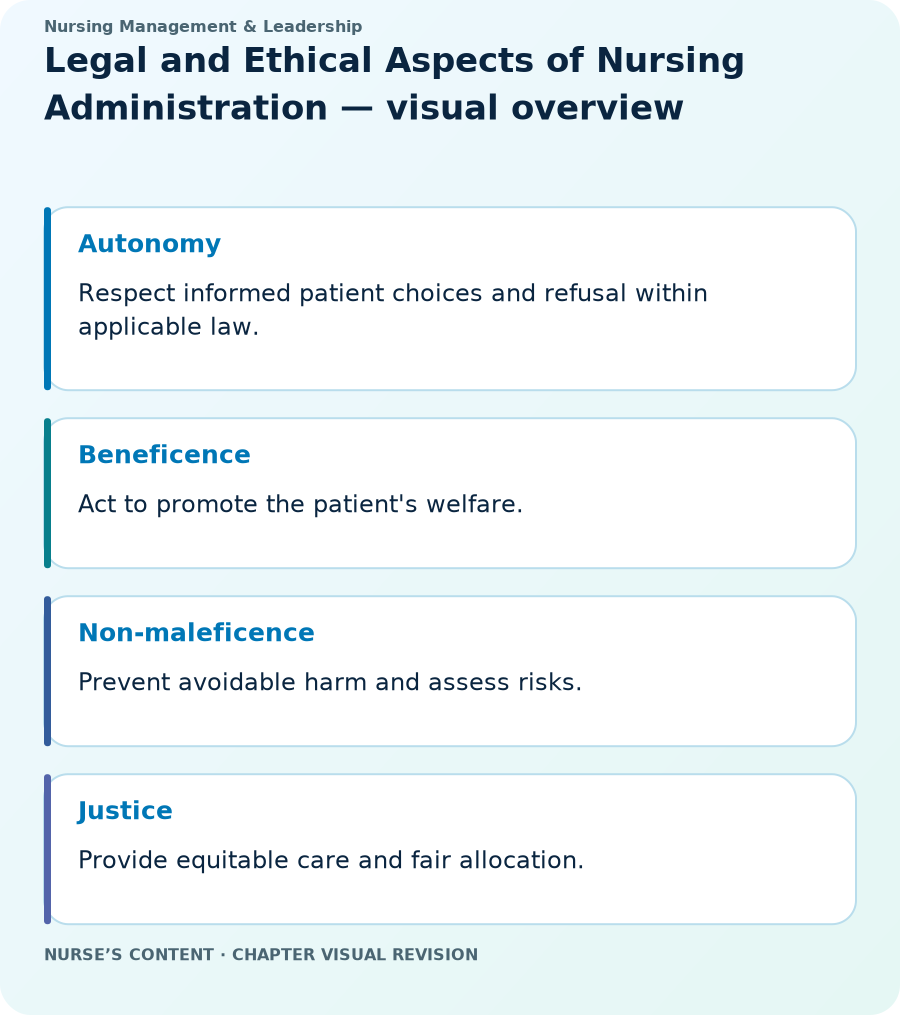
| Autonomy | Respect informed patient choices and refusal within applicable law. |
| Beneficence | Act to promote the patient's welfare. |
| Non-maleficence | Prevent avoidable harm and assess risks. |
| Justice | Provide equitable care and fair allocation. |
| Veracity | Provide truthful, understandable information. |
| Fidelity | Honour professional responsibilities and commitments. |
| Confidentiality | Protect private information and disclose only on an authorized basis. |
2. Accountability, scope of practice and professional regulation
Accountability is answerability for professional decisions and actions; responsibility is the obligation to perform duties safely. Verify professional qualifications, applicable registration, scope and competency before assigning clinical responsibilities. Nurses are accountable for their own practice, documentation and appropriate escalation; managers also have duties related to safe staffing, resources and supervision. India's regulatory framework includes nursing registration arrangements and legislation such as the Indian Nursing Council Act, 1947, and National Nursing and Midwifery Commission Act, 2023. The latter provides for a new framework; verify actual commencement provisions, notifications and state-level requirements before applying particular regulatory rules. Professional registration is distinct from hospital accreditation.
3. Negligence and malpractice
Negligence generally concerns failure to exercise reasonable care. Professional negligence or malpractice concerns breach of the expected professional standard resulting in harm. Common teaching elements include duty, breach, causal connection and injury; legal tests and remedies depend on applicable jurisdiction. An adverse outcome alone does not establish negligence. Examples of possible unsafe practice include failure to assess and escalate deterioration, wrong-patient medication or failure to follow required monitoring. Seek designated legal or risk-management advice for actual cases.
4. Informed consent and patient rights
Valid consent generally requires adequate information, decision-making capacity, voluntariness and a decision about the proposed intervention. The responsible treating professional obtains procedure-specific informed consent as required. Nurses verify completion, support understanding, document the patient's concerns and alert the responsible clinician if questions remain, a patient refuses or consent appears invalid. Signing as a witness does not substitute for explaining risks by the responsible professional. Emergency exceptions, minors and substitute decision-making require applicable legal procedures. Maintain dignity, privacy, non-discrimination and access to information.
5. Documentation and incident reporting
Document care accurately, contemporaneously, objectively and with authentication. Record assessment, decisions, interventions, response, escalation and relevant communication. Never erase or falsify records; use approved corrections and late-entry procedures. Protect access to records and restrict disclosure to authorized purposes. Incident reports support internal safety review and should not replace clinical notes. After harm, prioritize immediate clinical care, notify designated staff, follow disclosure policy and preserve relevant evidence.
6. Ethical decision-making
Identify the issue, relevant patient preferences, available facts, professional responsibilities and legal constraints. Consider alternatives and potential benefits or harms, consult the multidisciplinary team or ethics committee, document the decision and reassess. Escalate unsafe orders rather than ignoring them or following blindly. Administrative pressures never justify concealment of harm, unauthorized practice or discriminatory care.
7. Important Examination Questions
Long Answer Questions
- 1. Discuss ethical principles and legal responsibilities of nursing administrators.
- 2. Explain informed consent, negligence, malpractice and professional accountability.
Short Answer Questions
- 1. Confidentiality.
- 2. Patient rights.
- 3. Scope of practice.
- 4. Incident reporting.
- 5. Ethical decision-making.
Very Short Answer Questions (with answers)
- 1. What is autonomy? — Respect for informed choice.
- 2. What is non-maleficence? — Avoiding harm.
- 3. Does adverse outcome prove negligence? — No.
8. Quick Revision
- • Ethical and legal responsibilities underpin safe nursing management.
- • Valid consent and accurate records protect patient rights.
- • Current local laws, notifications and institutional procedures govern specific cases.
9. Conclusion
Ethical and legal responsibilities underpin safe nursing management. Valid consent and accurate records protect patient rights. Current local laws, notifications and institutional procedures govern specific cases.
Chapter reference images