Nursing Management & Leadership
Quality Assurance and Nursing Audit
Quality assurance, quality improvement, nursing standards, nursing audit, clinical indicators, accreditation, patient safety and evidence-based nursing practice.
Open quizzes and study tools Download PDF
CHAPTER 11 / NURSING MANAGEMENT AND LEADERSHIP 11. Quality Assurance and Nursing Audit
1. Quality of nursing care
Quality is the extent to which healthcare services improve desired outcomes and are consistent with current professional knowledge. Important dimensions include safety, effectiveness, patient-centredness, timeliness, efficiency and equity. Quality assurance (QA) checks whether standards are being met. Quality improvement (QI) systematically changes processes to improve performance and sustain better outcomes. Both require reliable measurement and staff involvement.
2. Standards and quality indicators
A standard describes expected performance; a criterion specifies an observable requirement; an indicator is a measure used to monitor performance. Donabedian's framework classifies quality into structure (staffing, equipment), process (care activities) and outcome (health results or experience). A balanced dashboard uses all three categories.
| Indicator | Example formula |
|---|---|
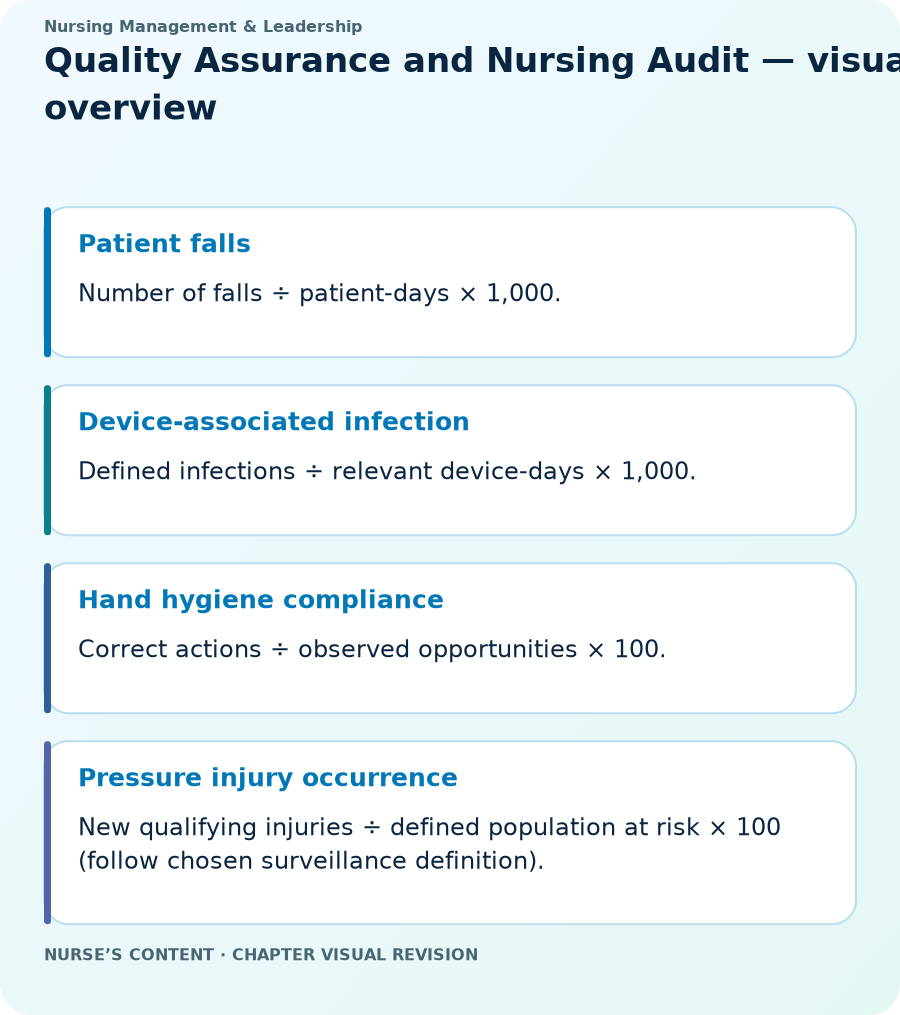
| Patient falls | Number of falls ÷ patient-days × 1,000. |
| Device-associated infection | Defined infections ÷ relevant device-days × 1,000. |
| Hand hygiene compliance | Correct actions ÷ observed opportunities × 100. |
| Pressure injury occurrence | New qualifying injuries ÷ defined population at risk × 100 (follow chosen surveillance definition). |
| Indicator | Example formula |
|---|---|
| Documentation completeness | Records meeting predefined criteria ÷ audited records × 100. |
Use explicit case definitions, denominators, sampling periods and consistent reporting. For example, 3 falls over 1,200 patient-days = 2.5 falls per 1,000 patient-days. A rising incident-report count may represent increased reporting rather than worse care. Review severity, context and trends.
3. Nursing audit
A nursing audit is a systematic review of care against explicit criteria to identify gaps and improve practice. Retrospective audit reviews completed records; concurrent audit examines ongoing care; prospective review assesses planned care before delivery. Clinical audit is a cycle: select a topic, define standards, collect and analyze data, compare with standards, implement changes and re-audit. It differs from research whose primary purpose is often generating new generalizable knowledge.
4. Example nursing audit
Audit: assessment of pressure injury risk on admission. Standard: risk assessed and documented within the locally defined period. Sample: 40 eligible records, 30 compliant. Compliance = 75%. Investigate barriers including assessment-tool access, training and admission workload. Improve the admission workflow, then repeat using the same criteria. Include balancing measures, such as documentation burden and actual preventive interventions.
5. Quality improvement methods
PDSA means Plan, Do, Study, Act. Plan a small change and measurement; test on a limited scale; review actual results; adopt, adapt or abandon. Root cause analysis (RCA) is a structured investigation of contributing factors after an event; failure mode and effects analysis (FMEA) proactively identifies potential failures and mitigations. Use process maps, run charts, checklists and cause-and-effect diagrams to support improvement. Avoid stopping at staff blame; address system design and human factors.
6. Accreditation and patient safety in India
NABH provides accreditation and a Nursing Excellence certification programme. The National Quality Assurance Standards (NQAS) support public health facility quality assessment and certification; revised standards issued in 2024 are available through NHSRC. Accreditation, certification and statutory professional registration serve different purposes. Facilities should use the applicable current edition and local regulations. Patient safety priorities include identity verification, medication safety, infection prevention, safe surgery, falls, communication and safe transitions.
7. Evidence-based nursing practice
Evidence-based practice integrates best available evidence, clinical expertise and patient values. Formulate a clinical question (PICO: population, intervention, comparison, outcome), search reliable sources, critically appraise evidence, apply appropriately and evaluate outcomes. Distinguish a guideline recommendation from a local protocol and adapt within authorized procedures.
8. Important Examination Questions
Long Answer Questions
- 1. Define nursing audit and describe the audit cycle with an example.
- 2. Explain quality assurance, quality improvement, clinical indicators and accreditation.
Short Answer Questions
- 1. Donabedian framework.
- 2. PDSA cycle.
- 3. RCA and FMEA.
- 4. NQAS and NABH.
- 5. PICO.
- 6. Calculation of fall rate.
Very Short Answer Questions (with answers)
- 1. What is an indicator? — A measure of performance.
- 2. What is re-audit? — Repeat assessment after improvement.
- 3. What does PDSA mean? — Plan, Do, Study, Act.
9. Quick Revision
- • Quality is measured through structure, process and outcomes.
- • Audit compares actual care with defined criteria and includes re-audit.
- • Quality improvement should target systems and measurable patient safety outcomes.
10. Conclusion
Quality is measured through structure, process and outcomes. Audit compares actual care with defined criteria and includes re-audit. Quality improvement should target systems and measurable patient safety outcomes.
Chapter reference images