Nursing Management & Leadership
Nursing Education and Staff Development
Orientation programmes, induction, continuing nursing education, in-service education, training methods, clinical teaching and professional development.
Open quizzes and study tools Download PDF
CHAPTER 10 / NURSING MANAGEMENT AND LEADERSHIP 10. Nursing Education and Staff Development
1. Meaning and objectives
Staff development is the planned improvement of knowledge, skills, attitudes and professional competence throughout employment. Nursing education in healthcare organizations supports safe practice, adaptation to changing evidence, effective teamwork and career progression. The nurse educator works with clinical leaders to identify learning needs and assess whether learning translates into patient care.
2. Induction, orientation and continuing education
| Programme | Purpose | Example |
|---|---|---|
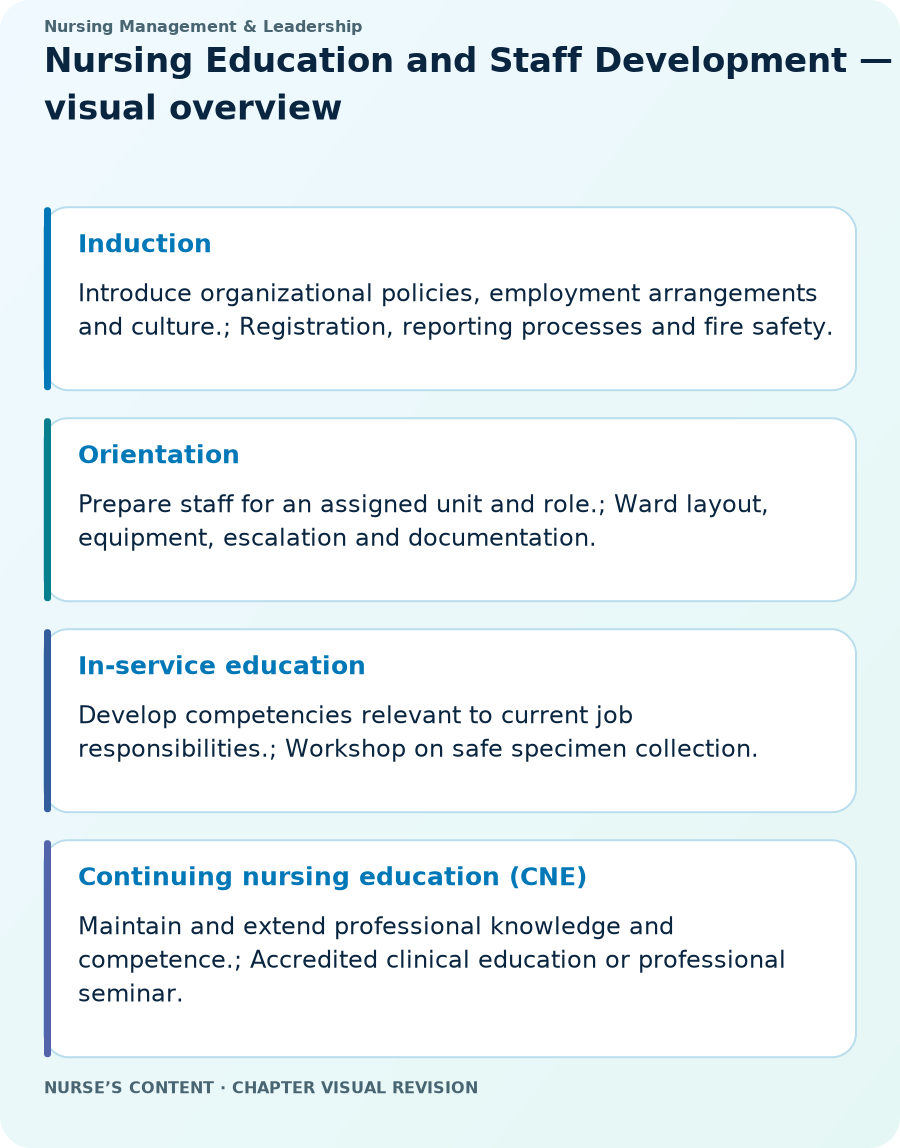
| Induction | Introduce organizational policies, employment arrangements and culture. | Registration, reporting processes and fire safety. |
| Orientation | Prepare staff for an assigned unit and role. | Ward layout, equipment, escalation and documentation. |
| In-service education | Develop competencies relevant to current job responsibilities. | Workshop on safe specimen collection. |
| Continuing nursing education (CNE) | Maintain and extend professional knowledge and competence. | Accredited clinical education or professional seminar. |
| Continuing professional development (CPD) | Broader ongoing learning and career development. | Mentorship, quality project, reflective practice. |
Orientation should be individualized: previous employment is not proof of competency in a new setting. High-risk skills require appropriately supervised demonstration and assessment before independent practice. Follow current regulator and employer requirements for education credits rather than assuming a universal number.
3. Educational needs assessment and planning
Identify gaps through staff surveys, observed performance, audit findings, new equipment, safety incidents and regulatory requirements. Determine whether education will address the cause: inadequate supplies or unsafe workloads require organizational changes as well. Define measurable learning objectives, select appropriate methods, identify resources, prepare materials and schedule learning without creating unsafe staffing shortages.
4. Training and clinical teaching methods
| Method | Advantages and limitations |
|---|---|
| Lecture and discussion | Efficient for concepts; discussion checks understanding, but practical skills need further training. |
| Demonstration and return demonstration | Builds procedural competency with direct feedback. |
| Simulation | Allows practice of rare or high-risk scenarios without exposing patients to avoidable risk. |
| Bedside teaching | Integrates clinical reasoning and patient care; maintain consent, privacy and dignity. |
| Case study and problem-based learning | Encourages analysis, prioritization and decision-making. |
| E-learning and blended learning | Flexible knowledge acquisition; verify engagement and practical competency separately. |
| Mentoring and preceptorship | Supports supervised integration into practice and career development. |
5. Evaluation of education
Assess immediate reaction, knowledge and skills acquired, change in workplace behaviour and resulting service outcomes. These correspond to the common Kirkpatrick evaluation framework. A written quiz assesses knowledge; an observed skills checklist assesses performance; an audit examines practice over time. Patient outcome changes may have several causes, so do not assume that a single programme produced them.
6. Example in-service education plan
Topic: prevention of medication identification errors. Audience: ward nurses. Objective: each participant correctly demonstrates two-identifier verification in a simulated medication round. Methods: short discussion, demonstration and supervised return demonstration. Evaluation: observed checklist and later audit of clinical practice. Document the date, participants, competencies achieved, remediation and follow-up.
7. Responsibilities of the nurse manager and educator
Provide protected learning time, appropriate trainers, resources and fair access to learning opportunities. Maintain competency records, facilitate remediation, monitor retention of critical skills and update training when practice changes. Support students through respectful supervision and ensure they work within approved scope.
8. Important Examination Questions
Long Answer Questions
- 1. Describe staff development and compare induction, orientation, in-service education and continuing education.
- 2. Prepare an in-service teaching plan with methods and evaluation.
Short Answer Questions
- 1. Clinical teaching methods.
- 2. Simulation.
- 3. Preceptorship.
- 4. Kirkpatrick evaluation.
- 5. Learning needs assessment.
Very Short Answer Questions (with answers)
- 1. What is CNE? — Continuing nursing education.
- 2. What is return demonstration? — Learner demonstrates a taught skill for assessment.
- 3. What is mentoring? — Developmental guidance from an experienced individual.
9. Quick Revision
- • Learning needs should determine the education plan.
- • Knowledge tests cannot replace assessment of practical competency.
- • Education is most useful when improvements transfer to safe bedside practice.
10. Conclusion
Learning needs should determine the education plan. Knowledge tests cannot replace assessment of practical competency. Education is most useful when improvements transfer to safe bedside practice.
Chapter reference images