Nursing Management & Leadership
Material and Financial Management
Budgeting, inventory control, purchasing, stores management, equipment management, maintenance, cost control and financial planning in nursing services.
Open quizzes and study tools Download PDF
CHAPTER 09 / NURSING MANAGEMENT AND LEADERSHIP 09. Material and Financial Management
1. Material management
Material management ensures that the correct supplies and equipment are available at the required place, time, quantity and quality, at a reasonable total cost. The cycle includes needs assessment, specification, procurement, receiving and inspection, storage, issuing, utilization, maintenance and disposal.
2. Purchasing and stores management
Estimate demand using consumption, patient workload, existing stock, lead time and emergency reserves. Prepare clear specifications, follow approved procurement and tender rules, evaluate suppliers on quality, price, safety, reliability and service, and document receipt and inspection. Separate incompatible materials, secure restricted stock and maintain temperature conditions specified by manufacturers. Use stock cards or electronic records and reconcile physical stock. Follow FEFO (first expiry, first out) for expiry-dated items and FIFO where appropriate. Quarantine damaged, recalled or expired goods according to policy; do not return them to usable stock.
3. Inventory control techniques
| Technique | Basis and application |
|---|---|
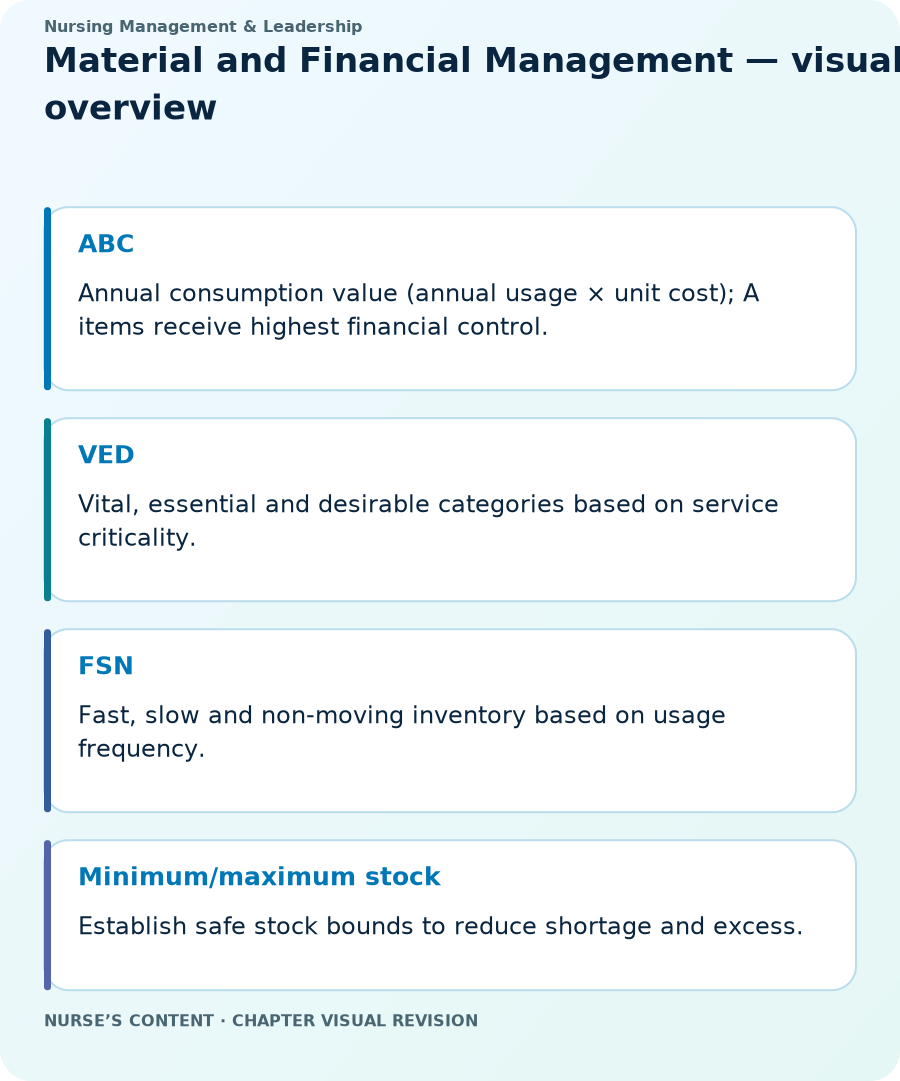
| ABC | Annual consumption value (annual usage × unit cost); A items receive highest financial control. |
| VED | Vital, essential and desirable categories based on service criticality. |
| FSN | Fast, slow and non-moving inventory based on usage frequency. |
| Minimum/maximum stock | Establish safe stock bounds to reduce shortage and excess. |
| Reorder level | Expected consumption during replenishment lead time plus safety stock. |
ABC percentage boundaries vary by organization; high financial value is not the same as clinical criticality. A low-cost vital airway item may require close monitoring regardless of its ABC class.
4. Worked inventory example
An item is used at 10 units daily, delivery takes 5 days and safety stock is 20 units. Reorder level = (10 × 5) + 20 = 70 units. Review lead-time variation and stock already on order. If annual use is 1,200 units at ₹25 each, annual consumption value = ₹30,000. These hypothetical calculations illustrate inventory planning, not recommended clinical stock levels.
5. Equipment management
Create an asset register with identification, location, status and maintenance dates. Check functionality before use, follow manufacturer instructions and calibration schedules, maintain preventive maintenance records, train users and report malfunction. Remove unsafe equipment from clinical use, label it and arrange authorized repair. Plan replacement based on safety, lifespan, service availability and whole-life cost.
6. Budgeting and financial management
A budget is a quantified plan of expected revenue and expenditure for a period. Nursing budgets may include salaries, consumables, maintenance, training and equipment. Operating budgets cover recurring expenditure; capital budgets cover long-term assets. Incremental budgeting uses a previous budget as a baseline; zero-based budgeting requires justification of activities and costs; flexible budgeting adjusts expected costs for workload; performance budgeting links spending to outputs or outcomes.
- 1. Assess service volume, objectives, staffing and required resources.
- 2. Estimate expenses and available funding; prioritize safety-critical needs.
- 3. Submit the proposal for review and approval.
- 4. Implement purchases and monitor expenditure.
- 5. Analyze variances and take corrective action without compromising care.
7. Worked budget example
| Category | Monthly budget | Actual expenditure |
|---|---|---|
| Nursing salaries | ₹600,000 | ₹620,000 |
| Consumables | ₹100,000 | ₹90,000 |
| Equipment maintenance | ₹25,000 | ₹30,000 |
| Total | ₹725,000 | ₹740,000 |
For cost reporting using actual minus budget, the variance is ₹15,000 unfavorable (2.07% over budget). Investigate increased staffing need and maintenance expenditure; determine whether consumable savings reflect better purchasing or unmet care. A favorable variance is not necessarily desirable if it results from stock-outs.
8. Nursing responsibilities
Predict requirements, avoid avoidable waste, verify stocks, report shortages and defective items, maintain controlled-drug records and coordinate with stores and finance. Cost containment should focus on removing unnecessary duplication and improving procurement and utilization, not withholding indicated care.
9. Important Examination Questions
Long Answer Questions
- 1. Explain material management and its inventory control methods.
- 2. Describe budgeting, its types and steps with a numerical example.
Short Answer Questions
- 1. ABC and VED analysis.
- 2. FEFO.
- 3. Reorder level.
- 4. Capital versus operating budget.
- 5. Equipment maintenance.
Very Short Answer Questions (with answers)
- 1. What is ABC analysis based on? — Annual consumption value.
- 2. What is VED based on? — Clinical criticality.
- 3. What is a budget variance? — Difference between actual and planned financial amounts.
10. Quick Revision
- • Material management protects reliable availability of safe supplies.
- • ABC and VED address different inventory risks.
- • Financial decisions must not undermine patient safety.
11. Conclusion
Material management protects reliable availability of safe supplies. ABC and VED address different inventory risks. Financial decisions must not undermine patient safety.
Chapter reference images