Nursing Management & Leadership
Human Resource Management in Nursing
Human resource planning, job description, job specification, staff development, performance appraisal, promotion, transfer, grievance handling and disciplinary procedures.
Open quizzes and study tools Download PDF
CHAPTER 08 / NURSING MANAGEMENT AND LEADERSHIP 08. Human Resource Management in Nursing
1. Definition and objectives
Human resource management (HRM) is the coordinated management of people throughout their employment, from workforce planning and recruitment to development, retention and separation. It aims to maintain an appropriate, competent workforce, support fair working conditions and align staff development with service needs.
2. HR planning and recruitment
Estimate future demand from census, acuity, expansion, retirement, turnover, skills and anticipated leave. Compare demand with available staff, identify gaps and plan recruitment, training or redeployment. Selection should be transparent and job-related: verify educational qualifications, registration where required, references, actual competency and eligibility. Provide reasonable accommodation and avoid discriminatory selection.
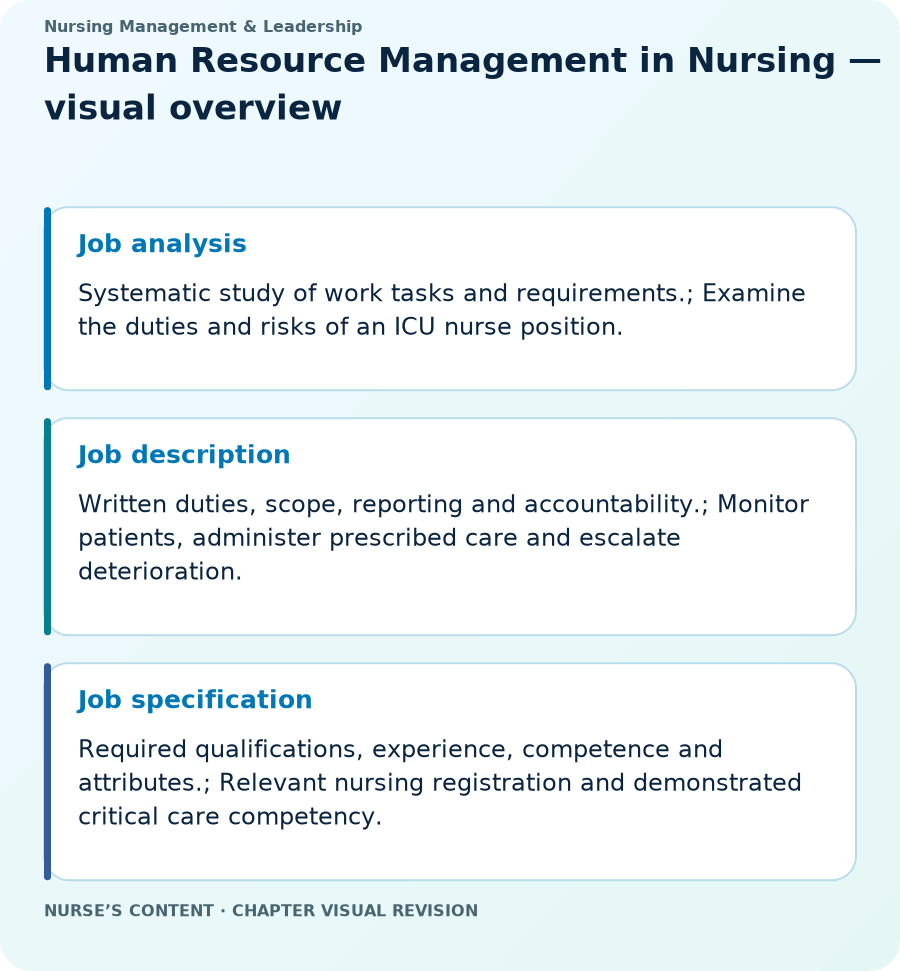
3. Job analysis, job description and job specification
| Term | Meaning | Example |
|---|---|---|
| Job analysis | Systematic study of work tasks and requirements. | Examine the duties and risks of an ICU nurse position. |
| Job description | Written duties, scope, reporting and accountability. | Monitor patients, administer prescribed care and escalate deterioration. |
| Job specification | Required qualifications, experience, competence and attributes. | Relevant nursing registration and demonstrated critical care competency. |
Avoid setting requirements that unnecessarily exclude candidates or misrepresent legal scope of practice. Review descriptions when responsibilities or technology change.
4. Staff development and appraisal
Development includes induction, orientation, continuing education, clinical skills training, mentoring and career planning. Identify learning needs from competency evaluations, changes in practice, incident reviews and staff input. Appraisal should evaluate performance against measurable standards and create an individual development plan. Discuss achievements and barriers, agree on resources and follow up. Recognize improvements rather than using appraisal solely as a penalty mechanism.
5. Promotion and transfer
Promotion is movement to a role with greater responsibility and usually higher grade or remuneration. It should follow transparent eligibility, competency and selection criteria. Transfer is movement to a different unit, shift or location, generally at a similar level. Transfers may address service needs, learning or employee requests, but require safe orientation and respect for employment conditions. Never transfer staff into an unfamiliar high-risk role without appropriate training and supervision.
6. Grievance handling
A grievance is a work-related complaint about conditions, treatment or decisions. Provide accessible and confidential channels, acknowledge the complaint, assess immediate safety, gather facts impartially, hear affected parties, communicate a reasoned decision and provide an appeal or review process as applicable. Protect against retaliation and follow applicable workplace law and institutional policy. Harassment or violence requires designated safeguarding and formal reporting procedures.
7. Disciplinary procedures and just culture
Discipline maintains safe, professional behaviour through fair and proportionate processes. A just culture distinguishes inadvertent human error, at-risk choices and reckless conduct while examining system contributions. Serious unsafe conduct may require immediate protective action, followed by documented investigation and due process. Depending on policy, responses may include coaching, warnings, improvement plans or formal disciplinary action. Do not equate incident reporting with wrongdoing.
8. HR indicators
| Indicator | Formula/interpretation |
|---|---|
| Turnover (%) | Separations during period ÷ average headcount × 100 (use consistent definition). |
| Vacancy rate (%) | Vacant approved posts ÷ total approved posts × 100. |
| Absence rate (%) | Unplanned absence hours ÷ scheduled work hours × 100. |
| Training completion (%) | Eligible staff completing training ÷ eligible staff × 100. |
A unit with 12 vacancies among 80 approved posts has a 15% vacancy rate. Examine workload, retention, wellbeing and safety rather than individualizing organizational shortages.
9. Important Examination Questions
Long Answer Questions
- 1. Explain the functions of HR management in nursing.
- 2. Describe recruitment, promotion, transfer, grievance and disciplinary processes.
Short Answer Questions
- 1. Job description versus job specification.
- 2. Staff appraisal.
- 3. Grievance handling.
- 4. Just culture.
- 5. HR indicators.
Very Short Answer Questions (with answers)
- 1. What is recruitment? — Attracting suitable applicants.
- 2. What is transfer? — Movement between posts or units.
- 3. What is a vacancy rate? — Vacant approved posts as a percentage of approved posts.
10. Quick Revision
- • HR management supports the entire employment cycle.
- • Competence, fair processes and safe staffing protect patients and employees.
- • Just culture balances system learning with accountability.
11. Conclusion
HR management supports the entire employment cycle. Competence, fair processes and safe staffing protect patients and employees. Just culture balances system learning with accountability.
Chapter reference images