Nursing Management & Leadership
Directing, Supervising and Controlling
Principles of direction, supervision, monitoring, performance appraisal, quality control and evaluation of nursing services.
Open quizzes and study tools Download PDF
CHAPTER 06 / NURSING MANAGEMENT AND LEADERSHIP 06. Directing, Supervising and Controlling
1. Directing
Directing is guiding personnel towards planned objectives by communication, motivation, instruction, leadership, coordination and supervision. It converts plans into action. A nurse manager communicates expected care standards, clarifies assignments and facilitates staff access to necessary resources.
2. Principles of effective direction
- • Communicate specific instructions and confirm understanding.
- • Match the assignment to competence and available resources.
- • Establish clear authority, responsibility and expected outcomes.
- • Encourage feedback and recognize good performance.
- • Maintain professional respect, consistency and fairness.
- • Reassess workload and provide assistance when conditions change.
3. Supervision
Supervision is the process of overseeing, guiding and supporting personnel to ensure safe and competent work. Direct supervision involves observation of actual performance; indirect supervision uses reports, documentation, consultation and periodic review when appropriate. The degree of supervision must reflect the individual's competency, the activity's risk and relevant regulation. Clinical supervision may also provide structured reflection and professional support.
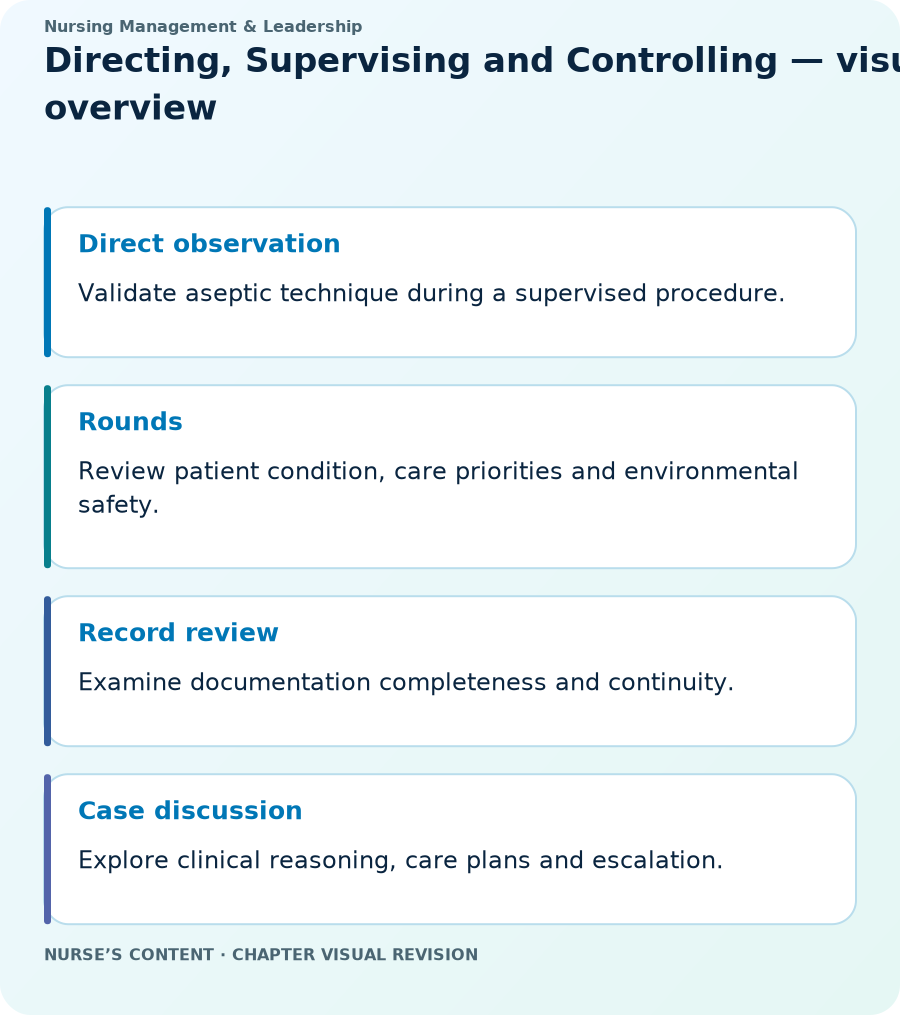
| Supervisory method | Application |
|---|---|
| Direct observation | Validate aseptic technique during a supervised procedure. |
| Rounds | Review patient condition, care priorities and environmental safety. |
| Record review | Examine documentation completeness and continuity. |
| Case discussion | Explore clinical reasoning, care plans and escalation. |
| Coaching and feedback | Correct a skill gap through demonstration and practice. |
4. Monitoring, controlling and evaluation
Monitoring is continuous collection and review of information on progress. Control is comparing actual performance against agreed standards and taking appropriate corrective action. Evaluation is systematic judgment of the effectiveness, efficiency and outcomes of a programme or service. Formative evaluation occurs during implementation to guide changes; summative evaluation examines results after a defined period.
- 1. Establish evidence-informed standards and measurable indicators.
- 2. Measure performance using reliable, defined data.
- 3. Compare actual performance with the standard.
- 4. Investigate significant gaps and their causes.
- 5. Implement corrective action and assign responsibility.
- 6. Re-measure and sustain effective improvements.
Feedforward control anticipates problems before activities begin (competency checks); concurrent control operates during the work (bedside supervision); feedback control uses completed results (audit review).
5. Performance appraisal
Performance appraisal is a structured assessment of staff performance against agreed job expectations. Methods include rating scales, objective-based review, competency checklists, peer feedback, self-assessment and validated multisource feedback. Use relevant criteria, direct evidence, transparent standards and confidential discussion. Avoid halo effect, recency bias, personal preferences and discrimination. Develop a mutually understood improvement plan with support, deadlines and reassessment; distinguish learning needs from serious unsafe practice that requires prompt escalation.
6. Example: medication safety control
An audit finds that 8 of 100 eligible medication administrations lack documented identity verification. The manager checks the observation method, staffing, identification-band availability and interruptions. After coaching and system improvement, the team repeats the audit and monitors reported errors and staff feedback. Better documentation alone is not proof that actual verification improved.
7. Important Examination Questions
Long Answer Questions
- 1. Describe directing and supervision in nursing services.
- 2. Explain the controlling process with a clinical quality example.
Short Answer Questions
- 1. Types of supervision.
- 2. Performance appraisal methods.
- 3. Formative versus summative evaluation.
- 4. Feedback control.
Very Short Answer Questions (with answers)
- 1. What is concurrent control? — Monitoring during work.
- 2. What is appraisal? — Structured assessment of performance.
- 3. What is monitoring? — Ongoing collection and review of progress information.
8. Quick Revision
- • Direction guides work and supervision protects safety.
- • Controlling compares performance with standards and corrects gaps.
- • Feedback should be specific, fair and linked to improvement.
9. Conclusion
Direction guides work and supervision protects safety. Controlling compares performance with standards and corrects gaps. Feedback should be specific, fair and linked to improvement.
Chapter reference images