Nursing Management & Leadership
Leadership in Nursing
Concept, characteristics, functions and styles of leadership; autocratic, democratic, laissez-faire, transformational, transactional and situational leadership.
Open quizzes and study tools Download PDF
CHAPTER 05 / NURSING MANAGEMENT AND LEADERSHIP 05. Leadership in Nursing
1. Definition and importance
Leadership is the process of influencing, guiding and supporting individuals or groups to achieve shared goals. Nursing leadership promotes patient safety, professional development, effective teamwork, innovation and ethical care. Formal leadership comes from appointed roles; informal leadership arises through expertise, credibility and influence.
A manager plans and administers resources and systems; a leader guides people towards a shared purpose. Effective nurse managers need both sets of abilities.
2. Characteristics and functions of a leader
- • Clinical credibility, integrity, fairness and accountability.
- • Clear vision, decision-making and communication.
- • Emotional intelligence, self-awareness and empathy.
- • Ability to motivate, delegate, coach and resolve conflict.
- • Advocacy for patient rights, safe staffing and staff wellbeing.
- • Capacity to adapt under pressure and evaluate outcomes.
3. Leadership styles
| Style | Characteristics | Nursing application |
|---|---|---|
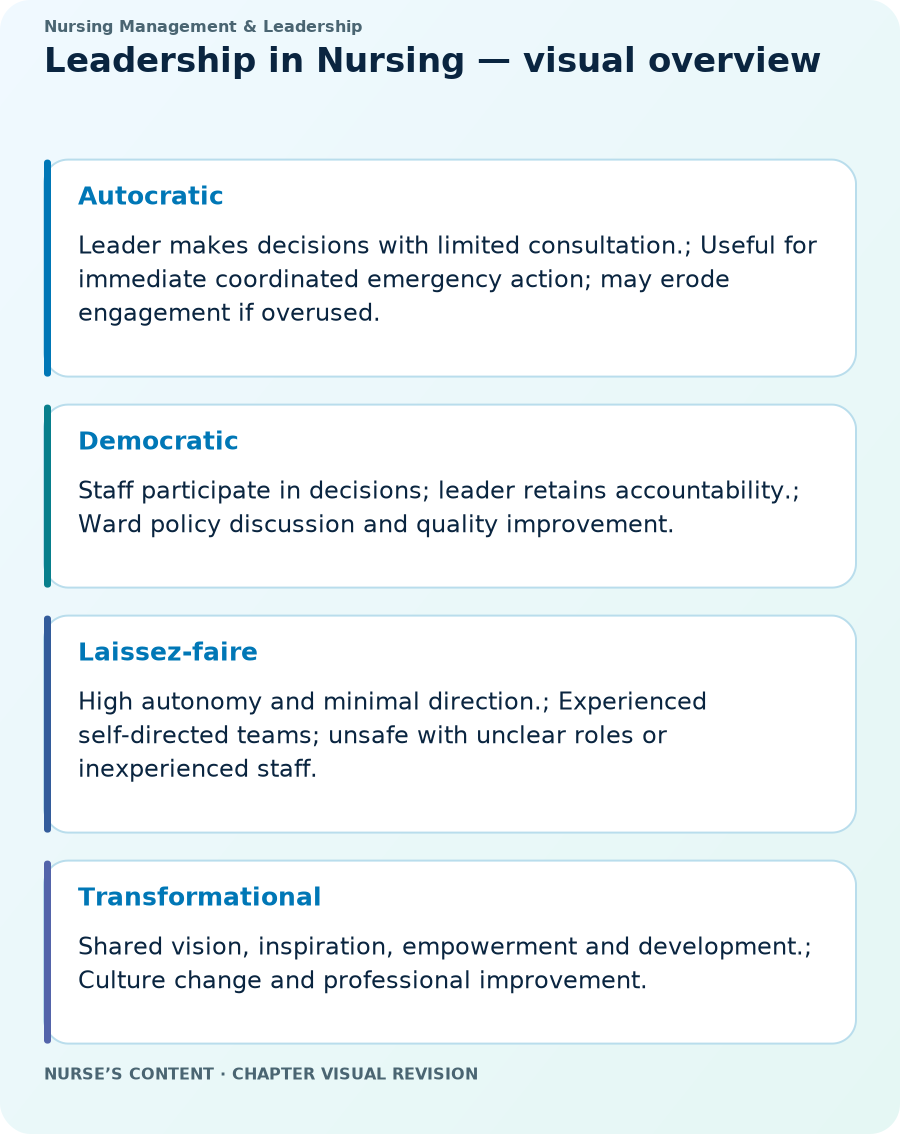
| Autocratic | Leader makes decisions with limited consultation. | Useful for immediate coordinated emergency action; may erode engagement if overused. |
| Democratic | Staff participate in decisions; leader retains accountability. | Ward policy discussion and quality improvement. |
| Laissez-faire | High autonomy and minimal direction. | Experienced self-directed teams; unsafe with unclear roles or inexperienced staff. |
| Transformational | Shared vision, inspiration, empowerment and development. | Culture change and professional improvement. |
| Transactional | Explicit expectations, feedback, rewards and corrective action. | Reliable completion of agreed performance requirements. |
| Situational | Style adjusted to staff competence, confidence and context. | Direct novice staff closely; coach and delegate to experienced staff as appropriate. |
4. Leadership theories
Trait approaches consider personal qualities; behavioural approaches focus on leadership behaviours; contingency approaches consider the fit between style and context. Transformational leadership is often discussed through idealized influence, inspirational motivation, intellectual stimulation and individualized consideration. Servant leadership emphasizes serving others, developing staff and ethical stewardship. None of these models removes the need for clear clinical accountability.
5. Leadership in clinical emergencies
During sudden patient deterioration, designate a leader, activate the appropriate emergency team, assign tasks by competence, communicate with closed-loop confirmation and reassess rapidly. Once the immediate threat is controlled, conduct a supportive debrief. Directive leadership during an emergency does not justify routinely silencing staff concerns.
6. Developing effective leadership
Use mentorship, self-reflection, feedback, simulation, continuing education, audit participation and progressively responsible assignments. Monitor turnover, staff feedback, safety culture and quality outcomes together rather than attributing performance to one individual. A leader should create psychological safety so staff can question an unsafe order, report a near miss and seek help without inappropriate retaliation.
7. Important Examination Questions
Long Answer Questions
- 1. Define leadership and discuss its styles with nursing examples.
- 2. Compare leadership and management and describe qualities of an effective nurse leader.
Short Answer Questions
- 1. Transformational leadership.
- 2. Situational leadership.
- 3. Democratic versus autocratic leadership.
- 4. Emotional intelligence.
- 5. Leadership in emergencies.
Very Short Answer Questions (with answers)
- 1. What is informal leadership? — Influence without formal appointment.
- 2. Which style involves participation? — Democratic leadership.
- 3. What is transactional leadership? — Leadership based on explicit expectations and exchanges.
8. Quick Revision
- • Leadership guides people towards shared patient-centred goals.
- • Different situations require different leadership approaches.
- • A safe leader encourages escalation and learning.
9. Conclusion
Leadership guides people towards shared patient-centred goals. Different situations require different leadership approaches. A safe leader encourages escalation and learning.
Chapter reference images