Nursing Management & Leadership
Organizing and Staffing
Organizational structure, organizational charts, authority, responsibility, delegation, staffing patterns, manpower planning, recruitment, selection and placement.
Open quizzes and study tools Download PDF
CHAPTER 04 / NURSING MANAGEMENT AND LEADERSHIP 04. Organizing and Staffing
1. Organizing and organizational structure
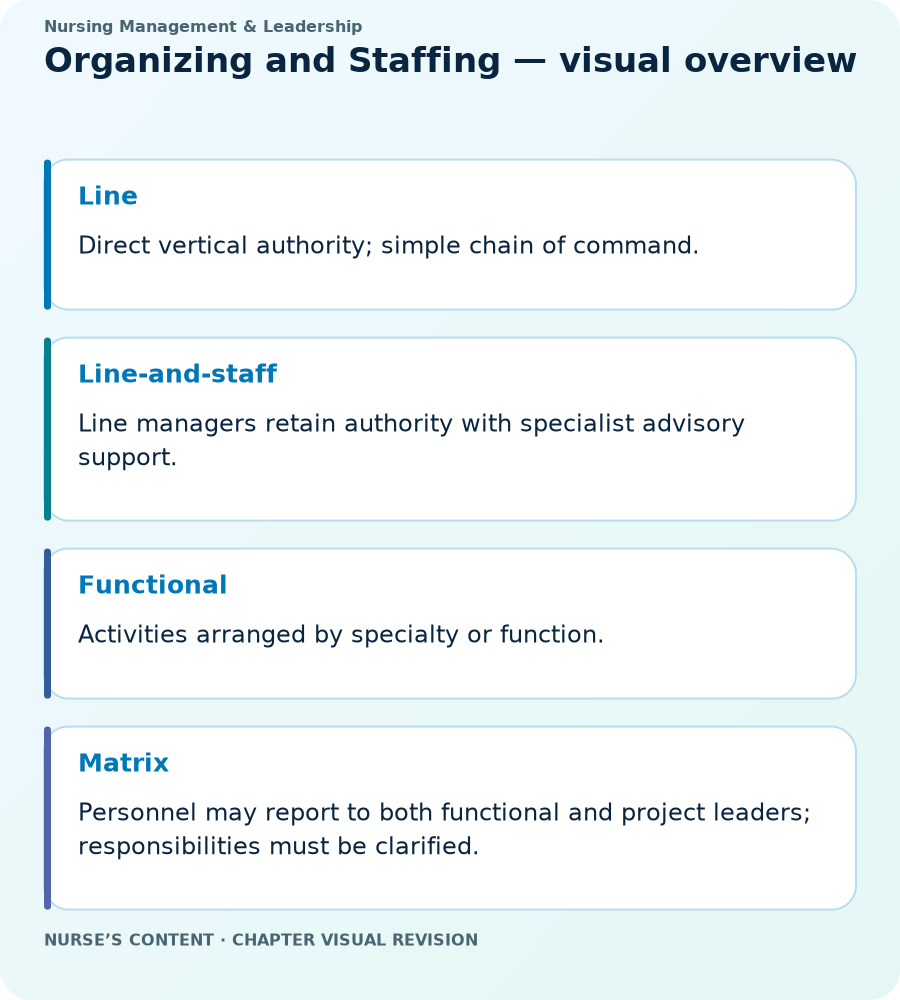
Organizing is arranging activities, people, authority and resources to implement plans. An organizational chart illustrates reporting relationships, formal levels and designated authority. The chart should be supported by job descriptions, escalation pathways and cross-departmental communication.
| Structure | Features |
|---|---|
| Line | Direct vertical authority; simple chain of command. |
| Line-and-staff | Line managers retain authority with specialist advisory support. |
| Functional | Activities arranged by specialty or function. |
| Matrix | Personnel may report to both functional and project leaders; responsibilities must be clarified. |
| Decentralized | Decision-making occurs closer to service delivery within defined authority. |
Typical nursing hierarchy (titles vary): director/chief nursing officer → nursing superintendent → deputy/assistant superintendent → ward or unit manager → registered nursing personnel and authorized support staff. Span of control is the number of people directly supervised; appropriate span depends on task complexity, experience and available support.
2. Authority, responsibility, accountability and delegation
Authority is the legitimate power to make decisions; responsibility is the obligation to perform assigned duties; accountability is answerability for one's decisions and actions. Delegation transfers performance of an appropriate activity, not all professional accountability. A registered nurse remains responsible for appropriate delegation and supervision; the recipient remains accountable for their own actions within competence.
Five rights of delegation: right task, circumstances, person, direction/communication, and supervision/evaluation. Assessment requiring independent clinical judgment, care planning and evaluation should remain with qualified nurses according to scope. Never delegate an activity merely because a worker is available; check credentials and competency.
3. Staffing and manpower planning
Staffing involves estimating needs, recruiting, selecting, placing, scheduling, orienting and retaining competent staff. Consider census, patient acuity, dependency, admissions/discharges, isolation, direct and indirect care, skill mix, breaks, leave, night shifts, emergencies and local staffing requirements. Fixed nurse-to-patient ratios alone may not reflect complexity.
4. Worked staffing calculation
For illustration only, assume 24 occupied beds and five required nursing hours per patient day. Daily required nursing hours = 24 × 5 = 120. Weekly requirement = 840 hours. If each full-time employee supplies 36 productive care hours per week on average, estimated staffing = 840 ÷ 36 = 23.33, rounded up to 24 full-time equivalents. Validate the assumed hours, skill mix, shift distribution and backup coverage; avoid double-counting leave if productive hours already account for it. This is not a prescribed national staffing norm.
5. Recruitment, selection and placement
Recruitment attracts eligible candidates through approved internal or external methods. Selection verifies qualifications, current registration where required, clinical competencies, references and suitability through fair criteria. Placement assigns the selected candidate to an appropriate unit. Induction covers organizational policies; orientation builds unit-specific readiness; supervised practice and competency assessment precede independent high-risk activities.
6. Nursing care delivery models
| Model | Main feature | Limitation |
|---|---|---|
| Case method/total patient care | One assigned nurse delivers comprehensive care during a shift. | Resource intensive for complex care. |
| Functional nursing | Work divided by tasks. | Fragmented care if coordination is weak. |
| Team nursing | Qualified leader coordinates a mixed-skill team. | Needs communication and supervision. |
| Primary nursing | A designated nurse coordinates the patient's care plan across the stay. | Requires continuity and adequate experienced personnel. |
| Case management | Coordinates care across settings, resources and time. | Depends on interdisciplinary cooperation. |
7. Duty roster
Prepare an equitable roster ensuring appropriate coverage, rest, weekly off days, leave and competency mix. Allocate by acuity rather than bed count alone. Record changes, avoid unsafe overtime and activate backup staffing or escalation if demand exceeds available capacity. Reassess each shift.
8. Important Examination Questions
Long Answer Questions
- 1. Explain organizing, staffing and manpower planning in a nursing unit.
- 2. Explain delegation and nursing care delivery models with examples.
Short Answer Questions
- 1. Organizational chart.
- 2. Span of control.
- 3. Recruitment and selection.
- 4. Nurse staffing calculation.
- 5. Duty roster.
Very Short Answer Questions (with answers)
- 1. What is unity of command? — A defined reporting authority.
- 2. Does delegation remove accountability? — No.
- 3. What is skill mix? — The combination of staff competencies and roles.
9. Quick Revision
- • Organizing defines relationships and responsibilities.
- • Staffing must match workload, acuity and competence.
- • Safe delegation requires clear directions, scope and supervision.
10. Conclusion
Organizing defines relationships and responsibilities. Staffing must match workload, acuity and competence. Safe delegation requires clear directions, scope and supervision.
Chapter reference images