Nursing Management & Leadership
Planning and Decision-Making
Meaning, types and steps of planning, strategic planning, operational planning, decision-making process, problem-solving and nursing action plans.
Open quizzes and study tools Download PDF
CHAPTER 03 / NURSING MANAGEMENT AND LEADERSHIP 03. Planning and Decision-Making
1. Definition and purpose
Planning is deciding in advance what is to be achieved, how, by whom, when and with what resources. It reduces uncertainty, coordinates work, prepares for emergencies and establishes criteria for evaluation. A plan should be realistic, flexible, evidence-informed and patient-centred.
2. Types and components of plans
| Type | Characteristics | Example |
|---|---|---|
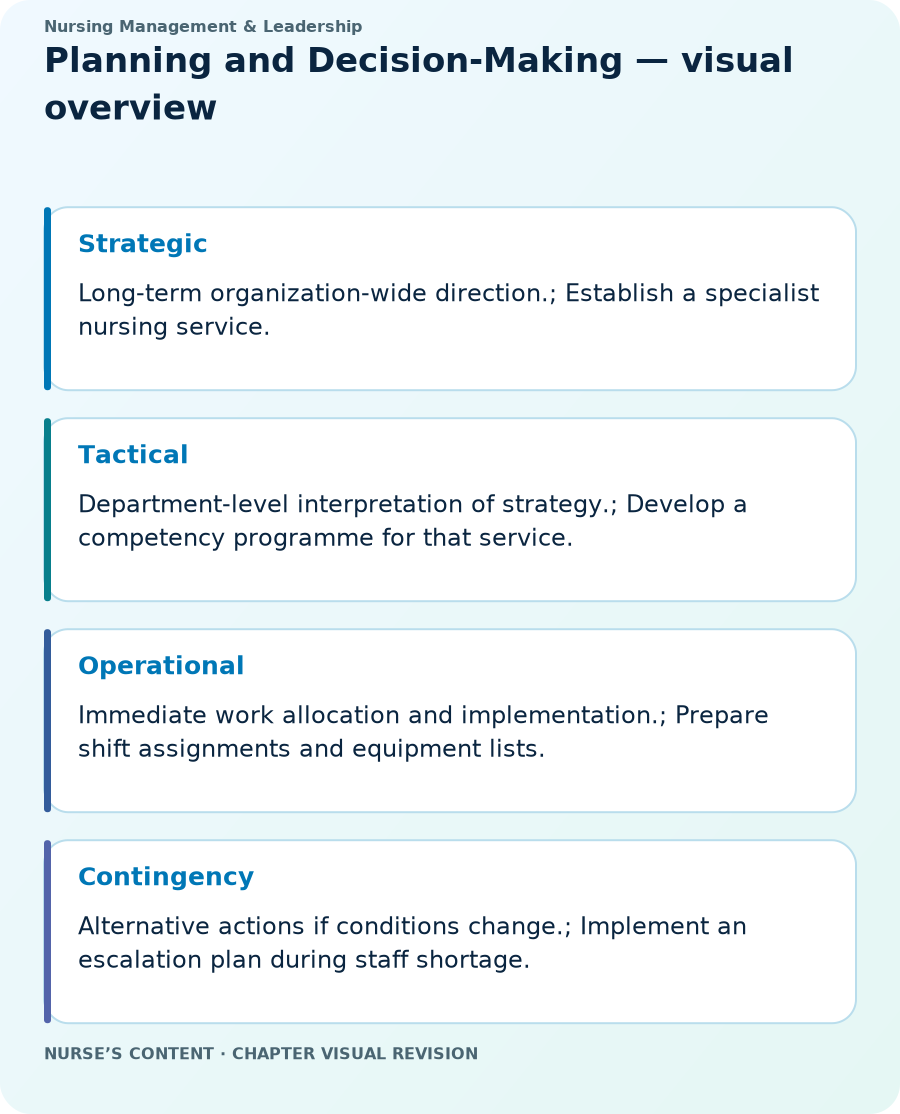
| Strategic | Long-term organization-wide direction. | Establish a specialist nursing service. |
| Tactical | Department-level interpretation of strategy. | Develop a competency programme for that service. |
| Operational | Immediate work allocation and implementation. | Prepare shift assignments and equipment lists. |
| Contingency | Alternative actions if conditions change. | Implement an escalation plan during staff shortage. |
| Standing | Repeated guidance for routine situations. | Policies, procedures and protocols. |
| Single-use | Designed for a particular activity. | A scheduled infection-prevention campaign. |
A mission defines the organization's purpose; vision describes the desired future; objectives define desired results. Policies guide decisions, procedures describe steps, rules define required or prohibited actions, and budgets express plans in financial terms. SMART objectives are specific, measurable, achievable, relevant and time-bound.
3. Steps in planning
- 1. Assess current situation, needs, resources and safety risks.
- 2. Identify priorities and formulate measurable objectives.
- 3. Identify alternative actions and assess feasibility, benefits, costs and risks.
- 4. Select an approach, define responsibilities and allocate resources.
- 5. Set deadlines, indicators, escalation criteria and contingency plans.
- 6. Communicate and implement the plan.
- 7. Monitor progress, evaluate results and revise as necessary.
SWOT analysis examines internal strengths and weaknesses and external opportunities and threats. A Gantt chart displays tasks along a timeline; PERT and critical path analysis identify dependent activities and potential schedule bottlenecks.
4. Decision-making and problem-solving
Decision-making means selecting an appropriate action among alternatives. Decisions can be programmed (routine, rules-based) or non-programmed (novel, requiring judgment), individual or shared, and strategic or operational. The rational model includes defining the problem, collecting reliable information, generating alternatives, comparing risks and benefits, selecting and implementing an option, and reviewing the outcome. In urgent clinical decisions follow approved escalation and emergency protocols rather than delaying for a full committee process.
Problem-solving aims to identify the actual cause rather than its symptoms. A fishbone diagram categorizes possible causes, the five-whys technique explores causal chains, and a Pareto chart highlights the most frequent contributors. Investigate systemic factors rather than automatically blaming a particular staff member.
5. Example nursing action plan
Problem: only 72 of 100 observed hand hygiene opportunities met the standard. Objective: improve measured compliance to at least 90% within eight weeks (illustrative target).
| Activity | Responsible person | Timing/indicator |
|---|---|---|
| Review supply and workflow | Ward manager and infection-control nurse | Week 1; identify barriers. |
| Place hand rub at care points and teach indications | Stores and infection-control team | Weeks 2–3; supplies and competency check. |
| Observe practice and provide feedback | Trained observer | Weekly; compliant actions ÷ observed opportunities × 100. |
| Evaluate and adjust | Quality team | Week 8; compare results and check unintended effects. |
6. Common barriers
Unclear objectives, inadequate data, unrealistic staffing assumptions, limited resources, resistance to change and poorly assigned responsibilities can prevent implementation. Involve frontline workers, ensure management support and set a feedback mechanism. A missed target may require system redesign, not simply stronger enforcement.
7. Important Examination Questions
Long Answer Questions
- 1. Define planning and describe its types, steps and importance.
- 2. Explain decision-making and problem-solving with a nursing action plan.
Short Answer Questions
- 1. SMART objectives.
- 2. SWOT analysis.
- 3. Gantt chart.
- 4. Programmed and non-programmed decisions.
- 5. Fishbone diagram.
Very Short Answer Questions (with answers)
- 1. What is operational planning? — Short-term implementation planning.
- 2. What is a contingency plan? — An alternative plan for unexpected events.
- 3. What does SMART stand for? — Specific, measurable, achievable, relevant and time-bound.
8. Quick Revision
- • Planning turns objectives into accountable actions.
- • Decision-making compares alternatives and considers patient safety.
- • Evaluation and feedback make planning a continuous process.
9. Conclusion
Planning turns objectives into accountable actions. Decision-making compares alternatives and considers patient safety. Evaluation and feedback make planning a continuous process.
Chapter reference images