Nursing Management & Leadership
Principles and Theories of Management
Classical, scientific, administrative, human relations and modern management theories; management principles and their application in nursing.
Open quizzes and study tools Download PDF
CHAPTER 02 / NURSING MANAGEMENT AND LEADERSHIP 02. Principles and Theories of Management
1. Classical approach
Classical management emphasizes formal structure, predictable procedures, division of labour and efficiency. Its main traditions are scientific management, administrative management and bureaucracy. These approaches help establish consistent clinical processes but may underestimate individual needs and informal relationships.
2. Scientific management — Frederick W. Taylor
Taylor studied work methods to improve efficiency through systematic analysis, selection and training of workers, standardization and cooperation between management and workers. In nursing, time-and-motion studies can identify wasted walking, poorly arranged stores and unnecessary duplication. A standard dressing trolley may reduce preparation time. Standardization must not turn individualized care into inflexible tasks or penalize staff working with complex patients.
3. Administrative theory — Henri Fayol
Fayol described planning, organizing, commanding, coordinating and controlling as managerial activities. His fourteen principles are:
| Principle | Meaning in nursing administration |
|---|---|
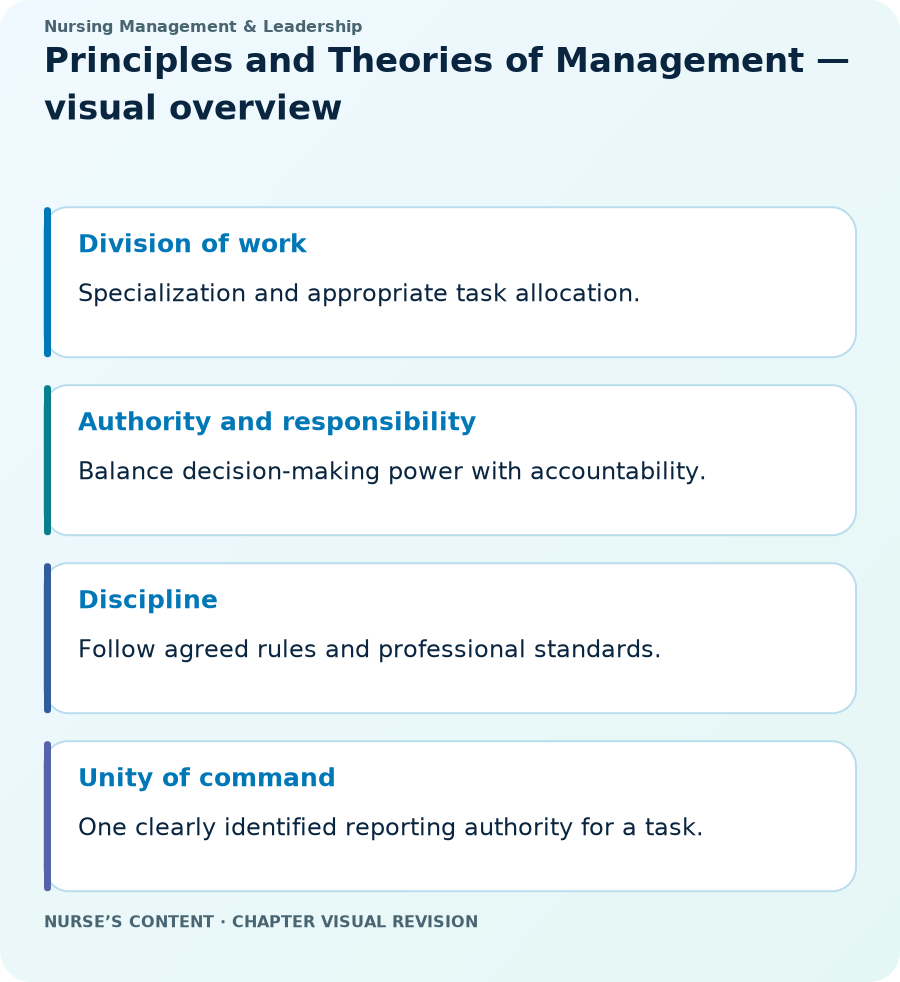
| Division of work | Specialization and appropriate task allocation. |
| Authority and responsibility | Balance decision-making power with accountability. |
| Discipline | Follow agreed rules and professional standards. |
| Unity of command | One clearly identified reporting authority for a task. |
| Unity of direction | Common plan for activities with the same objective. |
| Subordination of individual interest | Patient and organizational interests take precedence over improper personal advantage. |
| Remuneration | Fair and appropriate compensation. |
| Centralization | Balance central authority with local decision-making. |
| Principle | Meaning in nursing administration |
|---|---|
| Scalar chain | Defined line of authority with safe escalation pathways. |
| Order | Appropriate arrangement of people and materials. |
| Equity | Fair, respectful treatment. |
| Stability of tenure | Retain trained personnel where possible. |
| Initiative | Encourage staff to propose improvements. |
| Esprit de corps | Promote teamwork and mutual support. |
4. Bureaucratic theory — Max Weber
Weber described rational authority, hierarchy, written rules, specialist roles and merit-based appointment. Hospitals use credentialing, standard operating procedures and reporting hierarchies to reduce arbitrary decisions. Excessive bureaucracy may delay emergency action or discourage innovation; safe escalation should be explicitly supported.
5. Human relations approach
Elton Mayo and the Hawthorne studies are historically associated with recognition of social relationships, informal groups and employee morale. The studies have methodological limitations; they do not establish a universal productivity effect from attention alone. Nurses benefit from meaningful participation, supportive supervision and psychological safety. Behavioural theorists expanded attention to motivation and human needs, including Maslow, Herzberg and McGregor.
| Theory | Central idea | Nursing application |
|---|---|---|
| Maslow | Needs organized in a broad hierarchy. | Attend to safety, belonging, recognition and growth; avoid treating the hierarchy as universal. |
| Herzberg | Hygiene factors reduce dissatisfaction; motivators support satisfaction. | Improve working conditions and provide recognition and career growth. |
| McGregor X and Y | Contrasting assumptions about employee motivation and autonomy. | Use empowerment and appropriate supervision rather than assuming all staff avoid work. |
6. Modern theories
Systems theory treats the hospital as an open system: inputs (staff, equipment, funds) are transformed through care processes into outputs and outcomes, with feedback guiding improvement. Contingency theory states that management should adapt to circumstances rather than depend on one universally best approach. Quantitative approaches use forecasting, workload measures and decision models. Socio-technical approaches consider both technology and human relationships.
7. Application in nursing
An emergency department may combine standardized triage protocols (classical), team support and participatory review (human relations), workload forecasting (quantitative), and flexible surge staffing (contingency). Select approaches by patient need, risk and evidence. Management theories are conceptual frameworks rather than clinical treatment rules.
8. Important Examination Questions
Long Answer Questions
- 1. Explain Fayol's fourteen management principles with nursing applications.
- 2. Compare classical, human relations and modern management theories.
Short Answer Questions
- 1. Scientific management.
- 2. Bureaucratic management.
- 3. Systems approach.
- 4. Contingency theory.
- 5. McGregor's Theory X and Y.
Very Short Answer Questions (with answers)
- 1. Who proposed scientific management? — F. W. Taylor.
- 2. Who is associated with administrative principles? — Henri Fayol.
- 3. What is esprit de corps? — Team spirit.
9. Quick Revision
- • Taylor emphasizes work methods, Fayol administrative principles and Weber formal structure.
- • Human relations theory recognizes staff relationships and motivation.
- • Modern management adapts to systems, data and circumstances.
10. Conclusion
Taylor emphasizes work methods, Fayol administrative principles and Weber formal structure. Human relations theory recognizes staff relationships and motivation. Modern management adapts to systems, data and circumstances.
Chapter reference images