Nursing Management & Leadership
Introduction to Nursing Management
Concept, definition, principles, objectives, functions and importance of management in nursing.
Open quizzes and study tools Download PDF
CHAPTER 01 / NURSING MANAGEMENT AND LEADERSHIP 01. Introduction to Nursing Management
1. Introduction and definition
Management is the coordinated process of planning, organizing, staffing, directing and controlling resources to achieve defined objectives efficiently and effectively. Nursing management applies these functions to the provision of safe, competent, patient-centred nursing care. It integrates clinical priorities with personnel, finance, equipment, information and professional standards.
Administration generally emphasizes policy, institutional direction and governance; management emphasizes implementation and coordination. In healthcare practice the terms overlap, and administrators also perform management functions.
2. Objectives and importance
- • Provide safe, timely, equitable and effective nursing care.
- • Use human, financial and material resources responsibly.
- • Maintain adequate staffing, competency and continuity of care.
- • Coordinate care among departments and professional disciplines.
- • Prevent avoidable harm through quality monitoring and infection prevention.
- • Develop nurses' knowledge, leadership and professional accountability.
- • Maintain patient satisfaction, staff wellbeing and organizational sustainability.
3. Principles of nursing management
| Principle | Application in nursing |
|---|---|
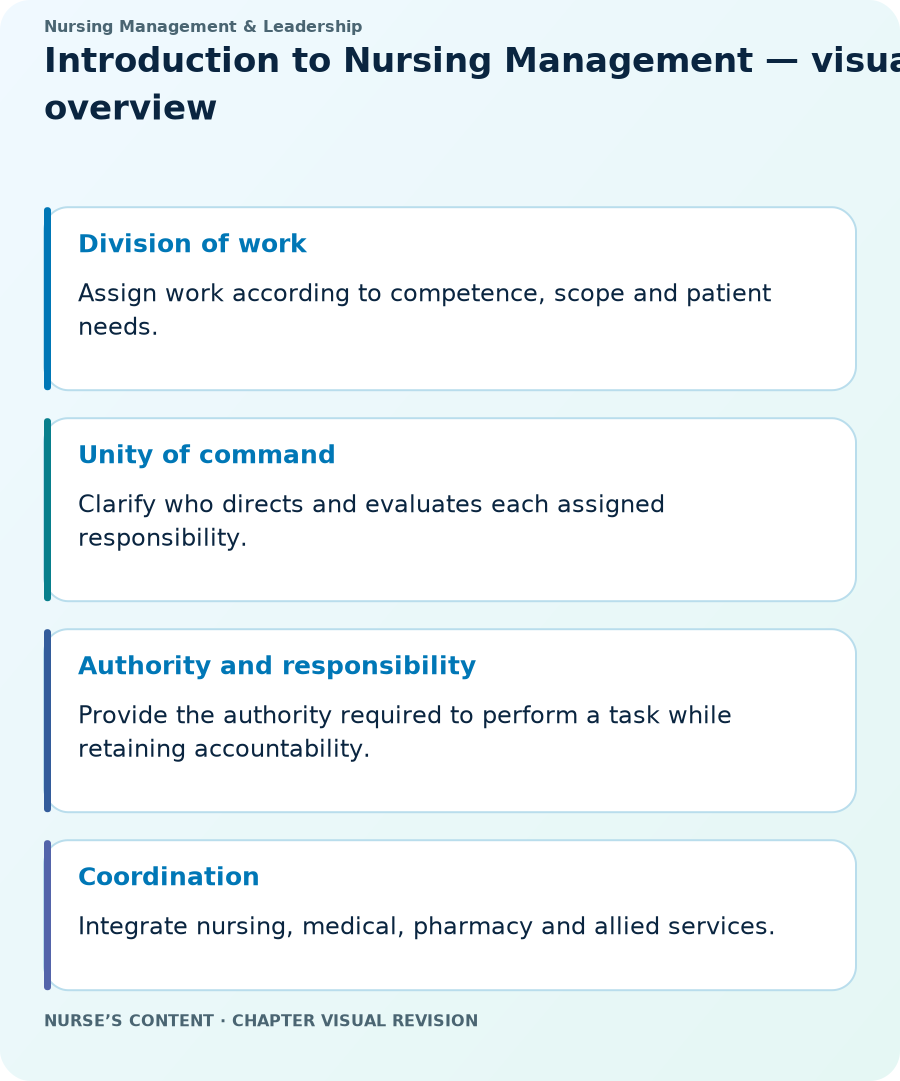
| Division of work | Assign work according to competence, scope and patient needs. |
| Unity of command | Clarify who directs and evaluates each assigned responsibility. |
| Authority and responsibility | Provide the authority required to perform a task while retaining accountability. |
| Coordination | Integrate nursing, medical, pharmacy and allied services. |
| Equity | Apply policies fairly without discrimination or favouritism. |
| Flexibility | Adapt staffing and priorities to acuity, emergencies and service demands. |
| Efficiency and effectiveness | Minimize waste without sacrificing patient safety or achieved outcomes. |
4. Functions of management
| Function | Meaning | Nursing example |
|---|---|---|
| Planning | Decide objectives and methods in advance. | Prepare a weekly ward staffing plan. |
| Organizing | Arrange roles, resources and relationships. | Establish a functional emergency trolley system. |
| Staffing | Recruit, deploy and develop suitable staff. | Match competent nurses to patient acuity. |
| Directing | Guide, communicate, motivate and supervise. | Conduct shift briefing and coach new nurses. |
| Controlling | Compare actual performance with expected standards and act on gaps. | Monitor medication errors and implement improvements. |
POSDCORB, associated with Luther Gulick, is a classical administrative framework: Planning, Organizing, Staffing, Directing, Coordinating, Reporting and Budgeting. It is a useful mnemonic, not a rigid sequence.
5. Levels of management
Top-level management establishes institutional strategy, policies and budgets; middle-level management converts strategy into departmental plans; first-line managers supervise day-to-day clinical work. Staff nurses also manage priorities and resources at the bedside, regardless of formal title.
6. Managerial skills
Technical skills include clinical procedures and operational knowledge. Human skills include communication, conflict management and motivating people. Conceptual skills include systems thinking, planning and understanding organizational relationships. Technical competence is especially important in frontline management; conceptual skills are increasingly important at senior levels. All levels require ethical judgment.
7. Practical example
A ward consistently experiences delayed morning medications. The nurse manager measures the problem, investigates workload and medicine availability, agrees a safer allocation with pharmacy, provides training and monitors on-time administration and error rates. Increasing speed alone would not be an adequate improvement if errors rise.
8. Important Examination Questions
Long Answer Questions
- 1. Define nursing management and explain its objectives, principles and functions.
- 2. Describe the levels and skills of nursing management with examples.
Short Answer Questions
- 1. POSDCORB.
- 2. Difference between administration and management.
- 3. Importance of nursing management.
- 4. Functions of a ward manager.
Very Short Answer Questions (with answers)
- 1. What is efficiency? — Appropriate use of resources.
- 2. What is effectiveness? — Achievement of intended outcomes.
- 3. What does staffing mean? — Obtaining and allocating suitable personnel.
9. Quick Revision
- • Management combines planning, organizing, staffing, directing and controlling.
- • Nursing management is accountable for safe care and appropriate resource use.
- • Patient safety takes priority over purely numerical productivity.
10. Conclusion
Management combines planning, organizing, staffing, directing and controlling. Nursing management is accountable for safe care and appropriate resource use. Patient safety takes priority over purely numerical productivity.
Chapter reference images