Nursing Foundation
Wound Care and Dressing
Types of wounds, wound healing, wound assessment, dressing techniques, wound irrigation, drainage systems, suture care and prevention of wound infection.
Open quizzes and study tools Download PDF
CHAPTER 18 Wound Care and Dressing
B.Sc. Nursing | Nursing Foundation I & II
Wounds and classifications
A wound is disruption of skin, mucosa or deeper tissue integrity. Types: incision (clean cut), laceration (tear), abrasion (superficial scraping), puncture (penetration), contusion (closed bruising), avulsion (tissue torn away), ulcer and pressure injury. Classify acute/chronic, open/closed, and surgical contamination (clean, clean-contaminated, contaminated, dirty/infected).
Healing
Four overlapping stages: haemostasis (clotting), inflammation (immune response), proliferation (granulation, angiogenesis, epithelialization and contraction), maturation/remodelling (collagen reorganization). Primary intention: approximated edges; secondary: open wound heals by granulation/contraction; tertiary: delayed primary closure. Factors: circulation, infection, glucose control, nutrition, smoking, pressure, trauma, immune status and medication.
Assessment and dressing types
Assess location, dimensions/depth, wound bed, edge, surrounding skin, exudate, pain, odour, tunnelling when indicated and infection signs. Use consistent measurement and approved documentation.
| Dressing | Typical application |
|---|---|
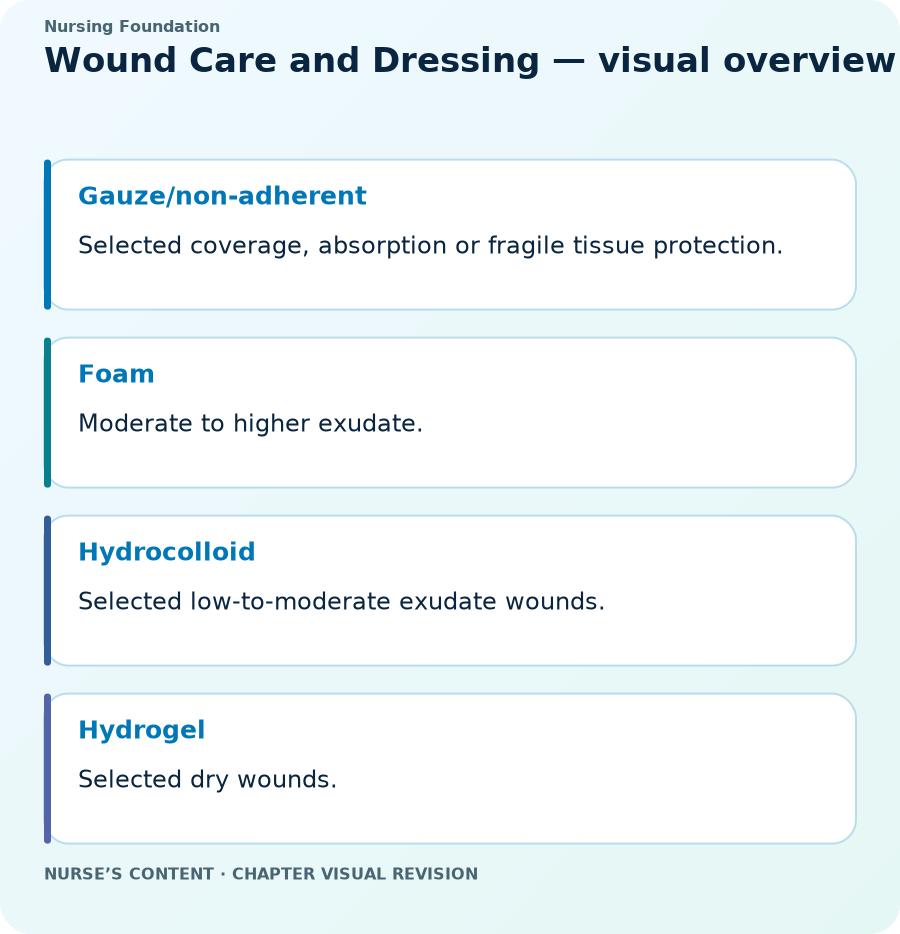
| Gauze/non-adherent | Selected coverage, absorption or fragile tissue protection. |
| Foam | Moderate to higher exudate. |
| Hydrocolloid | Selected low-to-moderate exudate wounds. |
| Hydrogel | Selected dry wounds. |
| Alginate | More heavily exuding wounds. |
| Transparent film | Selected superficial wounds and protection. |
| Antimicrobial | Specific indications following care plan. |
Dressing procedure and irrigation
Verify order/care plan, identify patient and assess pain, explain and provide privacy, prepare articles and hand hygiene. Remove old dressing with appropriate PPE, assess wound, create clean or sterile field according to wound/procedure, cleanse with prescribed solution and technique (sterile saline commonly used), protect healthy tissue, apply selected dressing and secure without impairing circulation. Dispose of waste, reassess comfort and document. Irrigation removes loose debris with appropriate solution and controlled pressure; avoid routine cytotoxic cleansers unless indicated.
Drains, sutures and complications
Drains include Penrose and closed-suction systems (e.g. Jackson-Pratt). Assess insertion site, output, colour, patency and prescribed suction; secure and maintain system; do not routinely strip. Observe sutures/staples and wound edges; remove only with authorization and appropriate training. Complications: infection (increasing pain, spreading erythema, purulent discharge or systemic signs), haematoma, seroma, dehiscence, evisceration and delayed healing. Evisceration: activate urgent response, protect exposed tissue with sterile saline-moistened dressing if available and do not push organs back.
Nursing responsibilities and exam revision
Prevent infection with aseptic technique, promote nutrition and pressure relief, educate on wound care and warning signs; track healing and escalate deterioration.
- 1. Explain wound types, healing phases and influencing factors.
- 2. Describe dressing and irrigation principles.
- 3. Discuss wound drainage, sutures, infection and complications.
Educational notes. Clinical skills require supervision, authorized orders and current facility protocols.
Chapter reference images