Nursing Foundation
Specimen Collection and Diagnostic Procedures
Collection of blood, urine, stool and sputum specimens, preparation for diagnostic tests, handling and transportation of specimens and nursing responsibilities.
Open quizzes and study tools Download PDF
CHAPTER 17 Specimen Collection and Diagnostic Procedures
B.Sc. Nursing | Nursing Foundation I & II
Definition and general principles
Specimens are biological samples used for diagnosis and monitoring. Verify request, two patient identifiers, collection timing, container, quantity and preparation. Explain and obtain appropriate consent; use required asepsis/PPE; label in the patient's presence at collection with identifiers, date/time and collector per policy. Send in leak-proof approved packaging with correct transport/storage conditions. Do not prelabel uncollected samples or use unmatched labels.
Blood specimen collection
Common tests: CBC, glucose, renal/liver function, electrolytes, coagulation and blood cultures. Prepare appropriate tubes and collection system, choose safe site, disinfect and allow to dry, collect using local order of draw, release tourniquet, remove needle safely, apply pressure, mix additive tubes as instructed, label and transport. Assess bleeding, haematoma, fainting or nerve symptoms. Blood cultures require special asepsis, correct volume and timing per protocol.
| Common tube colour | Additive and typical use |
|---|---|
| Purple/lavender | EDTA; CBC. |
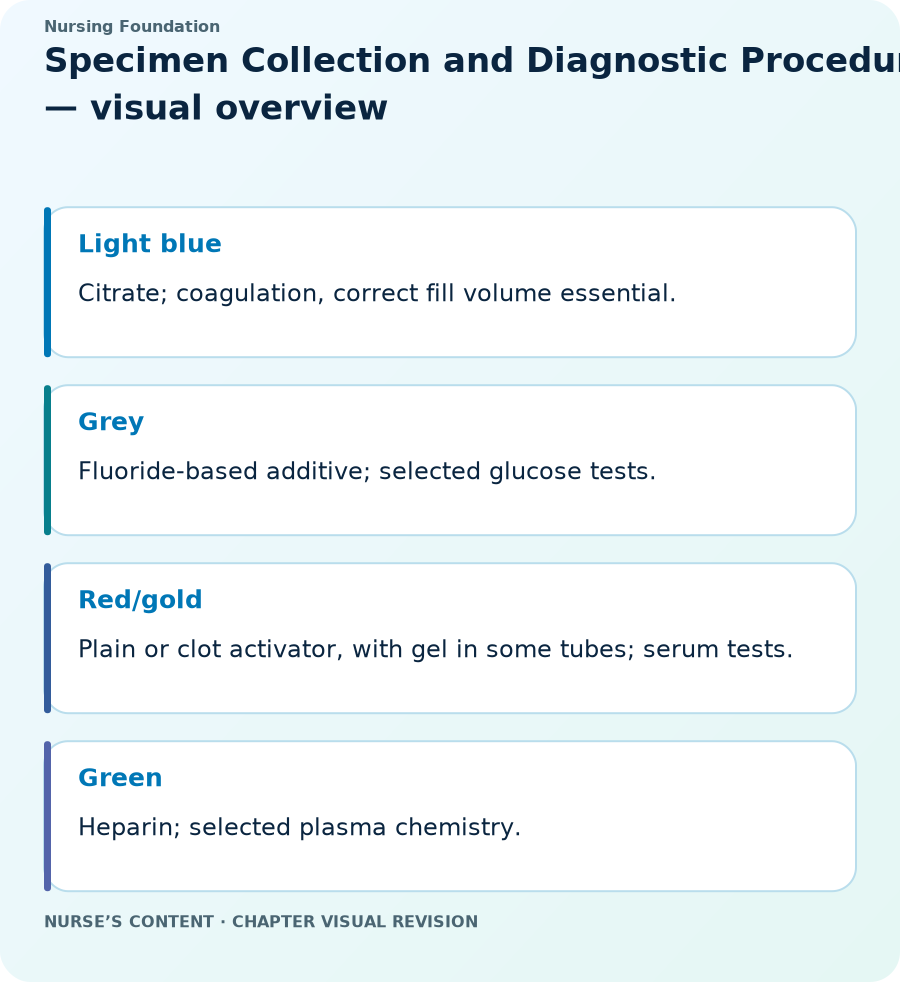
| Light blue | Citrate; coagulation, correct fill volume essential. |
| Grey | Fluoride-based additive; selected glucose tests. |
| Red/gold | Plain or clot activator, with gel in some tubes; serum tests. |
| Green | Heparin; selected plasma chemistry. |
Colour codes vary by manufacturer; check the actual tube and laboratory instructions.
Urine specimen
Random, first-morning, clean-catch midstream, timed/24-hour and catheter specimens. Midstream: clean as instructed, begin voiding, collect middle portion without touching inside container, cap and label. Timed 24-hour: discard first void at start, collect all subsequent urine including final void at end, store per lab instructions; report missed samples. Catheter culture samples are obtained aseptically from approved sampling port, not drainage bag.
Stool and sputum
Collect stool in suitable container without urine, water or cleaning-agent contamination. Sputum requires lower respiratory secretions, not saliva; instruct deep cough, use approved container and transport. Suspected TB sputum requires appropriate airborne precautions and designated collection environment.
Diagnostic tests and preparation
X-ray and CT use ionizing radiation; ultrasound uses sound; MRI uses magnetic fields; ECG records electrical cardiac activity; endoscopy visualizes internal structures; biopsy samples tissue. Verify order and relevant history, pregnancy possibility when indicated, allergies/contrast risk, renal status as appropriate, MRI implant/metal safety, fasting and medicine instructions only when required. During procedure provide privacy, positioning and monitoring. After procedure assess bleeding, sedation recovery, adverse reactions and other complications; report urgent findings and document.
Exam revision
- 1. Explain principles of specimen handling and identification.
- 2. Describe blood, urine, stool and sputum collection.
- 3. Discuss preparation and nursing responsibilities for diagnostic procedures.
Educational notes. Clinical skills require supervision, authorized orders and current facility protocols.
Chapter reference images