Nursing Foundation
Pain Management and Comfort Measures
Types of pain, pain assessment scales, physiological responses to pain, pharmacological and non-pharmacological pain management and nursing responsibilities.
Open quizzes and study tools Download PDF
CHAPTER 20 Pain Management and Comfort Measures
B.Sc. Nursing | Nursing Foundation I & II
Definition and types
Pain is an unpleasant sensory and emotional experience associated with or resembling actual or potential tissue damage. It is personal; the inability to communicate does not exclude pain. Acute pain commonly follows injury/surgery; chronic pain persists or recurs beyond three months. Nociceptive pain relates to non-neural tissue damage; neuropathic pain to a lesion/disease of somatosensory system; nociplastic pain to altered nociception not adequately explained by either. Referred pain is felt at another site; phantom pain is felt in an absent body part.
Physiology and manifestations
Transduction converts noxious stimulation into neural signals; transmission carries signals; modulation alters them; perception is the conscious experience. Responses may include guarding, sweating, tachycardia, increased BP, anxiety, sleep disturbance and reduced movement. Normal observations do not rule out pain.
Assessment
PQRST: provocation/palliation, quality, region/radiation, severity and timing. Assess onset, duration, aggravating/relieving factors, functional impact, patient goals, medication history and response. Self-report is preferred when possible.
| Scale | Application |
|---|---|
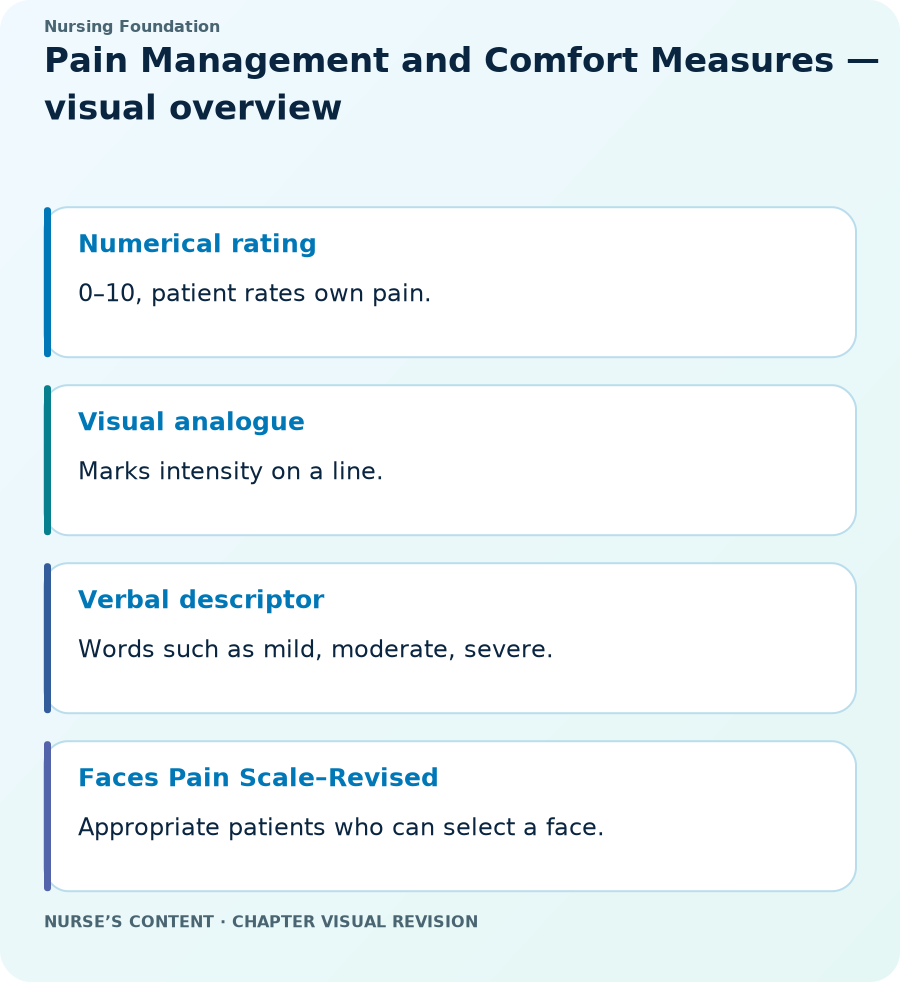
| Numerical rating | 0–10, patient rates own pain. |
| Visual analogue | Marks intensity on a line. |
| Verbal descriptor | Words such as mild, moderate, severe. |
| Faces Pain Scale–Revised | Appropriate patients who can select a face. |
| FLACC | Face, legs, activity, cry, consolability; suitable paediatric/nonverbal contexts as validated. |
Pharmacological and non-pharmacological care
Analgesic classes include paracetamol, NSAIDs, opioids, local anaesthetics and condition-specific adjuvants. Selection depends on pain type, contraindications, renal/hepatic function and prescription. Monitor sedation, respiration, constipation, nausea and response with opioids. Severe sedation or respiratory depression requires immediate assessment and emergency response. Non-drug measures: positioning, relaxation, distraction, breathing, music, activity/physiotherapy when indicated and safe heat/cold applications; avoid when circulation or sensation makes unsafe. Do not substitute comfort measures for necessary medical treatment.
Nursing process
Assess pain and function; establish measurable individualized comfort/function goals; administer authorized therapy; provide comfort, education and emotional support; reassess at appropriate intervals and after interventions. Record score, site, treatment, response, adverse effects and escalation. New severe unexplained pain, chest pain or signs of acute deterioration warrant urgent assessment.
Comfort measures
Provide clean bedding, temperature/noise control, sleep support, oral/personal hygiene, privacy, emotional support and positioning. Respect personal preferences and cultural needs.
Exam revision
- 1. Define and classify pain; explain pain physiology.
- 2. Describe PQRST and pain scales.
- 3. Discuss drug/non-drug approaches and nursing responsibilities.
Educational notes. Clinical skills require supervision, authorized orders and current facility protocols.
Chapter reference images