Nursing Foundation
Nursing Process
Assessment, nursing diagnosis, planning, implementation and evaluation; nursing care plans, documentation and clinical decision-making.
Open quizzes and study tools Download PDF
06. NURSING PROCESS
1. Definition
The nursing process is a systematic, patient-centred method used to identify health needs, plan nursing interventions, provide care and evaluate outcomes.
2. Characteristics
- Systematic
- Dynamic
- Individualized
- Goal-oriented
- Evidence-based
- Problem-solving
- Continuous and cyclical
3. Steps of Nursing Process – ADPIE
- Assessment
- Diagnosis
- Planning
- Implementation
- Evaluation
Outcome identification may also be described as a separate step in professional nursing standards.
4. Assessment
Assessment is the systematic collection, validation and documentation of patient information.
Types
- Initial assessment.
- Focused assessment.
- Emergency assessment.
- Ongoing or time-lapsed assessment.
Types of Data
| Subjective data | Objective data |
|---|---|
| Information reported by the patient | Observable or measurable findings |
| Pain, nausea and dizziness | Temperature, pulse and laboratory results |
Sources of Data
- Patient.
- Family members.
- Clinical records.
- Physical examination.
- Healthcare professionals.
- Diagnostic investigations.
5. Nursing Diagnosis
A nursing diagnosis is a clinical judgment about human responses to health conditions, life processes or vulnerability to those responses.
Types
- Problem-focused diagnosis.
- Risk diagnosis.
- Health-promotion diagnosis.
- Syndrome diagnosis.
PES Format
- P: Problem.
- E: Etiology or related factors.
- S: Signs and symptoms.
Example: Acute pain related to surgical tissue injury as evidenced by patient-reported pain of 7/10.
Risk diagnoses are supported by risk factors rather than existing signs and symptoms.
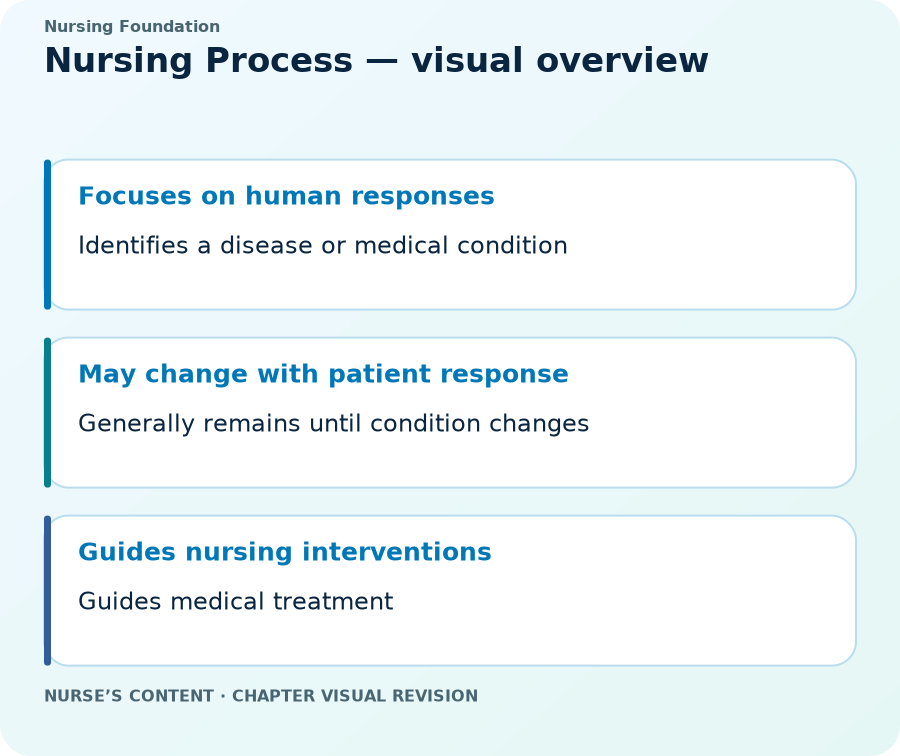
Nursing Diagnosis vs Medical Diagnosis
| Nursing diagnosis | Medical diagnosis |
|---|---|
| Focuses on human responses | Identifies a disease or medical condition |
| May change with patient response | Generally remains until condition changes |
| Guides nursing interventions | Guides medical treatment |
| Example: Impaired mobility | Example: Stroke |
6. Planning
Planning involves prioritizing problems, establishing measurable outcomes and selecting appropriate interventions.
Priorities
- Immediate threats to life.
- Airway, breathing and circulation.
- Patient safety.
- Actual and potential health problems.
- Patient preferences.
SMART Outcomes
Specific, Measurable, Achievable, Relevant and Time-bound.
Example: Patient will report pain of 3/10 or less within one hour of the prescribed intervention.
7. Implementation
Implementation is the performance of planned nursing interventions.
Types of Interventions
- Independent: Within the nurse's authorized scope.
- Dependent: Based on an authorized prescription or order.
- Collaborative: Conducted with multidisciplinary team members.
Activities
- Provide direct nursing care.
- Administer prescribed treatment.
- Educate and support patients.
- Monitor responses.
- Coordinate services.
- Document care.
8. Evaluation
Evaluation determines whether expected outcomes have been achieved.
Possible results:
- Goal met.
- Goal partially met.
- Goal not met.
Revise the care plan according to new assessment findings.
9. Sample Nursing Care Plan
Clinical situation: Postoperative patient reporting acute pain.
| Component | Description |
|---|---|
| Assessment | Patient reports pain 7/10; guarding observed |
| Nursing diagnosis | Acute pain related to surgical tissue injury |
| Goal | Pain will reduce to 3/10 or less within one hour |
| Planning | Assess pain, provide comfort and administer prescribed analgesia |
| Implementation | Assess pain, position comfortably, provide prescribed medication and monitor response |
| Rationale | Assessment guides treatment; analgesia and comfort measures reduce suffering |
| Evaluation | Reassess pain and document whether the goal was achieved |
10. Clinical Decision-Making
Clinical decision-making requires:
- Recognizing relevant patient findings.
- Interpreting clinical information.
- Prioritizing problems.
- Selecting safe interventions.
- Evaluating responses.
- Escalating deterioration.
11. Nursing Documentation
Record:
- Assessment findings.
- Nursing diagnoses.
- Planned interventions.
- Treatment provided.
- Patient responses.
- Changes in condition.
- Communication and escalation.
- Evaluation outcomes.
Important Examination Questions
- Define nursing process and explain its steps.
- Differentiate subjective and objective data.
- Explain nursing diagnosis and PES format.
- Describe planning and implementation.
- Prepare a nursing care plan for a selected patient problem.
Conclusion
The nursing process ensures systematic, individualized and goal-directed nursing care and promotes professional accountability.
Chapter reference images