Nursing Foundation
Nursing as a Profession
Characteristics of a profession, professional values, code of ethics, professional conduct, nursing standards and responsibilities of a professional nurse.
Open quizzes and study tools Download PDF
02. NURSING AS A PROFESSION
1. Meaning of Profession
A profession is an occupation requiring specialized education, scientific knowledge, practical competence, ethical standards and accountability.
2. Nursing as a Professional Discipline
Nursing is recognized as a professional discipline because it possesses a specialized body of knowledge, formal education, ethical standards, regulatory requirements and responsibilities towards society.
3. Characteristics of a Profession
- Specialized knowledge.
- Formal professional education.
- Scientific foundation.
- Service orientation.
- Professional autonomy within scope of practice.
- Code of ethics.
- Professional accountability.
- Regulatory oversight.
- Continuing education.
- Professional organizations.
4. Professional Values in Nursing
| Value | Meaning |
|---|---|
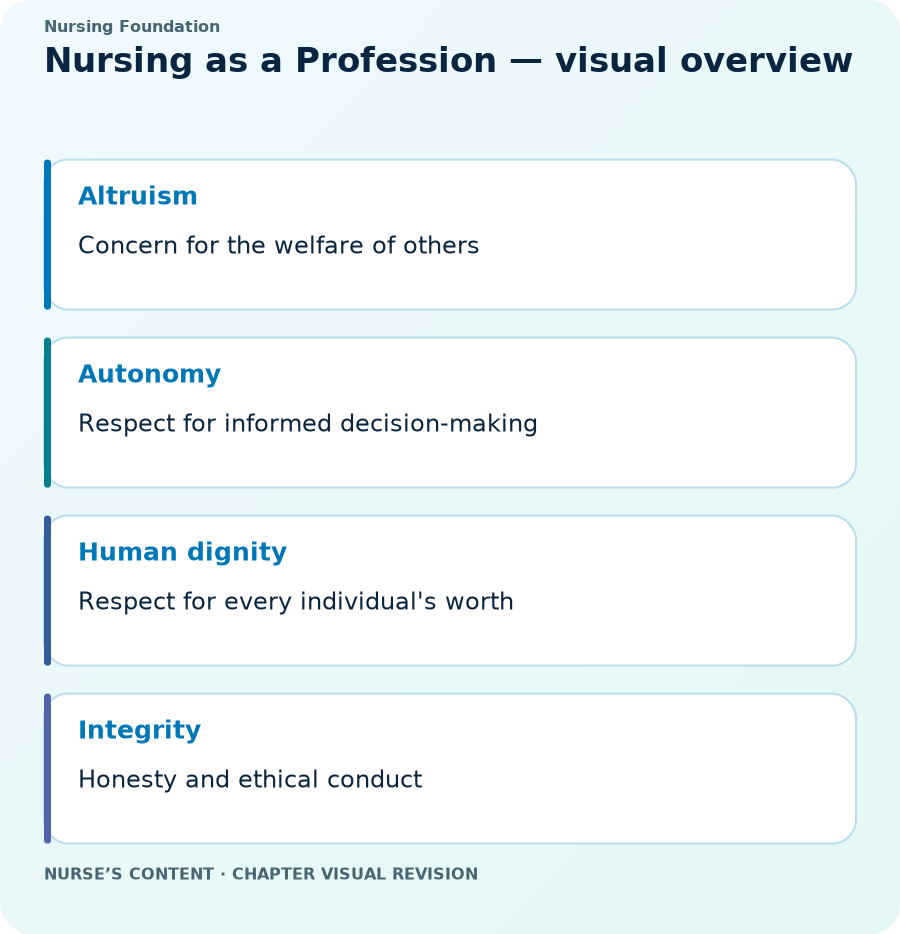
| Altruism | Concern for the welfare of others |
| Autonomy | Respect for informed decision-making |
| Human dignity | Respect for every individual's worth |
| Integrity | Honesty and ethical conduct |
| Social justice | Fair and equitable healthcare |
| Accountability | Responsibility for professional actions |
| Compassion | Recognition of suffering and appropriate support |
5. Code of Ethics
A nursing code of ethics provides professional guidance for ethical behaviour, patient protection and responsible nursing practice.
ICN Code of Ethics
The International Council of Nurses' 2021 framework contains four major elements:
- Nurses and patients or other people requiring care.
- Nurses and practice.
- Nurses and the profession.
- Nurses and global health.
Major Ethical Principles
| Principle | Meaning |
|---|---|
| Autonomy | Respecting patient choices |
| Beneficence | Promoting patient welfare |
| Non-maleficence | Avoiding preventable harm |
| Justice | Providing fair and equitable care |
| Veracity | Communicating truthfully |
| Fidelity | Keeping professional commitments |
| Confidentiality | Protecting private information |
6. Professional Conduct
A professional nurse should:
- Maintain clinical competence.
- Respect patient rights and privacy.
- Follow institutional policies.
- Maintain professional boundaries.
- Avoid discrimination.
- Report unsafe practices.
- Communicate respectfully.
- Maintain accurate records.
- Accept responsibility for actions.
- Avoid practising beyond authorized competence.
7. Nursing Standards
Nursing standards describe expected levels of professional performance and quality of care.
Standards of Nursing Practice
- Assessment
- Nursing diagnosis
- Outcome identification
- Planning
- Implementation
- Evaluation
Standards of Professional Performance
- Ethics
- Education
- Evidence-based practice
- Quality improvement
- Communication
- Collaboration
- Leadership
- Professional accountability
8. Professional Accountability
Accountability means being answerable for professional decisions, actions and omissions.
Examples include:
- Administering medicines safely.
- Documenting nursing interventions accurately.
- Reporting errors.
- Maintaining patient confidentiality.
- Accepting only responsibilities within one's competence.
9. Responsibility and Authority
Responsibility: Obligation to perform an assigned professional duty.
Authority: Legitimate power to perform or direct authorized activities.
Accountability: Answerability for the decisions and outcomes associated with professional actions.
10. Professional Nursing Organizations
| Organization | Function |
|---|---|
| International Council of Nurses (ICN) | International nursing representation and professional development |
| Indian Nursing Council (INC) | Historically responsible for uniform standards of nursing education in India; consult current regulatory notifications |
| State Nursing Registration Councils | Registration and regulatory functions according to applicable frameworks |
| Trained Nurses' Association of India (TNAI) | Professional welfare and development |
| Student Nurses' Association (SNA) | Student leadership and professional development |
11. Continuing Nursing Education
Continuing nursing education helps nurses update their knowledge, maintain clinical competence and improve professional practice.
Methods include:
- Workshops
- Conferences
- Clinical training
- Simulation
- Seminars
- Online courses
- Research activities
12. Responsibilities of a Professional Nurse
Towards Patients
- Provide safe and individualized care.
- Maintain privacy and dignity.
- Respect informed decisions.
- Protect patients from avoidable harm.
Towards the Profession
- Maintain competence.
- Follow ethical standards.
- Participate in professional development.
- Contribute to quality improvement.
Towards Society
- Promote public health.
- Provide equitable services.
- Participate in health education.
- Support disease prevention.
Important Examination Questions
- Explain nursing as a profession.
- Describe the characteristics of a profession.
- Discuss professional values and ethical principles.
- Explain professional accountability.
- Describe the responsibilities of a professional nurse.
Conclusion
Professional nursing requires scientific knowledge, ethical behaviour, clinical competence and accountability. Professional standards protect patients and maintain the quality and integrity of nursing services.
Chapter reference images