Nursing Foundation
Mobility, Exercise and Rehabilitation
Body mechanics, range-of-motion exercises, ambulation, transfer techniques, use of assistive devices, prevention of immobility complications and rehabilitation nursing.
Open quizzes and study tools Download PDF
CHAPTER 19 Mobility, Exercise and Rehabilitation
B.Sc. Nursing | Nursing Foundation I & II
Definitions and body mechanics
Mobility is ability to move; exercise is planned activity to maintain/improve function; rehabilitation supports optimal functioning and participation. Safe body mechanics: stable base, avoid twisting, keep loads close, adjust bed height, use mechanical aids and assistance. Assess weight-bearing status, cognition, balance, pain and strength. Do not manually lift dependent patients when safer equipment is available.
Types of exercises
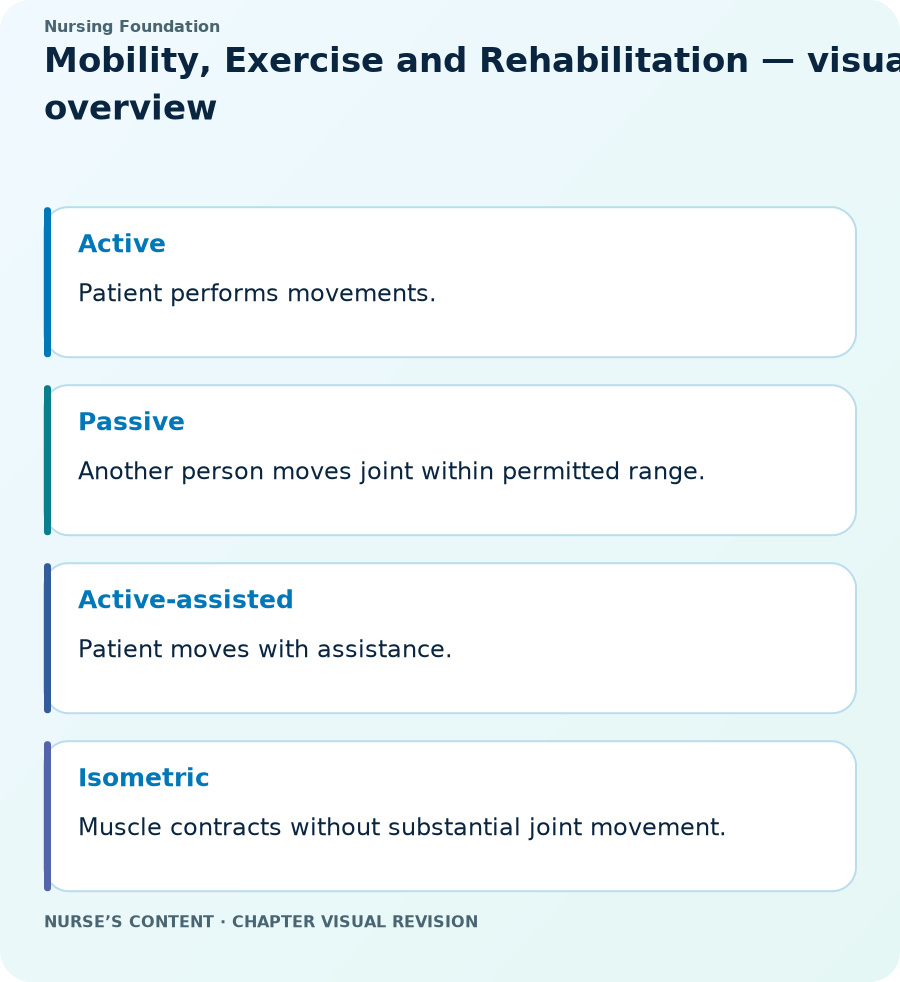
| Type | Description |
|---|---|
| Active | Patient performs movements. |
| Passive | Another person moves joint within permitted range. |
| Active-assisted | Patient moves with assistance. |
| Isometric | Muscle contracts without substantial joint movement. |
| Isotonic | Muscle contraction produces movement. |
| Aerobic | Sustained activity supporting cardiovascular fitness. |
| Resistance | Exercise against resistance to improve strength. |
ROM movements: flexion/extension, abduction/adduction, rotation, circumduction, pronation/supination, dorsiflexion/plantar flexion. Stabilize joint, move slowly through prescribed range, avoid force and stop for pain or resistance. Follow postoperative and fracture restrictions.
Ambulation and transfer
Assess stability, fall risk, footwear, dizziness and devices. Explain and assist patient to sit; assess orthostatic symptoms, stand with suitable aid, walk at safe pace, rest and record distance/tolerance. For wheelchair transfer, position chair, lock brakes, move footrests, assess mobility and choose approved transfer technique or lift. Protect lines, maintain alignment and confirm safety. If patient begins to fall, follow trained safe-assistance technique; summon help rather than attempting unsafe lifting.
Assistive devices
Cane adds support (often used on stronger side for unilateral leg weakness, with individualized instruction); walker provides broader support; crutches support selected weight-bearing restrictions; wheelchair supports mobility; transfer boards or mechanical lifts address specific transfer needs. Fit devices and teach gait under physiotherapy guidance.
Complications of immobility
Musculoskeletal: muscle wasting, contractures and bone loss. Respiratory: reduced expansion and retained secretions. Cardiovascular: venous stasis, DVT and orthostatic intolerance. Gastrointestinal/urinary: constipation and urinary stasis. Skin: pressure injuries. Psychological: reduced independence, isolation and distress. Prevent through safe early mobility, individualized repositioning, ROM, skin protection, nutrition/hydration, prescribed VTE prophylaxis and respiratory care.
Rehabilitation nursing
Assess function and goals, promote ADLs, teach safe self-care, encourage participation, coordinate rehabilitation with physiotherapy/occupational therapy and support psychosocial adjustment. Evaluate progress, home safety, equipment and caregiver training.
Exam revision
- 1. Explain body mechanics and safe patient transfer.
- 2. Classify exercises; describe ROM and ambulation.
- 3. Discuss immobility complications, prevention and rehabilitation.
Educational notes. Clinical skills require supervision, authorized orders and current facility protocols.
Chapter reference images