Nursing Foundation
Legal and Ethical Aspects of Nursing
Patient rights, informed consent, confidentiality, negligence, malpractice, professional accountability, ethical principles and legal responsibilities of nurses.
Open quizzes and study tools Download PDF
CHAPTER 26 Legal and Ethical Aspects of Nursing
B.Sc. Nursing | Nursing Foundation I & II
Meaning and ethical principles
Ethics concerns appropriate professional conduct; law establishes enforceable rights and obligations. Nursing practice must respect autonomy, beneficence, non-maleficence, justice, fidelity, veracity and confidentiality. Moral distress occurs when a professional recognizes an ethically appropriate action but faces barriers to carrying it out. Seek supervision or ethics support for dilemmas.
Patient rights
Patients should receive respectful care, appropriate information, privacy, confidentiality, informed consent, participation in decisions, access to records through applicable processes, non-discrimination, safety and appropriate grievance mechanisms. The Indian Charter of Patients' Rights provides guidance; requirements and implementation vary by jurisdiction and institution. Emergency care and continuity must follow applicable legal and professional duties.
Informed consent
Valid consent requires adequate information, decision-making capacity, voluntariness and authorization. Explain nursing procedures within competence and allow questions. For surgery or other invasive medical treatment, the responsible clinician provides required explanation of benefits, risks, alternatives and refusal; nurse verifies required consent and escalates unresolved concerns. A witness signature does not establish that consent is informed. Capacity may vary by decision/time; follow lawful surrogate decision-making rules and emergency exceptions. Never assume family authorization overrides a capable patient's choices.
Negligence and malpractice
Negligence is failure to exercise reasonable care, resulting in harm when legal elements are met. Malpractice refers to professional negligence. Common legal elements: duty of care, breach, causation and damage. Examples may include failure to monitor deterioration, wrong medication or unsafe care, depending on facts. A poor outcome or error alone does not automatically establish negligence.
Other legal terms
| Term | Educational meaning |
|---|---|
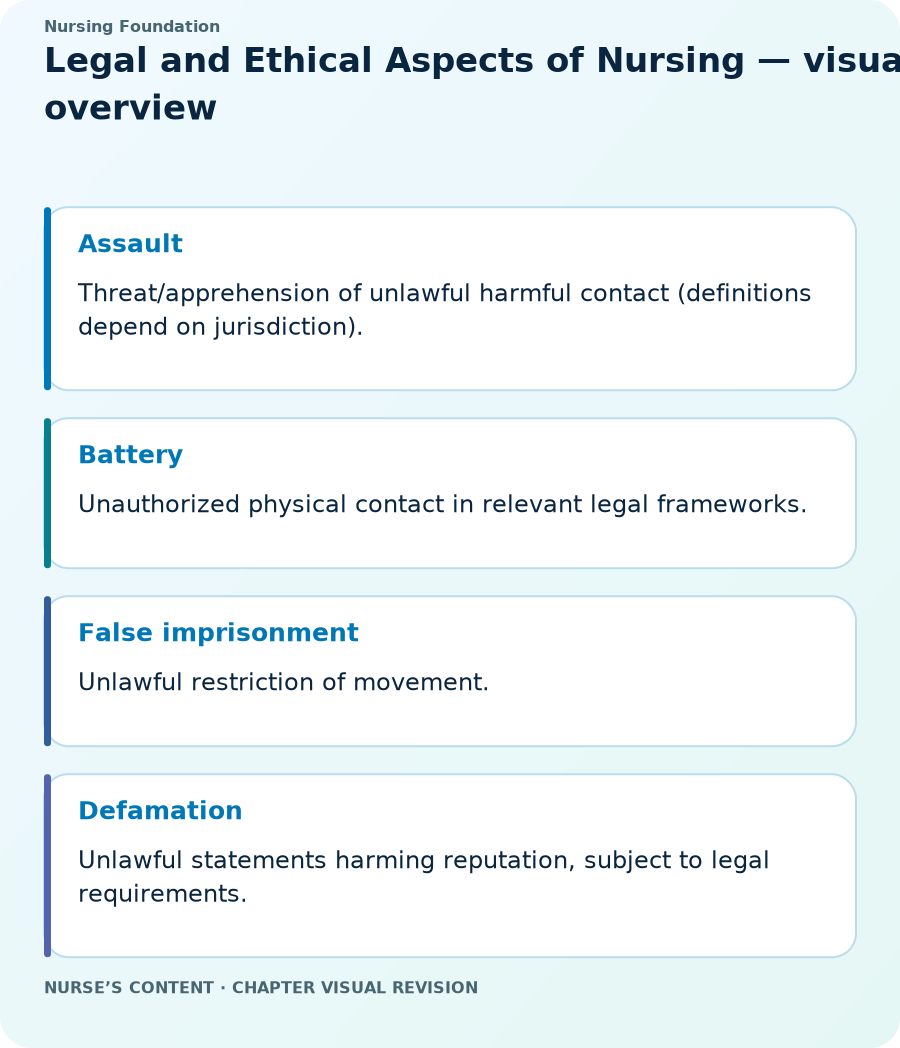
| Assault | Threat/apprehension of unlawful harmful contact (definitions depend on jurisdiction). |
| Battery | Unauthorized physical contact in relevant legal frameworks. |
| False imprisonment | Unlawful restriction of movement. |
| Defamation | Unlawful statements harming reputation, subject to legal requirements. |
| Confidentiality breach | Unauthorized use or disclosure of protected information. |
These common textbook concepts are not direct statements of every Indian statutory offence or civil remedy.
Professional accountability and legal responsibilities
Maintain current registration and competence; work within authorization; verify orders; respect consent, privacy and patient rights; follow infection, medication and safety standards; delegate appropriately and supervise; document truthfully; report errors, abuse/safeguarding concerns and legally reportable events through proper channels. Follow institution-specific procedures for medicolegal cases, evidence preservation, death reporting and restraint. Use restraints only when justified, authorized and monitored under law/policy, not for convenience.
Ethical decision-making
Identify issue and facts; assess capacity and wishes; identify relevant ethical principles and legal requirements; consult team/ethics services; consider alternatives and consequences; implement and document appropriate decision; evaluate. In India, the National Nursing and Midwifery Commission Act, 2023 provides a new legislative framework; consult current implementation and registration rules. This chapter is general education, not case-specific legal advice.
Exam revision
- 1. Explain patient rights and informed consent.
- 2. Discuss ethics, negligence and malpractice with examples.
- 3. Describe legal responsibilities, accountability and confidentiality.
References
MoHFW. Charter of Patients' Rights (NHRC recommendations). https://clinicalestablishments.mohfw.gov.in/
India Code. National Nursing and Midwifery Commission Act, 2023. https://www.indiacode.nic.in/indiacode/handle/123456789/19796
Educational notes. Clinical skills require supervision, authorized orders and current facility protocols.
Chapter reference images