Nursing Foundation
Introduction to Nursing
Definition, meaning, history, evolution of nursing, aims, objectives, scope and principles of nursing.
Open quizzes and study tools Download PDF
01. INTRODUCTION TO NURSING
1. Introduction
Nursing is a healthcare profession concerned with promoting health, preventing illness, caring for sick and injured individuals, supporting rehabilitation and providing compassionate end-of-life care.
Nursing combines scientific knowledge, clinical skills, ethical principles and interpersonal abilities.
2. Meaning and Definition of Nursing
The word nursing is derived from the Latin word nutrire, meaning to nourish.
Nursing involves assisting individuals, families and communities in maintaining, restoring and improving health.
Florence Nightingale's Concept
Nightingale emphasized placing patients in the best possible environmental conditions to support recovery.
Virginia Henderson's Concept
Henderson described nursing as assisting individuals in performing activities that contribute to health, recovery or a peaceful death, helping them achieve independence whenever possible.
3. Nature of Nursing
- Nursing is both an art and a science.
- It is a professional healthcare discipline.
- It provides holistic and individualized care.
- It is based on scientific evidence.
- It involves independent and collaborative responsibilities.
- It emphasizes disease prevention and health promotion.
- It requires continuous professional development.
4. History and Evolution of Nursing
Ancient Period
Nursing care was primarily provided by family members, religious groups and traditional healers.
Medieval Period
Religious institutions and charitable organizations provided care to sick and vulnerable individuals.
Modern Nursing Period
Florence Nightingale established a scientific foundation for modern professional nursing.
5. Florence Nightingale
Born: 12 May 1820
Died: 13 August 1910
Major Contributions
- Improved sanitation during the Crimean War.
- Promoted ventilation, hygiene and patient nutrition.
- Used statistics to study healthcare outcomes.
- Published Notes on Nursing.
- Established the Nightingale Training School in London in 1860.
- Promoted systematic nursing education.
She is widely known as the founder of modern nursing.
International Nurses Day is observed on 12 May.
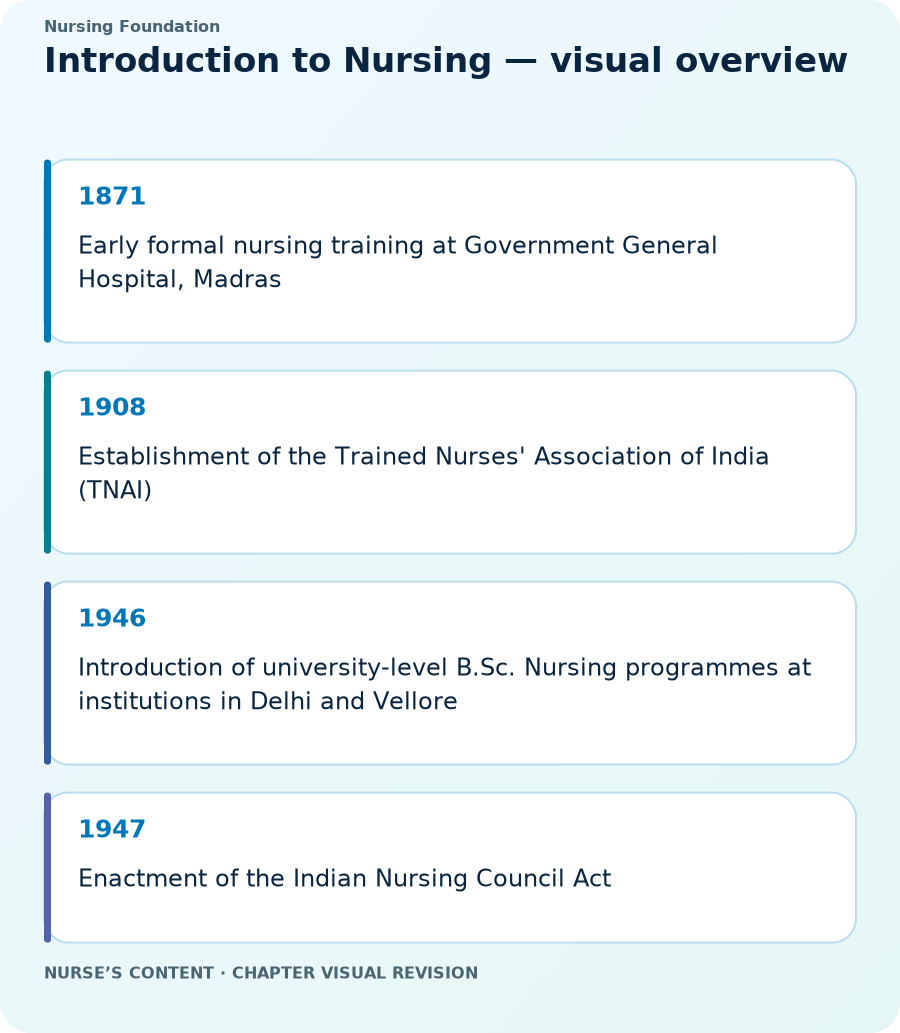
6. Development of Nursing in India
| Year | Development |
|---|---|
| 1871 | Early formal nursing training at Government General Hospital, Madras |
| 1908 | Establishment of the Trained Nurses' Association of India (TNAI) |
| 1946 | Introduction of university-level B.Sc. Nursing programmes at institutions in Delhi and Vellore |
| 1947 | Enactment of the Indian Nursing Council Act |
| 2021 | Notification of the revised B.Sc. Nursing curriculum |
Indian nursing education subsequently expanded into undergraduate, postgraduate, specialty and doctoral programmes.
7. Aims of Nursing
The four fundamental aims are:
- Promotion of health.
- Prevention of illness.
- Restoration of health.
- Alleviation of suffering.
8. Objectives of Nursing
- Maintain optimal health.
- Meet physical and psychological needs.
- Prevent disease and complications.
- Assist patients during illness.
- Promote independence.
- Provide health education.
- Support rehabilitation.
- Maintain dignity during terminal illness.
- Improve quality of life.
9. Scope of Nursing
| Area | Nursing activities |
|---|---|
| Medical nursing | Care of patients with medical illnesses |
| Surgical nursing | Preoperative and postoperative care |
| Paediatric nursing | Care of infants and children |
| Obstetric nursing | Maternal and newborn care |
| Psychiatric nursing | Mental healthcare |
| Community health nursing | Health promotion and disease prevention |
| Critical care nursing | Care of critically ill patients |
| Emergency nursing | Immediate assessment and emergency care |
| Geriatric nursing | Care of older adults |
| Nursing education | Teaching and clinical training |
| Nursing administration | Management of nursing services |
| Nursing research | Development of evidence-based practice |
10. Principles of Nursing
- Respect the patient's dignity.
- Provide individualized care.
- Maintain confidentiality.
- Follow infection-prevention principles.
- Ensure patient safety.
- Meet basic human needs.
- Promote patient independence.
- Maintain effective communication.
- Use scientific and evidence-based methods.
- Evaluate patient responses.
- Maintain accurate documentation.
11. Roles of a Nurse
| Role | Responsibility |
|---|---|
| Caregiver | Provides direct patient care |
| Communicator | Exchanges information effectively |
| Educator | Provides health education |
| Advocate | Protects patient rights |
| Counsellor | Provides emotional support within professional competence |
| Coordinator | Organizes multidisciplinary care |
| Leader | Guides and supports healthcare teams |
| Researcher | Contributes to evidence-based practice |
| Rehabilitator | Promotes functional independence |
12. Qualities of a Good Nurse
- Clinical competence
- Empathy
- Patience
- Honesty
- Accountability
- Observation skills
- Effective communication
- Emotional regulation
- Critical thinking
- Professional discipline
13. Holistic Nursing Care
Holistic nursing considers all aspects of patient well-being:
- Physical
- Psychological
- Emotional
- Social
- Cultural
- Spiritual
Important Examination Questions
- Define nursing and explain its aims and objectives.
- Describe the historical development of nursing.
- Discuss Florence Nightingale's contributions.
- Explain the scope and principles of nursing.
- Describe the roles and qualities of a professional nurse.
Quick Revision
- Founder of modern nursing: Florence Nightingale.
- International Nurses Day: 12 May.
- Nightingale Training School: 1860.
- Four fundamental aims: health promotion, illness prevention, restoration of health and alleviation of suffering.
Conclusion
Nursing is a scientific, ethical and patient-centred profession dedicated to promoting health, preventing illness, supporting recovery and maintaining human dignity.
Chapter reference images