Nursing Foundation
Emergency and First Aid Nursing
Basic life support, cardiopulmonary resuscitation, choking management, bleeding control, shock, burns, fractures, poisoning and emergency nursing responsibilities.
Open quizzes and study tools Download PDF
CHAPTER 23 Emergency and First Aid Nursing
B.Sc. Nursing | Nursing Foundation I & II
Definition and principles
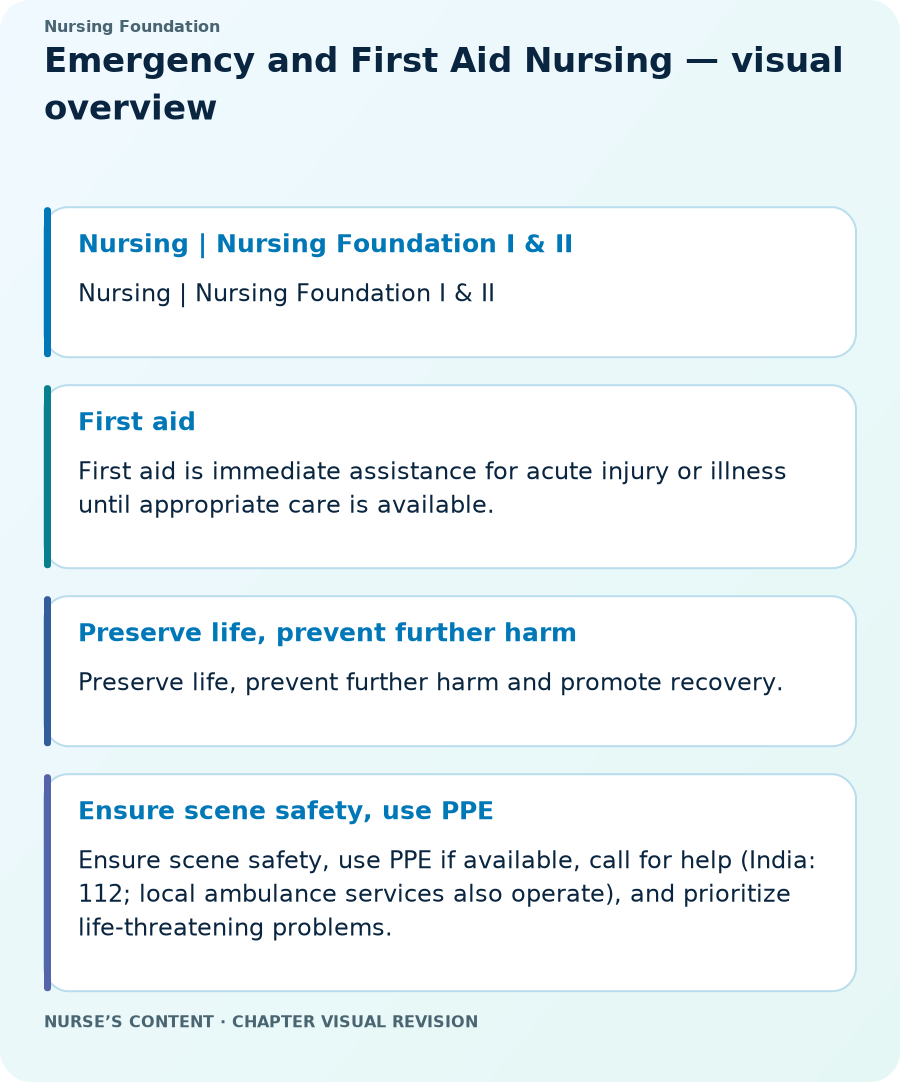
First aid is immediate assistance for acute injury or illness until appropriate care is available. Preserve life, prevent further harm and promote recovery. Ensure scene safety, use PPE if available, call for help (India: 112; local ambulance services also operate), and prioritize life-threatening problems. In hospital, activate the emergency/code response. ABCDE: airway, breathing, circulation, disability (neurological status), exposure/environment. Control life-threatening external bleeding promptly; reassess continuously.
Adult basic life support (BLS)
If unresponsive with absent normal breathing or only gasping, activate help and obtain AED. Trained healthcare providers assess breathing and pulse simultaneously for no more than 10 seconds; if no definite pulse, begin CPR. Lay rescuers should not delay CPR to check pulse. Use a firm surface; compress centre of chest (lower half of sternum), 100–120/min, about 5–6 cm depth in adults, full recoil and minimal interruptions. Provide 30 compressions to 2 breaths when trained and equipped (each breath about one second, visible chest rise); untrained lay rescuers may perform hands-only CPR for sudden adult collapse. Apply AED promptly, follow prompts and resume compressions immediately after analysis/shock. Continue until recovery, trained help takes over or unsafe/exhaustion prevents continuation. Children and infants require age-specific BLS training, including ventilation.
Choking (severe airway obstruction)
If effective cough remains, encourage coughing and monitor. With severe obstruction, activate help; 2025 AHA guidance recommends alternating five back blows and five abdominal thrusts for conscious adults and children. Use chest thrusts in late pregnancy or when abdomen cannot be encircled. For infants, alternate five back blows and five chest thrusts; never use abdominal thrusts. If unresponsive, begin CPR and remove only a visible object when opening airway; no blind finger sweeps.
Bleeding and shock
Apply firm direct pressure to external bleeding. For life-threatening limb bleeding, apply an appropriate tourniquet if trained/available; record time, do not loosen periodically. Wound packing is for suitable sites and trained responders. Shock indicates inadequate tissue perfusion; categories include hypovolaemic, cardiogenic, distributive and obstructive. Signs may include altered mentation, fast pulse, pallor, cool clammy skin and hypotension. Activate urgent care, control bleeding, keep warm, position appropriately (do not force flat if respiratory distress), give no oral food/drink and monitor. Avoid routine Trendelenburg.
Burns, fractures and poisoning
Thermal burns: stop exposure safely, cool with cool running water for about 20 minutes when feasible while avoiding hypothermia; remove constricting jewellery and nonadherent clothing, loosely cover with clean nonadherent dressing. Avoid ice, toothpaste, oils and breaking blisters. Major, electrical, chemical, inhalation or sensitive-site burns need urgent assessment. For chemical burns, protect yourself and irrigate when appropriate to the substance; seek specialist guidance.
Fractures: immobilize in observed position, support affected area, assess distal circulation/sensation, cover open wounds and control bleeding; avoid unnecessary movement or realignment. Poisoning: protect rescuer, stop exposure safely, contact emergency/poison services, preserve product information; do not induce vomiting or give substances unless directed. Monitor airway and breathing.
Nursing responsibilities and exam revision
Maintain airway and safety, perform authorized emergency interventions, record times, findings and treatments, communicate SBAR and prepare referral. Training and local protocols are mandatory for clinical procedures.
- 1. Explain ABCDE and adult BLS/AED use.
- 2. Describe management of choking, bleeding and shock.
- 3. Discuss first aid for burns, fractures and poisoning.
References
AHA. 2025 Adult Basic Life Support guidelines. https://cpr.heart.org/en/resuscitation-science/cpr-and-ecc-guidelines/adult-basic-life-support
AHA and American Red Cross. 2024 First Aid guidelines. https://cpr.heart.org/en/resuscitation-science/2024-first-aid-guidelines
Ministry of Home Affairs, India. ERSS 112. https://www.mha.gov.in/emergency-response-support-system-erss
Educational notes. Clinical skills require supervision, authorized orders and current facility protocols.
Chapter reference images