Nursing Foundation
Documentation and Reporting
Nursing records, nurses' notes, charting methods, incident reports, handover reports, confidentiality and legal aspects of documentation.
Open quizzes and study tools Download PDF
CHAPTER 25 Documentation and Reporting
B.Sc. Nursing | Nursing Foundation I & II
Meaning and purposes
Documentation is the accurate recording of assessments, interventions, observations and patient responses. Reporting communicates relevant information to the healthcare team. Records support continuity, safety, legal accountability, evaluation, audit, research (with appropriate governance) and reimbursement where applicable.
Types of nursing records
Admission assessment, nursing history and care plan, progress notes, observation chart, medication administration record, intake/output chart, wound and procedure records, discharge summary/teaching, handover, transfer and incident documentation. Electronic health records require secure access and proper authentication.
Charting methods
| Method | Structure or purpose |
|---|---|
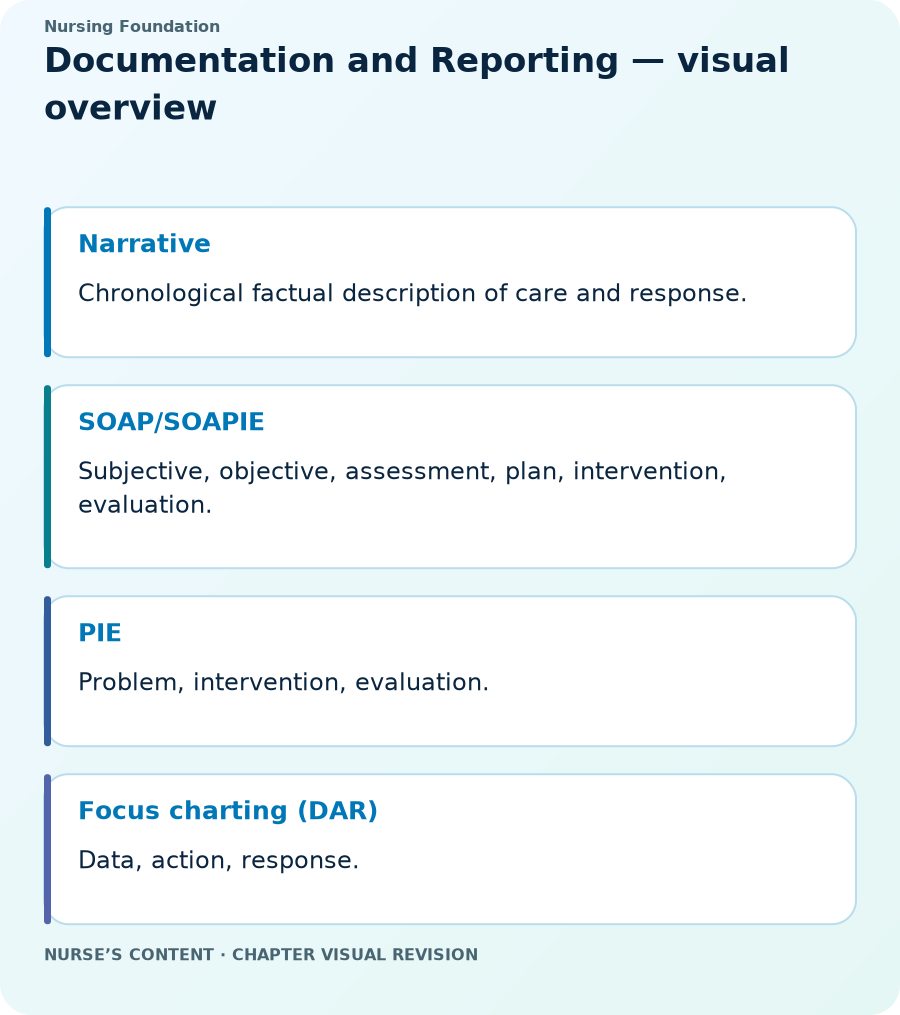
| Narrative | Chronological factual description of care and response. |
| SOAP/SOAPIE | Subjective, objective, assessment, plan, intervention, evaluation. |
| PIE | Problem, intervention, evaluation. |
| Focus charting (DAR) | Data, action, response. |
| Charting by exception | Record deviations plus required routine chart elements per policy. |
| Flow sheets | Structured measurements and repeated observations. |
Principles of effective documentation
Record promptly, accurately, objectively and completely; date/time and authenticate entries. Identify patient correctly; describe symptoms, interventions, response and escalation using approved terminology. Distinguish observations from patient statements; use quotation marks for relevant exact statements. Never document care not performed, falsify, backdate or delete records improperly. Correct errors using approved method: preserve original entry/audit trail, mark correction or late entry and authenticate. Avoid ambiguous abbreviations, speculation and blame.
Nursing notes example (illustrative)
14:00 — Patient reports incisional pain 7/10. Alert; respiratory status assessed. Assisted to comfortable position and administered prescribed analgesic as documented in medication record. 14:45 — Pain 3/10; patient resting, no observed adverse effect. Will continue prescribed monitoring. Signed by responsible nurse.
Handover and incident reporting
SBAR: situation, background, assessment and recommendation. Include identity, diagnosis, recent changes, allergies, medicines, devices, risks and outstanding actions. Use closed-loop confirmation for urgent instructions. Incident reports document events/near misses through approved safety reporting system to support learning and investigation. Protect patient first, notify relevant team and record clinical facts in the health record; keep separate safety reports according to policy. Avoid blame or speculation.
Confidentiality and legal aspects
Only access information necessary for authorized duties. Protect passwords, devices and records; do not share photos or patient information through unauthorized channels. Disclose only with appropriate consent or legally permitted/required basis. Follow local retention schedules and lawful access requirements. Records may be reviewed in legal proceedings; accurate contemporaneous documentation matters.
Exam revision
- 1. Define nursing documentation and explain its purposes.
- 2. Compare charting methods and prepare a sample note.
- 3. Explain SBAR, incident reporting and confidentiality.
Educational notes. Clinical skills require supervision, authorized orders and current facility protocols.
Chapter reference images