Nursing Foundation
Communication and Interpersonal Relationships
Types and levels of communication, therapeutic communication, barriers to communication, nurse–patient relationship, interviewing and interpersonal skills.
Open quizzes and study tools Download PDF
07. COMMUNICATION AND INTERPERSONAL RELATIONSHIPS
1. Definition
Communication is the exchange of information, thoughts, feelings and ideas between individuals.
2. Elements of Communication
Sender → Encoding → Message → Channel → Receiver → Decoding → Feedback.
Noise and environmental interference may affect the process.
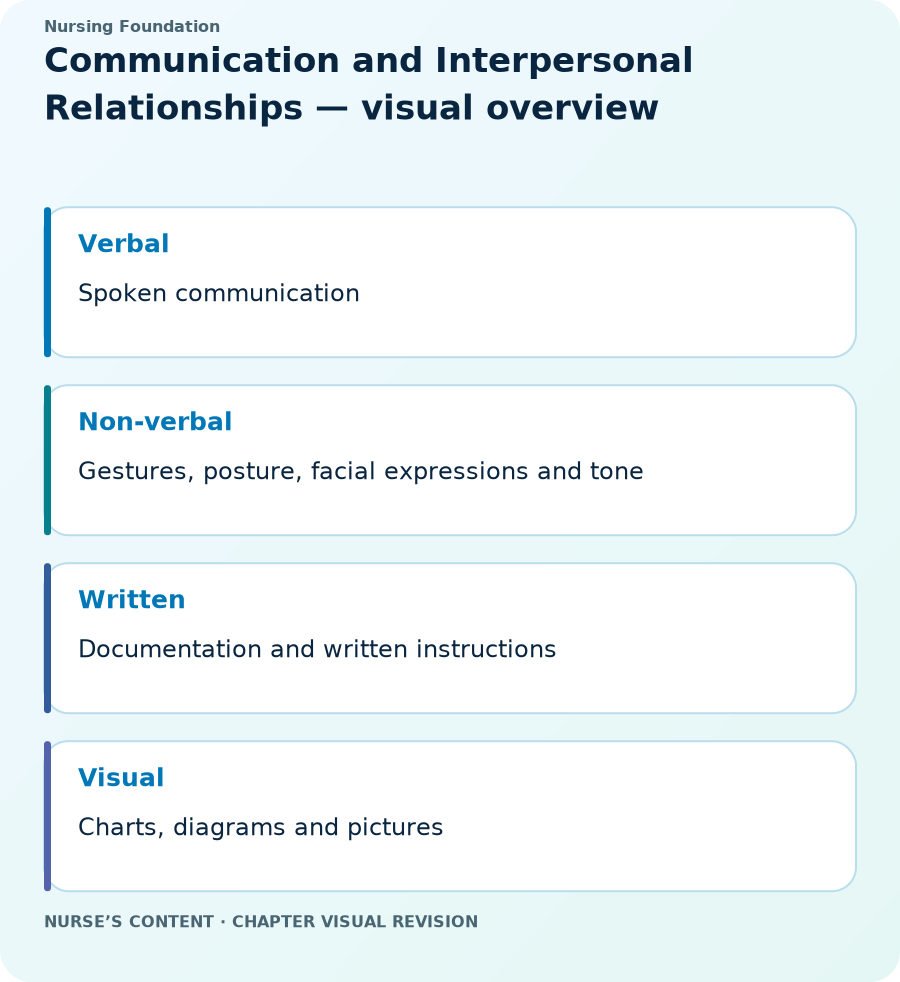
3. Types of Communication
| Type | Description |
|---|---|
| Verbal | Spoken communication |
| Non-verbal | Gestures, posture, facial expressions and tone |
| Written | Documentation and written instructions |
| Visual | Charts, diagrams and pictures |
| Electronic | Digital communication and clinical information systems |
4. Levels of Communication
- Intrapersonal: Communication within oneself.
- Interpersonal: Communication between individuals.
- Small-group: Communication among group members.
- Public: Communication to a larger audience.
- Organizational: Communication within institutions.
5. Principles of Effective Communication
The Seven Cs are clear, concise, concrete, correct, coherent, complete and courteous.
6. Therapeutic Communication
Purposeful professional communication that supports patient well-being.
Techniques
- Active listening.
- Open-ended questioning.
- Clarification.
- Reflection.
- Restating.
- Therapeutic silence.
- Summarizing.
- Providing accurate information.
- Empathy.
Non-Therapeutic Techniques
- False reassurance.
- Judgmental statements.
- Arguing.
- Unnecessary criticism.
- Interrupting.
- Dismissing patient concerns.
- Giving unrealistic promises.
7. Barriers to Communication
- Language differences.
- Hearing or visual impairment.
- Environmental noise.
- Anxiety and fear.
- Cultural differences.
- Medical terminology.
- Limited health literacy.
- Lack of privacy.
Management
Use simple language, qualified interpreters, communication aids, active listening and teach-back.
8. Nurse–Patient Relationship
A professional therapeutic relationship based on trust, empathy, confidentiality and respect.
Phases
| Phase | Activities |
|---|---|
| Pre-interaction | Preparation and review of patient information |
| Orientation | Introduction, rapport and identification of needs |
| Working | Implementation of care and problem-solving |
| Termination | Evaluation and professional closure |
9. Interviewing
A nursing interview is a purposeful conversation conducted to obtain information about patient needs.
Types
- Structured.
- Semi-structured.
- Unstructured.
Steps
- Prepare a private environment.
- Introduce yourself.
- Explain the purpose.
- Establish rapport.
- Ask relevant questions.
- Listen and clarify.
- Summarize findings.
- Document relevant information.
10. Interpersonal Skills
- Empathy
- Assertiveness
- Respect
- Cooperation
- Emotional regulation
- Negotiation
- Conflict resolution
- Teamwork
11. SBAR Communication
| Component | Meaning |
|---|---|
| S | Situation |
| B | Background |
| A | Assessment |
| R | Recommendation |
SBAR is useful during handover, referral and clinical escalation.
12. Communication with Special Patient Groups
- Children: Use developmentally appropriate explanations and play.
- Older adults: Allow additional response time.
- Hearing impairment: Face the patient and use appropriate aids.
- Unconscious patients: Explain procedures respectfully.
- Language differences: Arrange qualified interpretation where available.
- Anxious patients: Communicate calmly and clearly.
Nursing Responsibilities
Maintain confidentiality, verify understanding, communicate abnormal findings, prevent communication errors and document significant interactions.
Important Examination Questions
- Explain the communication process and its types.
- Describe therapeutic communication techniques.
- Discuss barriers to communication.
- Explain the phases of the nurse–patient relationship.
- Describe SBAR and nursing interview techniques.
Conclusion
Effective communication is essential for therapeutic relationships, accurate assessment, patient education and safe multidisciplinary care.
Chapter reference images