Nursing Foundation
Bed Making and Patient Positioning
Types of hospital beds, occupied and unoccupied bed making, postoperative bed, cardiac bed, Fowler's position, lateral position, prone position, supine position and other therapeutic positions.
Open quizzes and study tools Download PDF
CHAPTER 12 Bed Making and Patient Positioning
B.Sc. Nursing | Nursing Foundation I & II
Definition, purposes and types
Bed making prepares a safe, clean and comfortable patient environment. It facilitates rest, procedures, positioning and infection prevention. Hospital beds include manual, electric, adjustable, ICU, orthopaedic, paediatric and pressure-redistributing specialty beds. Traditional bed-making types include closed (unoccupied), open (ready for admission), occupied, postoperative, cardiac (upright comfort), fracture (prescribed alignment) and amputation (prescribed postoperative care).
Articles and principles
Clean sheets, pillowcases, blanket, appropriate mattress protector, drawsheet/repositioning sheet, laundry bag and PPE as needed. Perform hand hygiene; do not shake linen or place it on the floor; separate clean from used linen; use safe body mechanics, lock wheels, protect equipment and keep call bell within reach.
Unoccupied bed
- 1. Explain if applicable, perform hand hygiene and raise bed to safe working height.
- 2. Remove linen into laundry bag; clean mattress according to policy.
- 3. Apply clean bottom sheet, protective/repositioning sheet if needed, top linen and blanket.
- 4. Replace pillowcase; check for wrinkles, lower bed, secure brakes and document as needed.
Occupied bed
Assess patient mobility, pain, restrictions, lines and staffing needs. Provide privacy; assist patient to a safe side-lying position. Roll soiled linen inward toward patient, apply clean linen to exposed mattress, assist patient onto clean side, remove soiled linen and complete bedding. Reposition and check pressure points, devices and call bell. Use mechanical assistance when appropriate.
Postoperative and cardiac bed
Prepare clean linen arranged for safe transfer; keep monitoring, oxygen and suction available according to the operation and recovery plan. A cardiac bed supports an upright position with suitable pillows and foot support. Follow clinical positioning instructions; do not assume every postoperative patient requires the same position.
Therapeutic positions
| Position | Description and application |
|---|---|
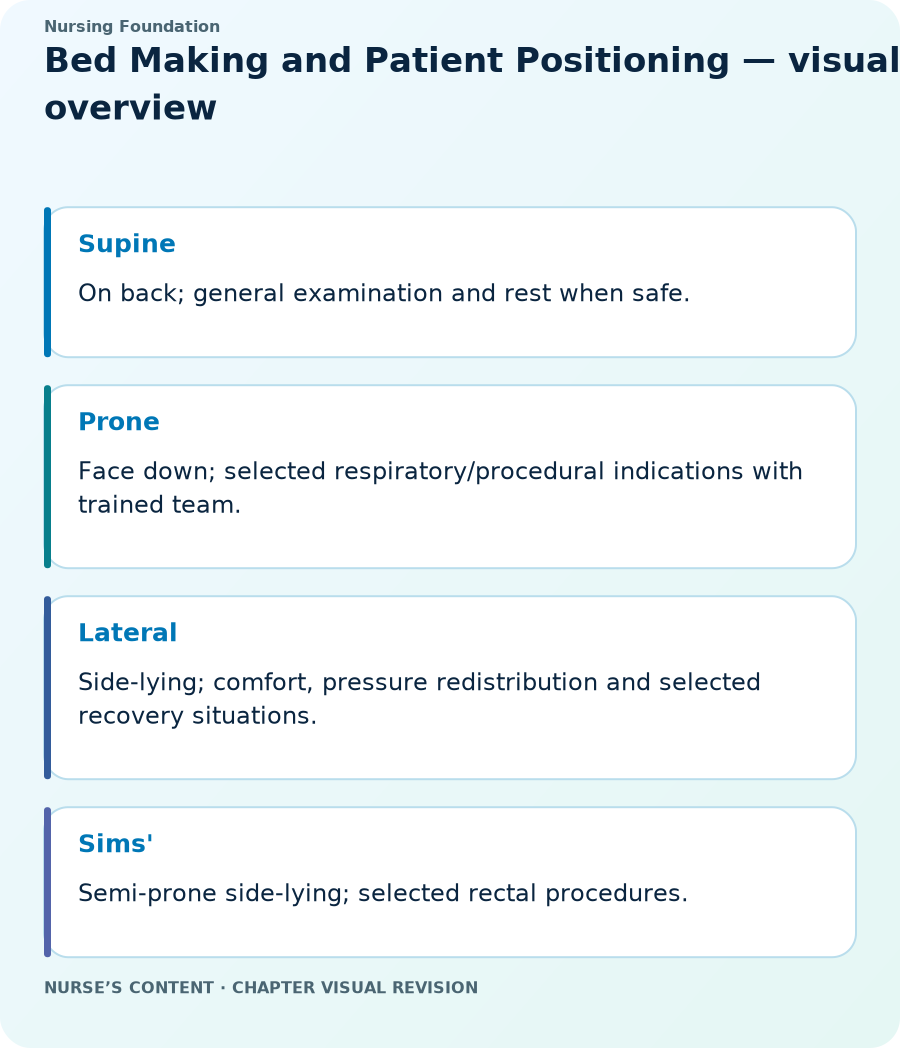
| Supine | On back; general examination and rest when safe. |
| Prone | Face down; selected respiratory/procedural indications with trained team. |
| Lateral | Side-lying; comfort, pressure redistribution and selected recovery situations. |
| Sims' | Semi-prone side-lying; selected rectal procedures. |
| Semi-Fowler's | Head elevated 30–45°; feeding or breathing support when indicated. |
| Fowler's | Head elevated about 45–60°; respiratory comfort. |
| High Fowler's | Head elevated about 60–90°; upright comfort. |
| Dorsal recumbent | On back, knees flexed; selected perineal examination. |
| Lithotomy | Supine, legs supported; selected obstetric/gynaecological procedures. |
| Trendelenburg | Whole bed tilted head-down; selected specialist indications, not routine shock treatment. |
| Reverse Trendelenburg | Whole bed tilted head-up; selected procedural needs. |
Nursing responsibilities and exam revision
Maintain alignment, circulation and respiratory comfort; protect skin, tubes and drains; check pain, restrictions and tolerance. Reassess regularly.
- 1. Describe occupied and unoccupied bed making.
- 2. Explain postoperative/cardiac beds and therapeutic positions.
- 3. Discuss positioning safety and pressure prevention.
Educational notes. Clinical skills require supervision, authorized orders and current facility protocols.
Chapter reference images