Midwifery & Obstetrical Nursing
Documentation, Reporting and Legal Aspects in Midwifery
Maternal and newborn records, labour room documentation, birth registration, informed consent, confidentiality, professional accountability, obstetric emergencies reporting and medico-legal responsibilities.
Open quizzes and study tools Download PDF
CHAPTER 26 / MIDWIFERY AND OBSTETRICAL NURSING 26. Documentation, Reporting and Legal Aspects in Midwifery
1. Purposes and principles
Maternity documentation supports continuity, early recognition, audit, legal accountability and service planning. Record accurate, timely, objective, dated/timed and attributable information; use approved abbreviations, correct errors according to policy and preserve confidentiality. Do not copy unverified observations or alter records to hide errors.
| Record | Essential content |
|---|---|
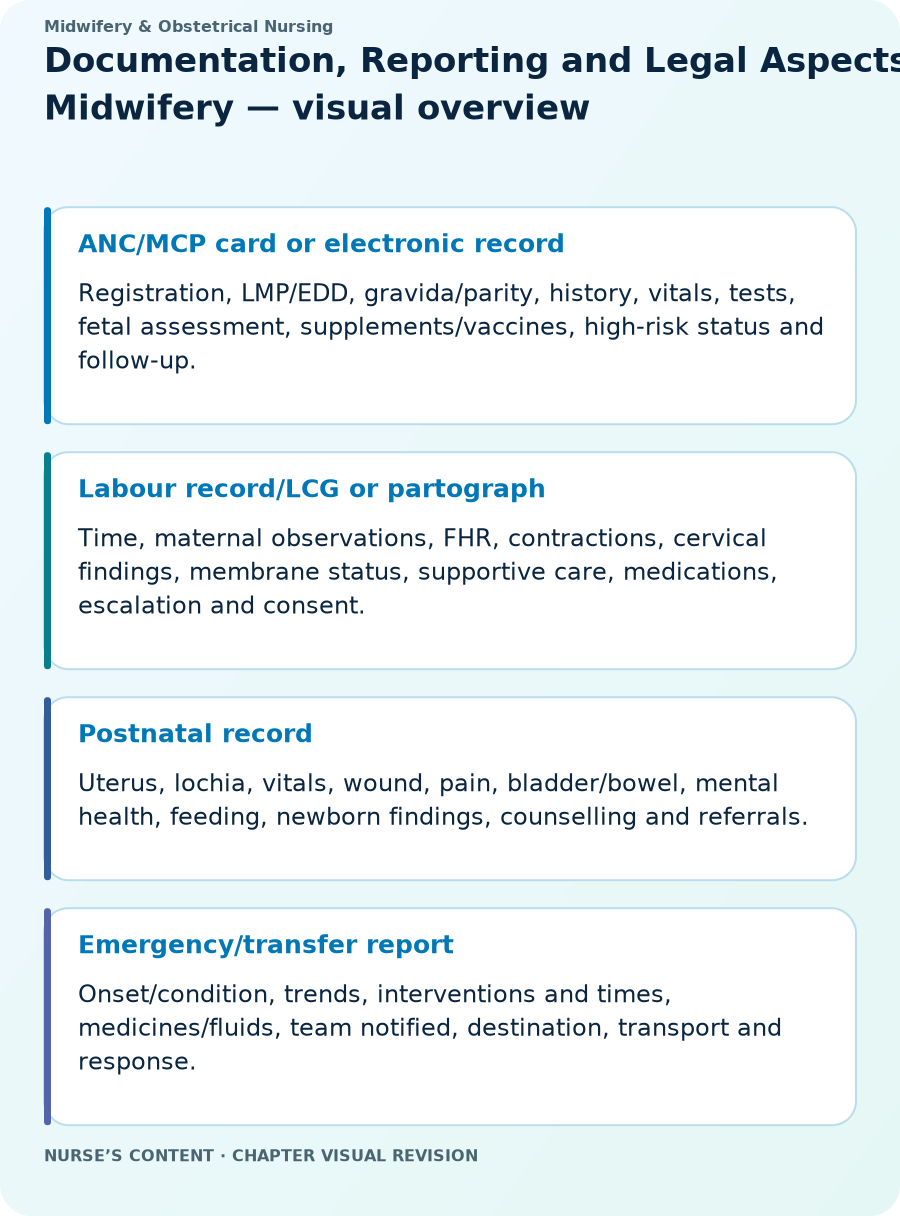
| ANC/MCP card or electronic record | Registration, LMP/EDD, gravida/parity, history, vitals, tests, fetal assessment, supplements/vaccines, high-risk status and follow-up. |
| Labour record/LCG or partograph | Time, maternal observations, FHR, contractions, cervical findings, membrane status, supportive care, medications, escalation and consent. |
| Birth and newborn record | Birth date/time, mode, attendants, maternal blood loss, placenta/perineum, newborn identifiers, sex recorded for clinical/register purpose after birth, weight, Apgar, resuscitation, prophylaxis and feeding. |
| Postnatal record | Uterus, lochia, vitals, wound, pain, bladder/bowel, mental health, feeding, newborn findings, counselling and referrals. |
| Emergency/transfer report | Onset/condition, trends, interventions and times, medicines/fluids, team notified, destination, transport and response. |
| Incident/death reporting | Objective events, immediate care, authorized reporting and review including maternal/perinatal death surveillance as required. |
2. Birth registration and legal context
Birth registration is governed in India by Registration of Births and Deaths Act and applicable rules/amendments. Health institution's designated informant/registering process reports births and deaths to civil registration authority according to timelines; commonly standard reporting within 21 days, verify local rules and duties. Clinical birth record is distinct from official civil birth certificate. For pregnancy termination use MTP Act and current rules, authorized provider and required consent/confidentiality; do not disclose prohibited information. PCPNDT law prohibits sex selection and disclosure of fetal sex for prohibited purposes; medically indicated ultrasound/diagnosis subject to requirements. Report child safeguarding or sexual offence concerns through applicable statutory/institutional pathways (including POCSO when relevant).
3. Consent, accountability and emergencies
Explain procedure, benefits, material risks, alternatives and option to refuse through responsible clinician; verify valid consent and decision-making support, document discussion/decision and emergency lawful basis if applicable. Obtain separate appropriate consent for student involvement. Preserve dignity and privacy even in emergencies, share information only as authorized. Practice within professional scope, follow authorized prescriptions, escalate deterioration and report clinical errors promptly. Keep samples, records and medico-legal evidence according to chain-of-custody policy when relevant.
4. Clinical handover and documentation example
SBAR: situation — postpartum woman with measured increasing blood loss and tachycardia; background — time/mode of birth and risk factors; assessment — current volume, vitals, uterine tone and treatment; recommendation — immediate PPH team review/transfer. Record exact time of call, advice, drugs and response. Review care and participate in improvement without fabricating records. Use current official laws/rules and facility protocols for definitive legal obligations.
5. Important Examination Questions
Long Answer Questions
- 1. Explain obstetrical records, legal responsibilities and emergency reporting.
Short Answer Questions
- 1. Describe birth registration
- 2. explain informed consent and confidentiality
- 3. state legal concerns in prenatal diagnosis.
Very Short Answer Questions (with answers)
- 1. What does SBAR stand for? — Situation, background, assessment, recommendation.
- 2. Is birth record always the civil birth certificate? — No.
6. Quick Revision
- • Timely records support safety.
- • Consent and legal obligations require verification.
- • Escalate and document emergencies accurately.
7. Conclusion
Timely records support safety. Consent and legal obligations require verification. Escalate and document emergencies accurately.
Chapter reference images