Midwifery & Obstetrical Nursing
Obstetrical Nursing Procedures and Clinical Skills
Antenatal examination, abdominal palpation, fetal heart rate assessment, vaginal examination principles, partograph recording, labour room preparation, assisting normal delivery, placental examination, newborn assessment and postnatal procedures.
Open quizzes and study tools Download PDF
CHAPTER 25 / MIDWIFERY AND OBSTETRICAL NURSING 25. Obstetrical Nursing Procedures and Clinical Skills
1. General preparation and safety
All clinical procedures require verified identity, indication, consent, explanation, equipment, hand hygiene, appropriate PPE/asepsis, privacy, trained supervision and documentation. Assess urgent symptoms before routine tasks. Use authorized checklists and ensure resuscitation/referral capacity.
2. Antenatal examination checklist
| Step | Essential observations |
|---|---|
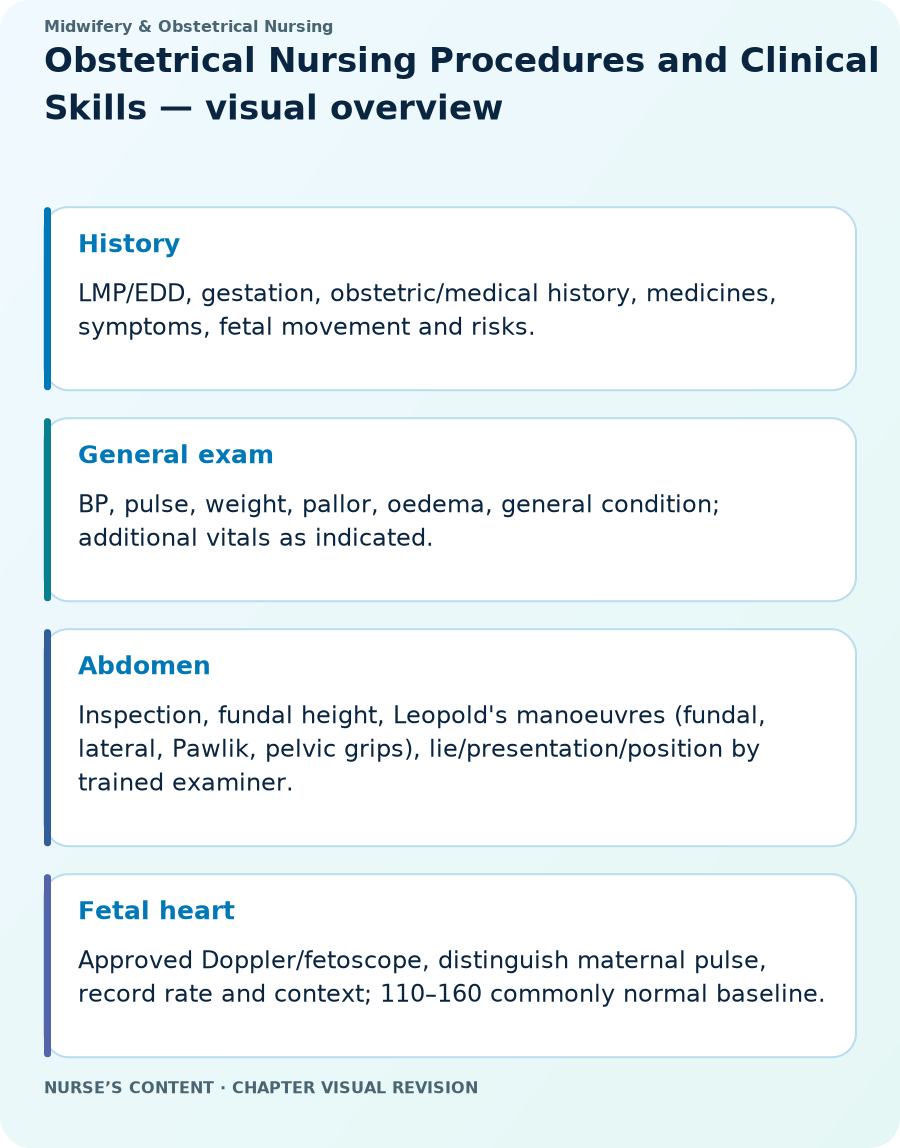
| History | LMP/EDD, gestation, obstetric/medical history, medicines, symptoms, fetal movement and risks. |
| General exam | BP, pulse, weight, pallor, oedema, general condition; additional vitals as indicated. |
| Abdomen | Inspection, fundal height, Leopold's manoeuvres (fundal, lateral, Pawlik, pelvic grips), lie/presentation/position by trained examiner. |
| Fetal heart | Approved Doppler/fetoscope, distinguish maternal pulse, record rate and context; 110–160 commonly normal baseline. |
| Investigations/plan | Review results, supplementation, immunization, risk referral, danger signs and next contact. |
3. Vaginal examination principles
Conduct only when indicated, by authorized trained provider, consent and chaperone/privacy, hand hygiene and appropriate clean/aseptic technique. Assess cervix dilatation/effacement, presenting part, position, station, membranes and findings as relevant. Minimize unnecessary examinations after rupture of membranes; contraindicated digital examination if suspected placenta previa before exclusion. Communicate findings and document examiner/time. Stop if consent withdrawn and reassess urgency/alternatives.
4. Labour room preparation and partograph
Check clean/sterile supplies, delivery tray, uterotonic and haemorrhage kit, newborn warming/resuscitation equipment, oxygen, suction and emergency referral contacts. Record fetal heart, contractions, progress, maternal vitals, drugs/fluids, urine and supportive care on approved partograph/WHO LCG. Escalate alert findings rather than acting on arbitrary cervical rate alone.
5. Birth assistance, placenta and newborn assessment
Assist skilled birth attendant with positioning, monitoring, sterile equipment, respectful support and emergency escalation. Immediate newborn dry/warm, assess breathing, resuscitate when needed, record Apgar, cord clamp timing, identification, weight and exam. Placenta and membranes examined by trained provider for completeness, cord vessels and abnormalities; observe mother for bleeding, tone and trauma. Fourth stage monitor at prescribed intervals, assess uterus, lochia, BP/pulse, bladder, perineum/wound and breastfeeding.
6. Postnatal procedures
Assist perineal/wound care, breast and attachment assessment, newborn weighing/vitals and approved prophylaxis/immunization; maintain asepsis, safe positioning and warmth. Provide counselling and document all findings/actions, outcomes and referrals. Use simulation/clinical logbooks to confirm competency; written notes are not authorization for independent performance.
7. Important Examination Questions
Long Answer Questions
- 1. Describe ANC examination with Leopold manoeuvres and partograph recording
- 2. discuss birth and newborn care checklist.
Short Answer Questions
- 1. Explain vaginal exam safety
- 2. list labour room equipment
- 3. describe placental examination.
Very Short Answer Questions (with answers)
- 1. What is station 0? — Presenting part at ischial spines.
- 2. How many normal umbilical arteries? — Two.
8. Quick Revision
- • Invasive skills need supervision.
- • Verify equipment and emergency readiness.
- • Record findings in real time.
9. Conclusion
Invasive skills need supervision. Verify equipment and emergency readiness. Record findings in real time.
Chapter reference images