Midwifery & Obstetrical Nursing
Maternal and Newborn Health Programmes in India
Maternal and child health services, RMNCH+A, Janani Suraksha Yojana (JSY), Janani Shishu Suraksha Karyakram (JSSK), Pradhan Mantri Surakshit Matritva Abhiyan (PMSMA), LaQshya and related national programmes.
Open quizzes and study tools Download PDF
CHAPTER 23 / MIDWIFERY AND OBSTETRICAL NURSING 23. Maternal and Newborn Health Programmes in India
1. Health service continuum
NHM's RMNCH+A strategy evolved into RMNCAH+N (reproductive, maternal, newborn, child, adolescent health and nutrition) continuum. Community ASHA/ANM/CHO, Ayushman Arogya Mandir/PHC, CHC/FRU, district hospital, medical college and specialist facilities link care based on acuity. Ensure timely referral, transport, blood and emergency obstetric/neonatal capability.
| Programme | Purpose and nursing relevance |
|---|---|
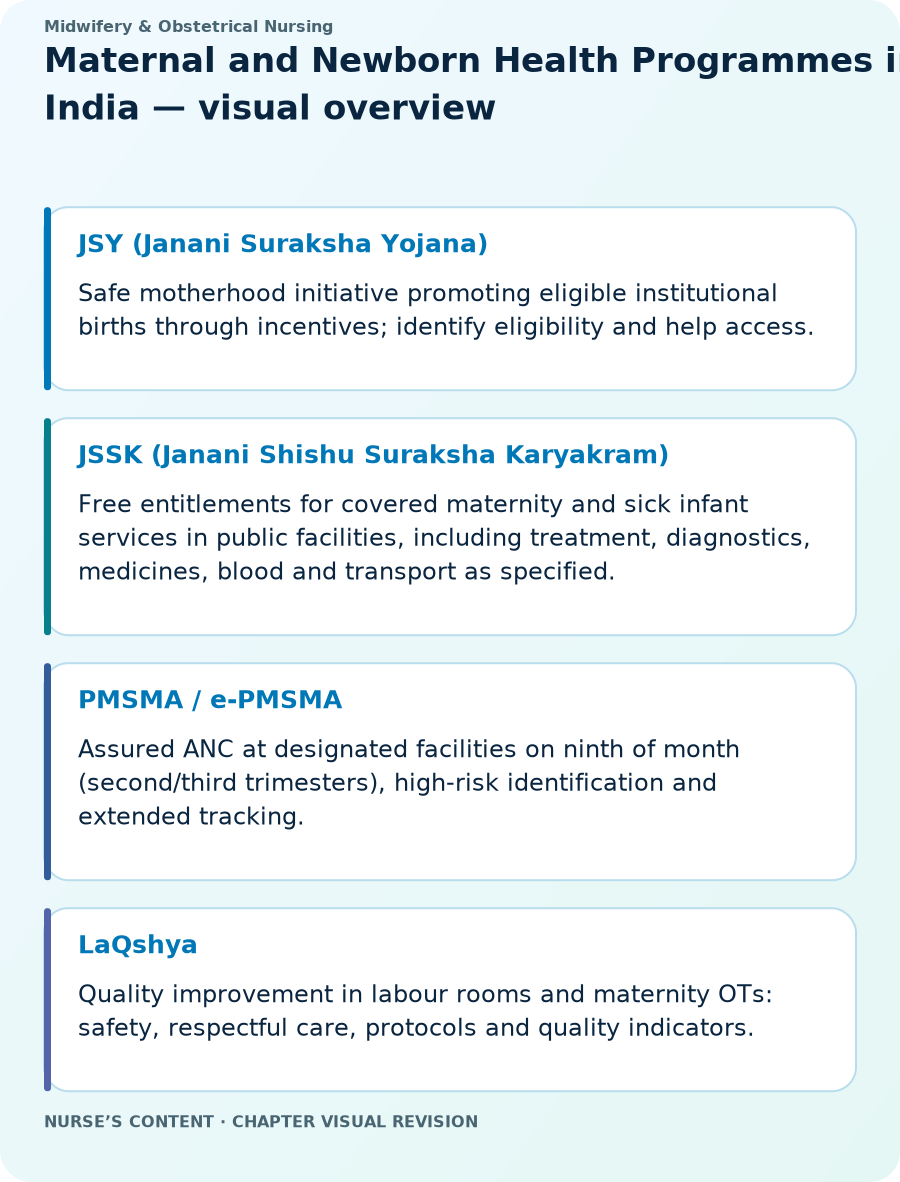
| JSY (Janani Suraksha Yojana) | Safe motherhood initiative promoting eligible institutional births through incentives; identify eligibility and help access. |
| JSSK (Janani Shishu Suraksha Karyakram) | Free entitlements for covered maternity and sick infant services in public facilities, including treatment, diagnostics, medicines, blood and transport as specified. |
| PMSMA / e-PMSMA | Assured ANC at designated facilities on ninth of month (second/third trimesters), high-risk identification and extended tracking. |
| LaQshya | Quality improvement in labour rooms and maternity OTs: safety, respectful care, protocols and quality indicators. |
| SUMAN | Assured respectful and quality maternal/newborn care, reducing preventable mortality and addressing denial of services. |
| Anemia Mukt Bharat | Anaemia prevention, testing/treatment, IFA and behaviour change for target groups. |
| FBNC / MNCU | Facility-based newborn care: NBCC, NBSU, SNCU and mother-newborn care units as appropriate. |
| SSBSK / HBNC-HBYC continuity | Current NHM community-based programme integrates home-based newborn/young-child care to age three; track at-risk newborns and referral. |
| RBSK | Child screening and early intervention for four Ds; refer identified defects, diseases, deficiencies and developmental delays. |
2. Monitoring and indicators
Maternal mortality ratio = maternal deaths per 100,000 live births in defined period; neonatal mortality rate = deaths within first 28 completed days per 1000 live births. Other indicators: early ANC, coverage of visits, institutional births, skilled attendance, IFA/Td, early breastfeeding, PNC and referral completion. Definitions and data period matter; use authorized registers and HMIS. Maternal/perinatal death surveillance and response reviews deaths to identify preventable factors and improve systems, not blame individuals.
3. Nursing responsibilities
Register pregnancy, assess risk, support ANC and entitlement information, arrange referral and transport; maintain maternal/child records and counselling. In labour use safety checklist/bundle and timely escalation. Provide postnatal/newborn assessment, home follow-up linkages, immunization and family planning. Protect dignity and confidentiality; check current state eligibility, service and reporting requirements.
4. Important Examination Questions
Long Answer Questions
- 1. Explain major maternal and newborn health programmes in India and nursing role.
Short Answer Questions
- 1. Differentiate JSY/JSSK
- 2. describe PMSMA, LaQshya and SUMAN
- 3. define MMR and NMR.
Very Short Answer Questions (with answers)
- 1. When is PMSMA normally held? — 9th of month.
- 2. MMR denominator? — 100,000 live births.
5. Quick Revision
- • Programmes connect community and facilities.
- • Entitlements vary with eligibility/rules.
- • Quality improvement and referral completion matter.
6. Conclusion
Programmes connect community and facilities. Entitlements vary with eligibility/rules. Quality improvement and referral completion matter.
Chapter reference images