Midwifery & Obstetrical Nursing
Normal Newborn Care
Immediate care at birth, neonatal assessment, Apgar scoring, thermoregulation, cord care, eye care, vitamin K administration, newborn identification, immunisation and breastfeeding support.
Open quizzes and study tools Download PDF
CHAPTER 21 / MIDWIFERY AND OBSTETRICAL NURSING 21. Normal Newborn Care
1. Essential immediate care
Prepare warm environment, resuscitation equipment and trained staff. Assess breathing/tone immediately, dry, keep warm, skin-to-skin and delayed cord clamping when appropriate; stable newborns benefit from early breastfeeding within first hour. Apnoea/gasping or HR <100 after initial steps requires timely effective ventilation per neonatal resuscitation algorithm. No routine suctioning of vigorous newborn. Record birth time and maternal/newborn identification.
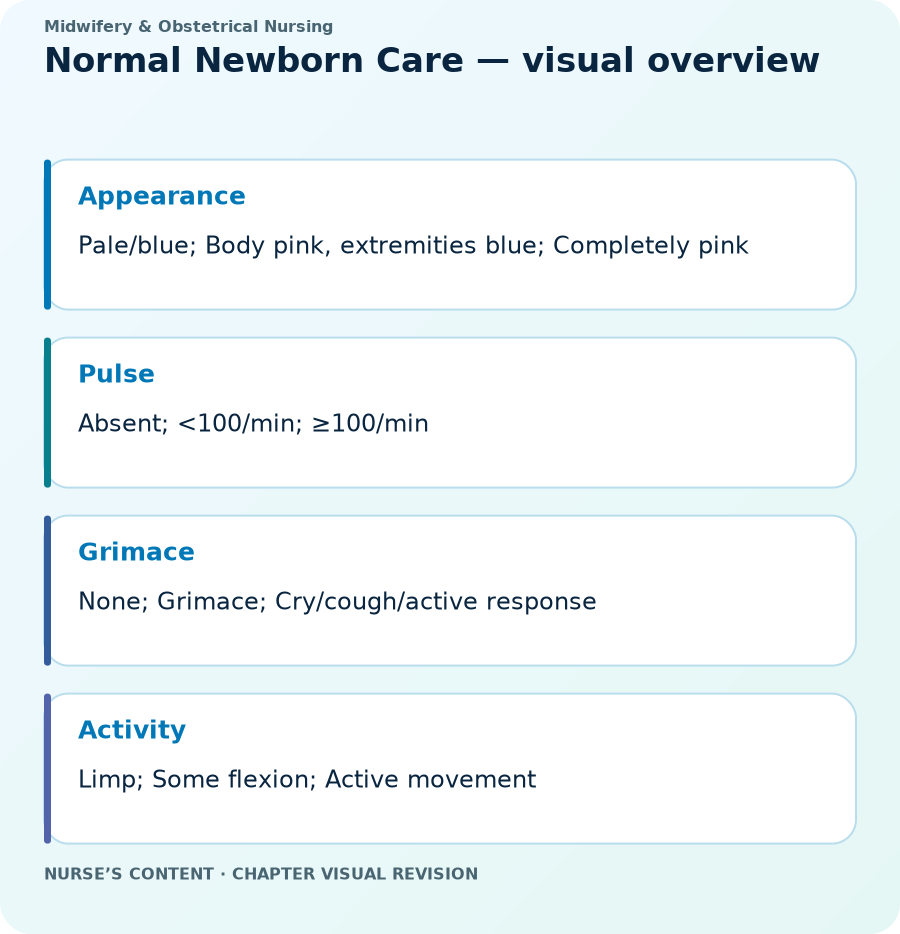
2. Apgar assessment
| Component | 0 | 1 | 2 |
|---|---|---|---|
| Appearance | Pale/blue | Body pink, extremities blue | Completely pink |
| Pulse | Absent | <100/min | ≥100/min |
| Grimace | None | Grimace | Cry/cough/active response |
| Activity | Limp | Some flexion | Active movement |
| Respiration | Absent | Slow/irregular | Good cry/breathing |
Score at 1 and 5 min; if 5-min score <7 repeat per neonatal protocol. Do not delay resuscitation until Apgar scored; score does not alone diagnose asphyxia. Colour assessment has limitations.
3. Examination and thermoregulation
Typical term newborn: gestation 37+0–41+6 weeks, RR 30–60/min, HR often 100–160/min, temperature 36.5–37.5°C in stable state. Assess head/fontanelle, eyes/red reflex by trained provider, palate, heart/pulses, lungs, abdomen, cord, genitalia/anus, skin, limbs/hips, spine, tone and reflexes (rooting, suck, Moro, grasp). Measure weight/length/head circumference and plot gestation-appropriate growth. Prevent evaporation, convection, conduction and radiation heat loss; warm linens, skin-to-skin, delayed bath (ideally ≥24 h), avoid overheating.
4. Cord, eye, vitamin K and immunisation
Keep cord clean/dry according to protocol, no unapproved application. Eye prophylaxis according to programme. Vitamin K prophylaxis prevents vitamin K deficiency bleeding; IM dose is product/weight/gestation-specific under protocol (commonly 1 mg IM for term infants). India UIP birth vaccines: BCG, OPV-0, hepatitis B birth dose within 24 hours. Verify current schedule, route/site, product, consent and records. Identify baby with matching identifiers per policy; never separate without safe handover.
5. Family education
Teach responsive feeding, thermal care, safe sleep supine on firm flat separate surface, hygiene, cord care, expected urine/stool and follow-up. Danger signs: poor feeding, breathing difficulty, apnoea, fever/hypothermia, convulsions, reduced activity, jaundice <24 h or worsening, signs of infection. Urgent evaluation, not home remedies.
6. Important Examination Questions
Long Answer Questions
- 1. Describe essential newborn care and Apgar scoring with nursing role.
Short Answer Questions
- 1. Explain thermal care
- 2. list newborn reflexes and birth immunisation
- 3. discuss vitamin K prophylaxis.
Very Short Answer Questions (with answers)
- 1. What is vitamin K used to prevent? — Vitamin K deficiency bleeding.
- 2. Maximum Apgar score? — 10.
7. Quick Revision
- • Breathing and warmth take priority.
- • Verify baby identification.
- • Educate caregivers about urgent signs.
8. Conclusion
Breathing and warmth take priority. Verify baby identification. Educate caregivers about urgent signs.
Chapter reference images