Midwifery & Obstetrical Nursing
Obstetrical Analgesia and Anaesthesia
Pain during labour, non-pharmacological pain relief, pharmacological analgesia, epidural analgesia, spinal anaesthesia, general anaesthesia and nursing responsibilities.
Open quizzes and study tools Download PDF
CHAPTER 17 / MIDWIFERY AND OBSTETRICAL NURSING 17. Obstetrical Analgesia and Anaesthesia
1. Labour pain and assessment
Pain arises from uterine contractions/cervical dilation and later stretching of pelvic floor/perineum; experience influenced by position, fear, support and prior experiences. Assess patient's report, coping, preferences, stage, maternal/fetal status and available options. Provide informed choice without coercion; support non-drug and pharmacological methods according to eligibility.
2. Non-pharmacological methods
Continuous support/birth companion, breathing/relaxation, movement and position changes, massage/counterpressure, warm water/temperature measures where safe, quiet environment and music/distraction. Explain that methods may reduce distress but response varies; avoid withholding analgesia from patients requesting it.
| Method | Use and nursing considerations |
|---|---|
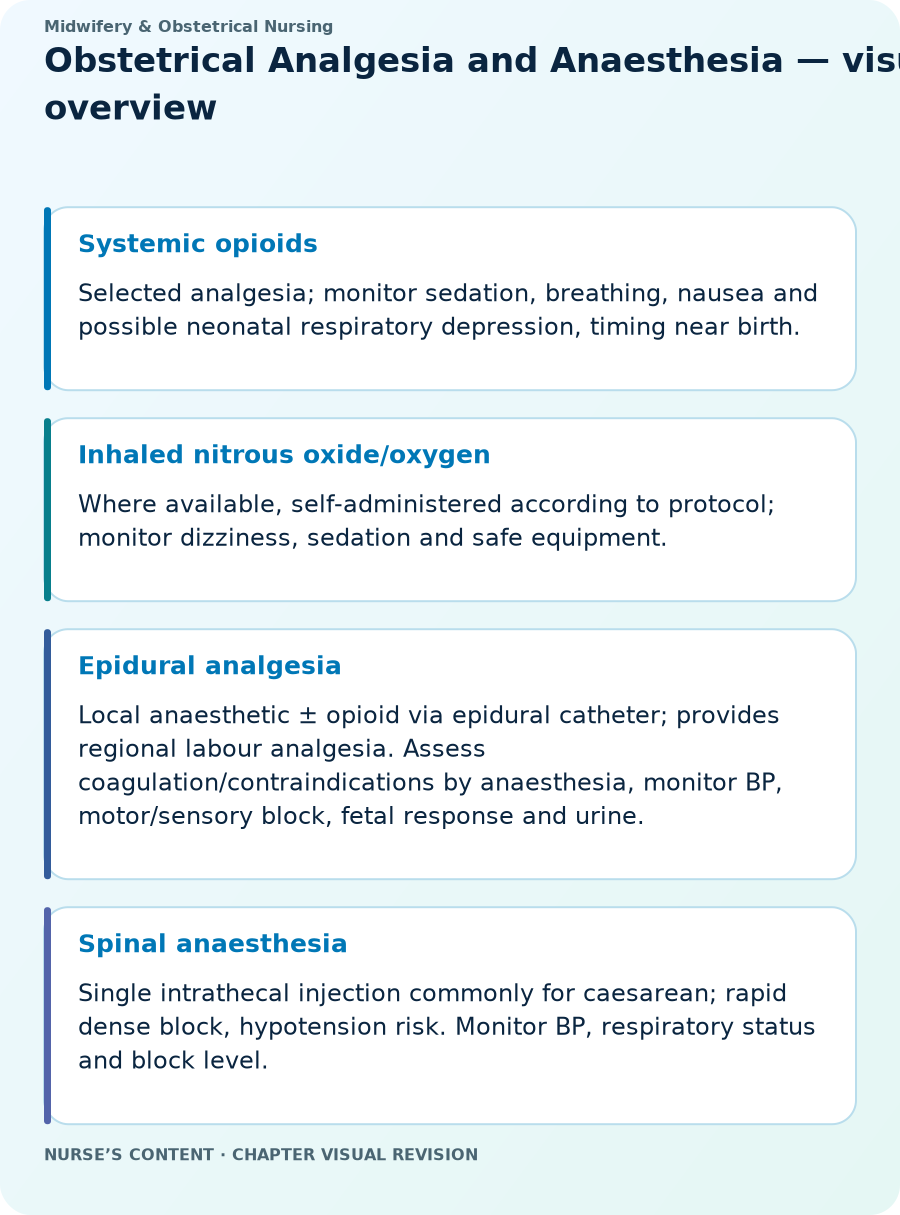
| Systemic opioids | Selected analgesia; monitor sedation, breathing, nausea and possible neonatal respiratory depression, timing near birth. |
| Inhaled nitrous oxide/oxygen | Where available, self-administered according to protocol; monitor dizziness, sedation and safe equipment. |
| Epidural analgesia | Local anaesthetic ± opioid via epidural catheter; provides regional labour analgesia. Assess coagulation/contraindications by anaesthesia, monitor BP, motor/sensory block, fetal response and urine. |
| Spinal anaesthesia | Single intrathecal injection commonly for caesarean; rapid dense block, hypotension risk. Monitor BP, respiratory status and block level. |
| Combined spinal-epidural | Combines rapid onset with catheter-based continuation when selected. |
| General anaesthesia | Unconsciousness for selected operative indications, airway/aspiration and haemodynamic risks; specialist team. |
3. Pre-, intra- and post-anaesthetic nursing responsibilities
Verify procedure, consent, allergies, medicines, fasting according to urgency and anaesthesia plan, baseline observations, vascular access and monitors. During regional block assess maternal BP and fetal status, support positioning, report hypotension, unexpected high block, dyspnoea or altered consciousness immediately. After procedure monitor airway, breathing, circulation, motor/sensory recovery, pain, nausea, bladder and bleeding; prevent falls until strength returns. Severe postural headache or neurological symptoms after neuraxial procedure needs anaesthetic review.
4. Safety and newborn considerations
Local anaesthetic systemic toxicity may cause neurological/cardiac symptoms; activate emergency response immediately, follow lipid rescue protocol by trained team. Monitor newborn if maternal opioids/general anaesthesia used. Do not prescribe or titrate anaesthetic drugs independently; support pain relief and respectful choice.
5. Important Examination Questions
Long Answer Questions
- 1. Describe obstetrical pain relief and compare epidural, spinal and general anaesthesia with nursing care.
Short Answer Questions
- 1. List non-drug methods
- 2. explain regional anaesthesia monitoring
- 3. discuss post-anaesthetic care.
Very Short Answer Questions (with answers)
- 1. Where is spinal drug delivered? — Intrathecal/subarachnoid space.
- 2. Common regional block complication requiring monitoring? — Hypotension.
6. Quick Revision
- • Respect pain-relief preferences.
- • Monitor mother and fetus during analgesia.
- • Regional recovery requires fall prevention and assessment.
7. Conclusion
Respect pain-relief preferences. Monitor mother and fetus during analgesia. Regional recovery requires fall prevention and assessment.
Chapter reference images