Midwifery & Obstetrical Nursing
Assessment and Management of First Stage of Labour
Admission assessment, maternal monitoring, fetal monitoring, cervical dilatation, uterine contractions, partograph, pain relief, supportive care and nursing responsibilities.
Open quizzes and study tools Download PDF
CHAPTER 13 / MIDWIFERY AND OBSTETRICAL NURSING 13. Assessment and Management of First Stage of Labour
1. Admission assessment
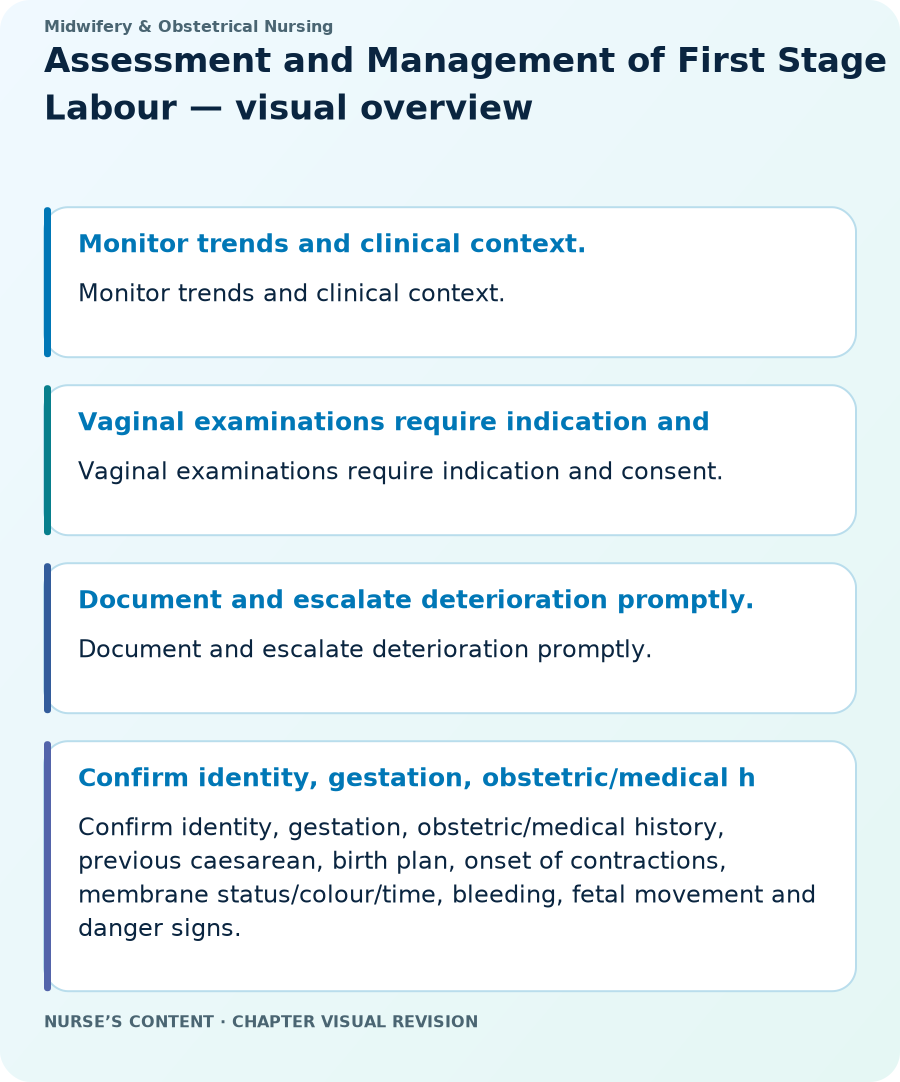
Confirm identity, gestation, obstetric/medical history, previous caesarean, birth plan, onset of contractions, membrane status/colour/time, bleeding, fetal movement and danger signs. Assess maternal pulse, BP, temperature, respirations, hydration, pain and emotional state; abdominal palpation, fetal heart and contraction pattern. Vaginal examination only when indicated, consented and safe, by trained clinician; record dilatation, effacement, presenting part, position, station and membranes. Do not perform digital exam with suspected placenta previa before exclusion.
2. Monitoring and supportive care
Track maternal vitals, intake/output, bladder, pain, contractions, cervical progress and fetal heart according to risk and protocol. Intermittent auscultation appropriate in many low-risk labours; continuous CTG for indicated risks. Record baseline fetal rate 110–160, decelerations/changes and relation to contractions; assess maternal pulse. CTG interpretation requires trained team, not a single number. Abnormal fetal findings, meconium with concerns, fever, bleeding or maternal deterioration need prompt review.
3. Partograph and WHO Labour Care Guide
Traditional partograph plots time, cervical dilatation, descent, fetal heart, liquor/moulding, contractions, maternal vitals, drugs/fluids and urine; older versions teach alert/action lines based on 1 cm/h. WHO Labour Care Guide (LCG) uses active first stage from 5 cm, individualized assessment, time thresholds prompting review, supportive care and shared decision-making; does not mandate intervention solely for slower-than-1 cm/h progress. Use approved facility chart and evaluate maternal/fetal condition, labour pattern and obstruction before intervention.
4. Nursing interventions
- • Provide privacy, companion choice where permitted, respectful explanations and consent.
- • Encourage mobility/positions, oral fluids/food when safe under care plan, bladder emptying and rest; offer non-drug or prescribed analgesia.
- • Maintain hand hygiene and aseptic procedures, minimize unnecessary vaginal exams, assess membrane leakage and infection risk.
- • Ensure emergency equipment, newborn resuscitation readiness, referral and communication; monitor prescribed oxytocin with uterine/fetal surveillance if used.
5. Evaluation and documentation
Record time of assessments, exact observations, cervical findings by examiner, interventions and response. Escalate abnormal CTG/FHR, excessive contractions, prolonged/obstructed labour concern, cord prolapse, fever, severe hypertension or haemorrhage. Update plan with woman and team.
6. Important Examination Questions
Long Answer Questions
- 1. Describe admission assessment, monitoring and nursing management in first stage
- 2. explain partograph/LCG.
Short Answer Questions
- 1. List partograph components
- 2. discuss fetal monitoring
- 3. describe supportive measures.
Very Short Answer Questions (with answers)
- 1. Which phase begins at 5 cm in WHO LCG? — Active first stage.
- 2. Is 1 cm/h a mandatory universal threshold? — No.
7. Quick Revision
- • Monitor trends and clinical context.
- • Vaginal examinations require indication and consent.
- • Document and escalate deterioration promptly.
8. Conclusion
Monitor trends and clinical context. Vaginal examinations require indication and consent. Document and escalate deterioration promptly.
Chapter reference images