Midwifery & Obstetrical Nursing
Physiology and Mechanism of Labour
Definition and stages of labour, factors affecting labour (5 Ps), signs of true and false labour, uterine contractions, fetal movements, mechanism of normal labour and cardinal movements.
Open quizzes and study tools Download PDF
CHAPTER 12 / MIDWIFERY AND OBSTETRICAL NURSING 12. Physiology and Mechanism of Labour
1. Definition and onset
Labour is the process of regular uterine contractions leading to progressive cervical effacement/dilatation and birth of fetus and placenta. Involves prostaglandins, oxytocin receptors, cervical ripening, fetal and maternal signalling; no single trigger explains all onset. Term labour occurs from 37+0 to 41+6 weeks.
| True labour | False labour/Braxton Hicks |
|---|---|
| Regular contractions typically increase in strength/frequency | Irregular contractions often do not progressively intensify |
| Progressive cervical change | No progressive cervical dilatation/effacement |
| May continue despite rest | May lessen with rest/position change |
Clinical assessment is needed; pain/intensity alone cannot confirm labour. Ruptured membranes, bleeding or reduced movements require assessment even without contractions.
2. Stages of labour
First stage: onset of labour to complete cervical dilatation (about 10 cm); latent and active phases (WHO active from 5 cm; local definitions may differ). Second: full dilatation to birth of baby. Third: birth to placental delivery. Fourth: commonly taught immediate first 1–2 hours postpartum, intensive observation of recovery/bleeding; not universally defined as formal stage. Duration varies by parity, epidural, position, fetal factors and maternal/fetal condition.
3. Factors affecting labour: 5 Ps
| Factor | Description |
|---|---|
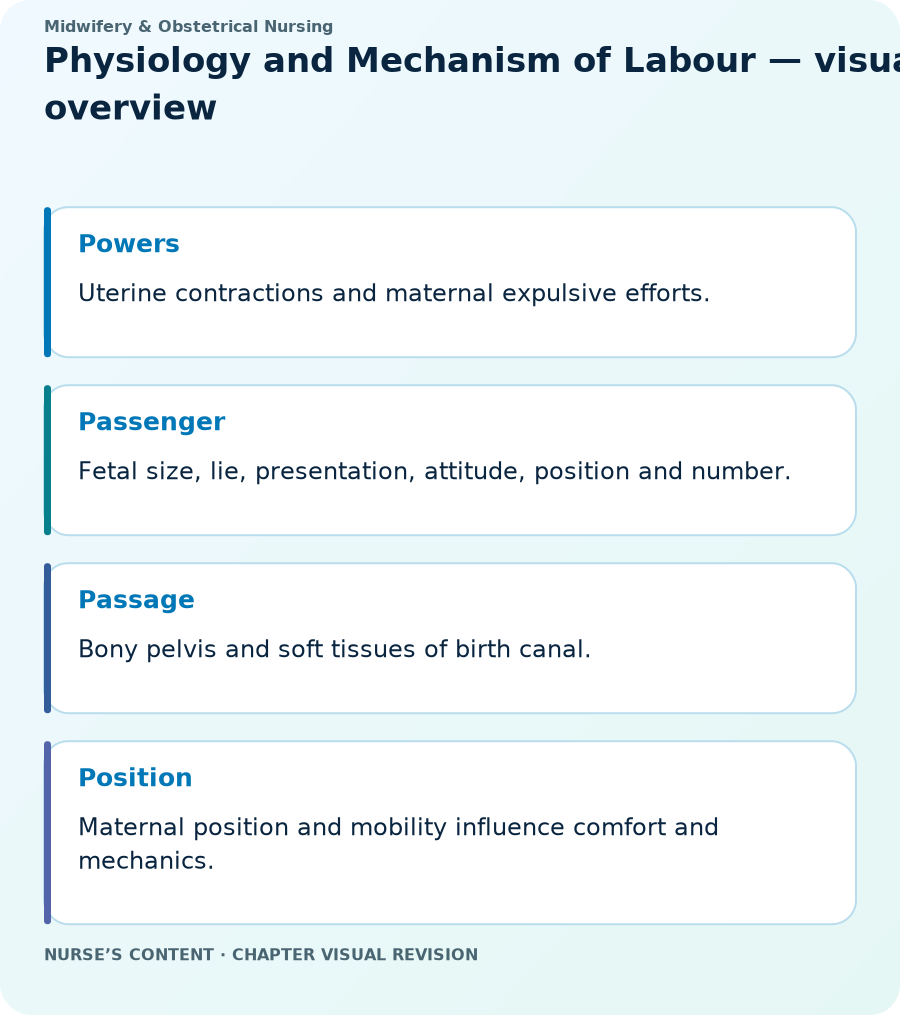
| Powers | Uterine contractions and maternal expulsive efforts. |
| Passenger | Fetal size, lie, presentation, attitude, position and number. |
| Passage | Bony pelvis and soft tissues of birth canal. |
| Position | Maternal position and mobility influence comfort and mechanics. |
| Psyche | Fear, support, coping and experience; respectful care improves experience. |
Assess contraction frequency per 10 min, duration and strength/relaxation. Fetal lie longitudinal/transverse/oblique; attitude flexion/extension; presentation cephalic/breech/shoulder; vertex denominator occiput. Station relates presenting part to ischial spines (0 station at spines). Engagement is biparietal diameter through pelvic inlet in vertex presentation.
4. Cardinal movements in vertex vaginal birth
Engagement → descent (throughout labour) → flexion → internal rotation → extension → restitution and external rotation → expulsion. Movement sequence adapts fetus to pelvic dimensions, not rigid discrete events. Moulding is overlap of fetal skull bones, caput is scalp oedema; degree and labour progress require assessment.
5. Nursing role
Observe contractions, maternal vitals, fetal heart and progress by authorized method, support hydration/nutrition and movement when safe, provide chosen pain relief and respectful communication, document findings. Identify obstruction, abnormal fetal heart, maternal fever or bleeding and escalate. Avoid arbitrary intervention solely because cervical dilation is slower than 1 cm/h when other findings reassuring.
6. Important Examination Questions
Long Answer Questions
- 1. Explain stages of labour, 5 Ps and cardinal movements of normal labour.
Short Answer Questions
- 1. Differentiate true/false labour
- 2. define station and engagement
- 3. describe uterine contractions.
Very Short Answer Questions (with answers)
- 1. Full cervical dilatation? — Approximately 10 cm.
- 2. WHO active phase begins at? — 5 cm.
7. Quick Revision
- • Labour progress is individual.
- • Descent occurs throughout labour.
- • Monitor the woman and fetus together.
8. Conclusion
Labour progress is individual. Descent occurs throughout labour. Monitor the woman and fetus together.
Chapter reference images