Midwifery & Obstetrical Nursing
Antenatal Assessment and Investigations
Maternal assessment, fundal height measurement, abdominal palpation, Leopold's manoeuvres, fetal heart rate assessment, laboratory investigations, ultrasound and high-risk screening.
Open quizzes and study tools Download PDF
CHAPTER 07 / MIDWIFERY AND OBSTETRICAL NURSING 07. Antenatal Assessment and Investigations
1. Maternal assessment
Verify identity and consent, obtain history and gestation, check BP with suitable cuff, pulse, temperature when indicated, weight/BMI context, pallor, oedema, symptoms and overall condition. Assess nutrition, anaemia, medication and mental health, previous obstetric risk. Sudden severe symptoms require assessment before routine examination.
2. Fundal height and abdominal palpation
Symphysis-fundal height measured in centimetres from upper pubic symphysis to uterine fundus with nonstretch tape and consistent technique, commonly serially after about 24 weeks, with interpretation according to growth chart and clinical context. Around 20 weeks fundus often near umbilicus; after midpregnancy cm tends to approximate weeks in singleton gestation, but obesity, multiple pregnancy, fibroids, fluid and fetal lie affect measurement. A discrepancy or poor interval growth warrants evaluation, not diagnosis by tape alone.
3. Leopold's four manoeuvres
- 1. Fundal grip: identify fetal pole in fundus (head or breech).
- 2. Lateral/umbilical grip: locate smooth fetal back and small parts to assess lie/position.
- 3. Pawlik's grip: assess presenting part above symphysis and mobility.
- 4. Pelvic grip: face mother's feet, assess descent and flexion of presenting part.
Explain procedure, empty bladder if appropriate, position comfortably with slight lateral tilt as needed and warm hands, avoid painful pressure; trained examiner confirms uncertainty with
ultrasound. Lie is relationship of fetal long axis to maternal axis; presentation is part entering pelvis; position describes presenting denominator relative to maternal pelvis; engagement means widest presenting diameter has passed inlet.
4. Fetal heart rate and movements
Use approved Doppler/fetoscope and distinguish fetal heart from maternal pulse; normal baseline commonly 110–160 bpm. Record rate, method, position and timing. Assess fetal movement pattern; reduced movements compared with baby's usual pattern warrant prompt maternity assessment, not waiting for next appointment or home Doppler reassurance.
5. Investigations
| Test | Purpose |
|---|---|
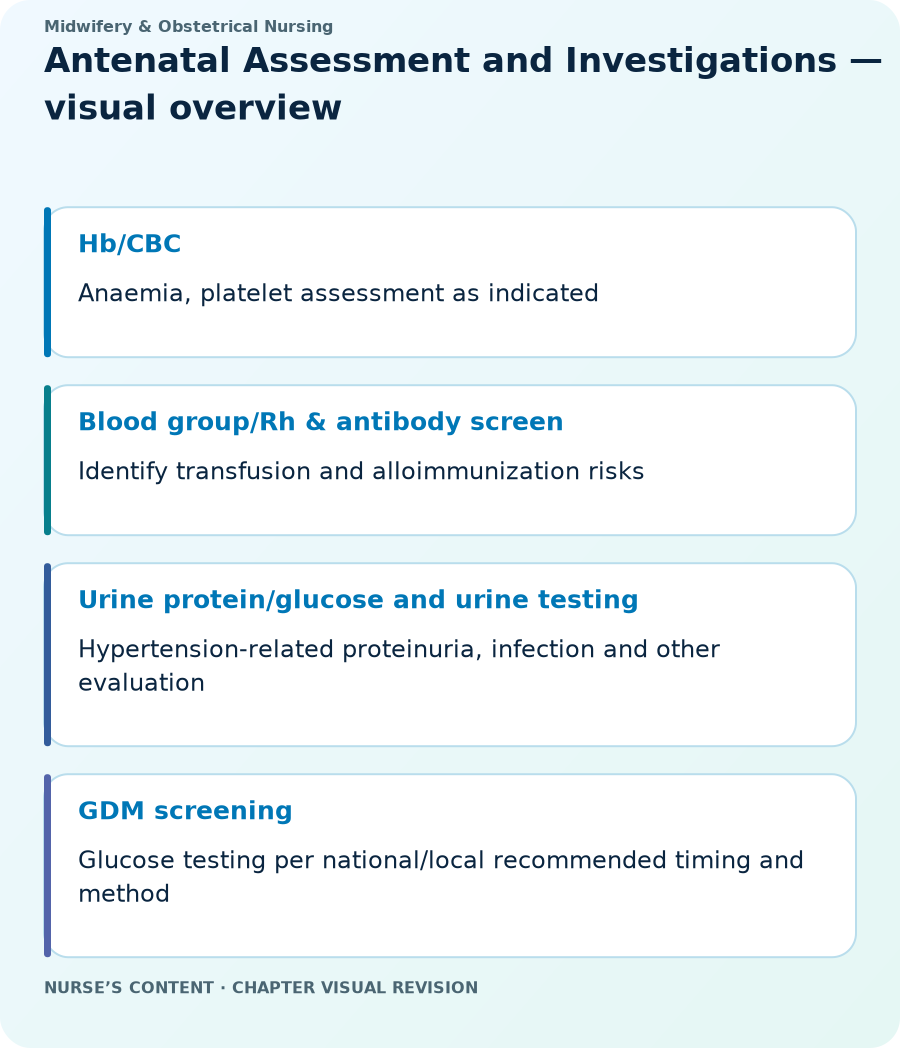
| Hb/CBC | Anaemia, platelet assessment as indicated |
| Blood group/Rh & antibody screen | Identify transfusion and alloimmunization risks |
| Urine protein/glucose and urine testing | Hypertension-related proteinuria, infection and other evaluation |
| GDM screening | Glucose testing per national/local recommended timing and method |
| HIV, syphilis, HBsAg and others | Detect infections for maternal care/transmission prevention per approved policy and consent |
| Ultrasound | Dating (early), fetal anatomy, placental location, growth and high-risk evaluation as indicated |
| Other tests | Thyroid, renal/liver, coagulation, cultures or genetic screening based on protocol/risk |
6. Nursing responsibilities
Explain purpose/limitations, obtain appropriate consent, maintain privacy, collect labelled specimens, verify results and notify abnormalities. Document growth trend, BP, fetal findings and risk category; arrange high-risk referral and ensure follow-up. Avoid unnecessary invasive exams.
7. Important Examination Questions
Long Answer Questions
- 1. Describe antenatal examination and Leopold's manoeuvres with nursing responsibilities.
Short Answer Questions
- 1. Explain fundal height
- 2. describe fetal heart assessment
- 3. list ANC investigations.
Very Short Answer Questions (with answers)
- 1. Normal fetal baseline heart rate? — 110–160/min.
- 2. What is presentation? — Fetal part entering pelvis.
8. Quick Revision
- • Use trends, not isolated fundal height.
- • Reduced fetal movements warrant assessment.
- • Verify maternal and fetal heart rates separately.
9. Conclusion
Use trends, not isolated fundal height. Reduced fetal movements warrant assessment. Verify maternal and fetal heart rates separately.
Chapter reference images